Lowry at the Tate Britain

The Pond 1950 by L.S. Lowry 1887-1976

L.S.Lowry is an English painter, born in 1887, died 1976, who devoted his life to painting the England – especially Manchester – of the industrial revolution. Most people know him for his townscapes populated by matchstick figures, almost child-like in their portrayal. The Tate exhibition, “Lowry and the Painting of Modern Life”, opens on 26 June.

As a Tate member, paying a little extra for private views, I got a preview of the exhibition today. I work quite near the Tate, so I popped down there at lunchtime today for the members’ preview. It was pretty busy, but nothing, I imagine, like the scrum that will form in the opening weeks.

It’s a wonderful show, and I urge anyone with a love of art, who can make it, to get down there.

There are all the classic Lowry paintings. The backdrop of factories spewing out smoke, the dark satanic mills, the shadowy figures, the matchstick people, heads bowed, shoulders slumped, heading to work, or away.  They feel quite familiar, although seeing so many brings out the variety.
L-S-Lowry-Returning-from-work-1929-large-1083583949

There’s joy in some – maybe a Lancashire fair, or VE day in 1945. In the happier ones especially, I see the influence of good old Pieter Bruegel the Elder, the great sixteenth century painter, whose paintings, like his sons, told the real story of ordinary people in those times, with their myriad characters, going about their lives in the foreground of the paintings.

Lowry, Fun Fair At Daisy Nook

But the overriding theme is, it’s grim up north, in the words of the KLF, dance band from the 1990s. There’s a room called Ruined Landscape, in which the paintings depict scenes of industrial devastation. Without the matchstick people. They are powerful pictures, with a strong hint of impressionism in their style. I read that Lowry was more enthusiastically exhibited in Paris than in England in his early days. I can see why.

I was really struck by a painting from 1925, called Industrial Landscape, Wigan. It’s hellish, and yet rather beautiful. There are others like it. Some less hazy, but all with the dark silhouettes of the industrial chimneys haunting – and enhancing – the devastated surroundings.

images

Sorry, v.small but the only image that wasn’t pink that I could find!

And here’s the pink one.

landscape_in_wigan_1925

The second room in the exhibition is really interesting because it juxtaposes Lowry’s paintings with those of late 19th and early 20th century artists in France and Italy who had portrayed urban scenes: Pissarro, Van Gogh, Utrillo, Valette. The latter actually painted Manchester scenes, including this one. The real version is greyer and foggier than this image.

valette

Much as I love the classics Lowrys, it was the ones I hadn’t really seen before that excited me most. Those impressionistic industrial landscapes for a start. And then the few closer up portrayals of people. Not many: people in Lowry’s paintings are usually part of the scenery, conveying a general message, not exhibiting their individuality. There are exceptions, mostly tragic. There is a very striking painting from 1919 called Pit Tragedy in which the bereaved are gathered round. The people have a ghostly feel to them, redolent of Edvard Munch.

l-s-lowry-pit-tragedy-

There are a few other works which echo the angsty Norwegian. One called A Protest March from 1959 has those elongated characters and spectral faces. Spooky, as they fan out.

Lowry rarely escapes from the Manchester and Lancashire, but when he does, it can be impressive. There are three paintings from Wales – still industrial towns, still consumed by factory smoke, but with green in the surrounding hills and fields.  Green!  Oh yes!

DACS?; (c) Ms Carol Ann Lowry/DACS; Supplied by The Public Catalogue Foundation

I only spent an hour at the exhibition. I will go back, no question. It’s a fascinating collection, which shows in equal measure despair and love for those industrial scenes. It aches with the pain of the working people of those industrial town, but, like, Bruegel before him, celebrates the simple, everyday detail of people’s lives.

This is a Bruegel, called ‘Hunters In The Snow”.

hunters

There’s distance, and intimacy in Lowry’s work. And through the tragedy of the industrial devastation, I think Lowry was expressing a love for place and people. seeking redemption in small things. The fair, the children playing in the corners. The dogs romping. The colour breaking out on VE Day. The green hills of Ebbw Vale.

Real life.

PS. Back in 1978 there was a novelty single which made No1, called “Matchstalk Men and Matchstalk Cats and Dogs” by Brian and Michael, which, as a 19 year old lover of punk and new wave, I was almost duty-bound to hate. It was celebrating Lowry, who had died in 1976. Today, there was a young man with a mic in the gallery interviewing two grey haired men in summer suits – looking rather good, it has to be said. I overheard a question which referred to the aforementioned single and the influence it had on Lowry’s popularity. (Positive).

It was them. Brian and Michael. In real life, Michael Coleman and Kevin Parrott. (Why did Kevin change his name to Brian?). There on preview day in clearly in love with the art. Credit to them…
Posted in Art, books, theatre, cinema, London | Tagged , , , , , , | 7 Comments

Sportsthoughts (78) – Lucky Lions

D23AUS_352425k

The British and Irish Lions rugby team played the first test in their three match series against Australia yesterday. In Brisbane, on a pitch that looked like it had taken in a fair bit of rain in recent times. This was important at the end of the game…

The Lions concept – England, Ireland, Scotland and Wales coming together with a common objective – is a great one. Shame we can’t do it more in other walks of life. The team is cobbled together, without too much practice, but the quality of the players ensures that they always give their opponents a good game. Every four years they assemble to tour either Australia, New Zealand or South Africa. They are visited in rotation and 2013 was the turn of Australia.

images

The selection process is always a bit controversial. Do you have a good spread of players from all countries or go for whoever you think is best even if that means one country dominates? Generally it tends to be a compromise, although you have to err towards the latter. But there was a bit of a sour taste this time (for us English), because head coach, New Zealander Warren Gatland went heavily for Welsh players and minimised the England contribution. His day job is head coach of Wales. And yes, they did win the Six Nations, but not as brilliantly as the selection suggested. The Welsh bias meant that Chris Robshaw, England captain, man of the match in two Six Nations games, heroic against New Zealand in the Autumn, wasn’t selected.  OK, I write as a Quins fan, but I thought that was an insult to Robbo. And is Danny Care a lesser scrum half than Conor Murray of Ireland?. Ireland, who came fifth in the Six Nations? Mike Brown a worse bet as full back/wing than the Scots, Maitland and Hogg?

So it took me a bit of time to start caring about this Lions tour, but as it progressed, as the big day neared, it was hard to resist. You forget those club and country rivalries and focus on the Lions.

And this morning, ready for the 11 am kick off, British time, I dug out my retro Lions shirt and headed to the pub to meet my friend Jon and his daughter Connie to watch the game.

And what a game it was! The Lions sneaked a win, 23-21. It was an exhilarating, messy game. Very open, both sides unable to exert control. Both maybe a bit rusty at this highest level, the Lions because they only come together once every four years, the Aussies because they hadn’t played a test since December.

The Lions, as expected, were stronger at the set pieces, the scrum and line out (until near the end of the game), but Australia are so brilliant in open play and, against the run of early play, scored a superb opportunist try, after their scrum half Will Genia jinked through a dozy Lions defence and set Aussie debutant Israel Folau free. Folau is a phenomenon – he has played rugby league, Aussie rules football and now rugby union, at the highest level.

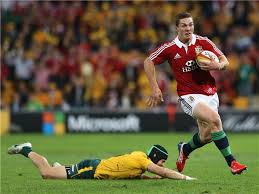
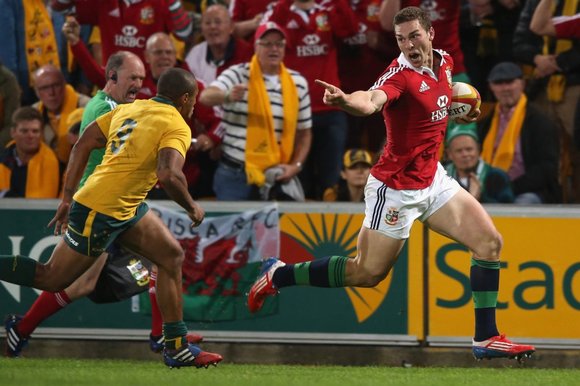
But the Lions have their own phenomenon, winger George North of Wales (though English born). Massive and fast. He fielded a high kick from the Aussies deep in his own half, assessed the options and motored. Through a couple of Aussie midfield tackles, then a jink passed the full back, Berrick Barnes and then a disdainful salute to Genia (see top photo) as he raced over the try line. A sixty yard solo effort. Amazing!

images

Suddenly, every time he got the ball, anticipation rose. Great when you have a player like that. Manu Tuilagi is similar for England, and might yet be for the Lions, if he recovers from his shoulder injury. North did go over for another try, but it was disallowed – rightly – after the TV replays showed that his elbow went out of play just before he touched it down. Small margins…

images

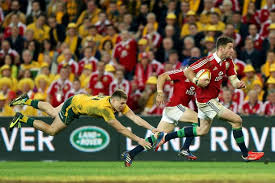
There were two more tries in the game, both also brilliant individual efforts. Folau got another for Australia; Alex Cuthbert, the other Lions wing, did his bit too. All four tries in the game were spectacular. Indicative of the quality of the players, or was there also an element of not-quite-organised defences? Both, I’d say, but all to the good for entertainment value.

images

Australia were very unlucky with injuries. Three of their backs had to go off with head/neck injuries after collisions, sometimes with their own colleagues. Leali’ifano (after a minute), Barnes and the replacement for Leali’ifano, McCabe. And near the end, Ashley-Cooper, who had been playing for a while with a dislocated shoulder. But they coped and remained a huge threat. And towards the end of the game, something odd happened. The Lions brought on replacements for all their front row players, Adam Jones, Tom Youngs and Alex Corbisiero. All had played very well, but it’s normal to bring on fresh legs in this area and the replacements, Vunipola, Hibbard and Cole, are all great players. We expected the Lions to ratchet up the pressure. Instead, the Aussies slowly started to dominate the forward battle, including the scrums. This was a potential game-loser for the Lions, because they were giving away penalties, with a ref who had already been hard on them at the breakdown.

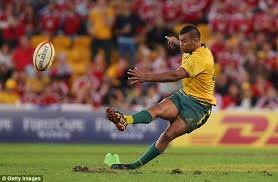
This was when the key difference between the two teams came into play. The Lions had Leigh Halfpenny, who converted all but one of his six kicks. The Aussies had James O’Connor and later Kurtley Beale, who missed five between them. Beale was particularly unfortunate because he missed two penalties in the last few minutes, either of which would have won Australia the game. The last was actually the final act of the game. It was from quite a long way out, but fairly straight. He’d scored one from further when he first came on.

Ahhh, it looked like the Lions were going to lose with the last kick of the game…

But no, Beale slipped on the cut-up pitch and completely miscued. A horrible end for him, just back in the Australian squad after drink and other problems. Hope it doesn’t send him back to rehab. It’s only a game, but then, it’s a massive game, and shreds the nerves.

images

How to take kicks…

images

How not to, in last seconds of game!

Phew! The Lions did it. It wasn’t daylight robbery – the game overall was pretty evenly matched. There were four brilliant tries. But if the Aussies had taken a normal percentage of their kicks they would have won. They will be gutted.

Second test next Saturday. I can see the Lions winning again it because they will have learned a lot about themselves today, and will correct some of the weaker areas. They could also have people like Tuilagi and Irish wing, Tommy Bowe, back from injury. You could say the same about the Aussies in terms of getting their act together, but how many of their players who went off injured will be ready to return?

And will they recover from that kicking nightmare?

Fingers crossed… NO!

(Photos from Google Images)

Posted in Sportsthoughts | Tagged , , , , , , , , | 2 Comments

The night Bruce played “Darkness on the Edge of Town”.

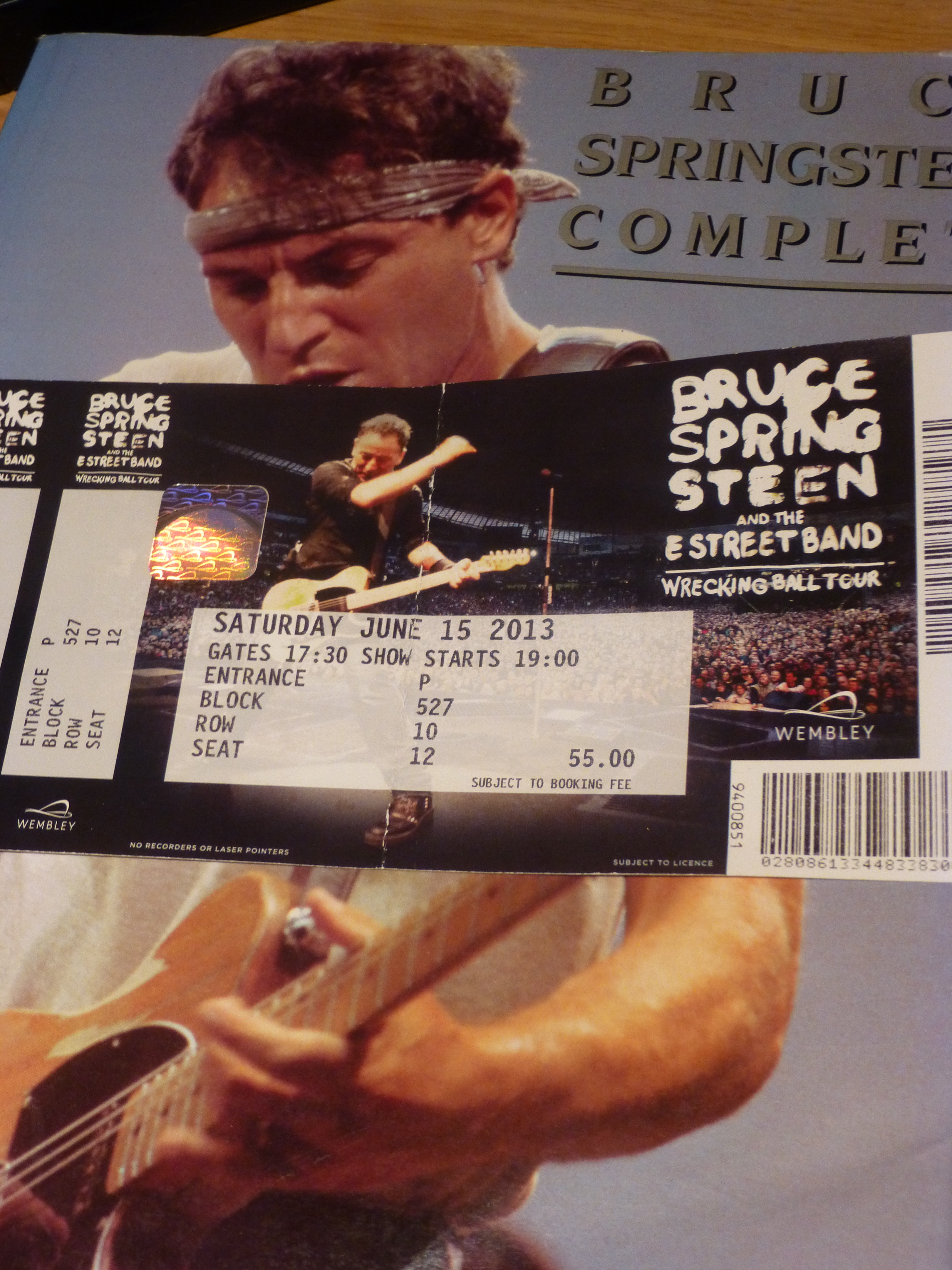
P1020190

Bruce Springsteen and the E Street band played Wembley Stadium on 15 June 2013. I was fortunate enough to be there. Fortunate because it turned out to be the best concert I have ever witnessed.

In being so it takes over from Bruce at Wembley Arena in 1981, which has always been the concert I have held up as the benchmark.

The reason why the concert I saw last night trumped 1981 was because Bruce and the band did something completely unexpected. They played the whole of “Darkness On The Edge Of Town” in sequence, in the middle of the set. The whole of the greatest album of all time, its only rival, “Born To Run”.

I couldn’t believe it. A great concert already, and then Bruce said, almost casually, we are going to play “Darkness On The Edge Of Town” from start to finish.

The greatest album of all time. In its entirety.

Moments before, I’d asked my friend Dave how he was enjoying it. He turned to me and said, great, but he hasn’t played anything from “Darkness”. As if in response…

I couldn’t believe it. But it was actually happening. For me it was it was the best possible moment in rock’n’roll history. My rock’n’roll history.

Badlands – Adam Raised A Cain – Something In The Night –  Candy’s Room – Racing In The Street – The Promised Land – Factory – Streets Of Fire – Prove It All Night – Darkness On The Edge Of Town.

DownloadedFile

I sang, I cried – “Racing In The Streets” was impossible not to blub to – I punched the air, and so did most people around me. Not all though –  with some of the less well-known tracks, I think the people who had discovered Bruce later than ’78, maybe with “Born In The USA” in 1984, were a bit lost. Or not interested.  I just couldn’t believe anyone could go out to buy a beer during “Racing In The Street”. Or “Something In The Night”, as the tension in that song mounted, ready to explode. But you know, some did.

But I, like so many  people around me – including a bunch of Swedes, good people, just in front – was in total celebration mode. Have I ever sung so much at a concert? I don’t think so. Like those dogs on main street…

The best ever. Really.

What about before and after?

The concert started  with ‘Land Of Hope And Dreams”, one of the new anthems, from “Wrecking Ball. This train… Then “Jackson Cage” from “The River”, and ‘Radio Nowhere” a great rocker from “Magic”. After “Save My Love” (which I didn’t really know) we launched into “Rosalita”. One of the great, sprawling Bruce songs, from his early days, “The Wild, The Innocent And The E Street Shuffle. Usually encore material; here song five.

I was thinking, most of these songs would be encores for anyone else. Such a rich source of material. So many anthems.

There was something happening…

We went through great versions of ‘This Hard Land”, “Lost In The Flood” (from the first album, “Greetings from Asbury Park, NJ’), “Wrecking Ball” and “Death To My Hometown’ from the latest album and then the celebration of “Hungry Heart” from ‘The River”, with crowd singing most of the lyrics.

It was going so well and then it got exponentially better.

The whole of “Darkness On The Edge Of Town”.

There aren’t many moments like this. When some of the greatest music of all time, that means more to you than anything else, is played right there, right now, by the band and the man. In sequence, so that everything about the album makes sense. All your memories distilled. It was a dream come true. I mean, really, did I ever expect Bruce to play my favourite album of all time, from start to finish? “Badlands” maybe, perhaps “The Promised Land”. Maybe even “Racing In The Streets” if we were really lucky. But all ten songs? All in one go?

Unbelievable….

And then there was more. Though how do you follow the whole of “Darkness On The Edge Of Town”?

Well, Bruce started with a rousing version of “Shackled and Drawn” from the new album. It made its raucous mark. Not intimidated by what went before. “Waiting On A Sunny Day” was completely joyous, with a lovely intervention by one of Bruce’s children at the end. “Born To Run” was just “Born To Run” and “Dancing In The Dark”  was predictably wonderful, with Bruce, as ever, dancing with some women from the audience. A massive celebration.

With “Tenth Avenue Freeze Out” in the encore, we had a heartfelt tribute to sadly departed members of the band, Danny Federici and the Big Man, Clarence Clemons, the king of the saxophone. Clarence has been replaced by his nephew, Jake, a huge ask. The boy has answered the call brilliantly. The new Big Man.

And then, the finale: “Twist and Shout”, recalling the notorious power cut when he played it with Paul McCartney at Hyde Park last year. Good time rock’n’roll. Bruce celebrating his roots, as always.

The end, we thought, and then, maybe not.

Bruce returned, alone, with his acoustic guitar. ‘Thunder Road”. Yes, ‘Thunder Road”. As if playing the whole of “Darkness On THe Edge Of Town” wasn’t enough, he then went and played ‘Thunder Road”, maybe his greatest ever song, to finish. Just him and his guitar and a 70,000 voice choir.

The screen door slams, Mary’s dress waves…

In 1981, Bruce sang an encore of Elvis Presley’s ‘”I Can’t Help Falling In Love With You”, with a voice so hoarse that it sounded like the most heartfelt song ever sung. When he sang “Thunder Road”, solo, tonight, it came close to that moment.

So, 15 June, 2013. Wembley Stadium. Bruce Springsteen and the E Street Band.

The best concert ever.

DownloadedFile

Posted in Music - concerts, lists, reflections | Tagged , , , | 13 Comments

Have You Heard? – (39) “Settle” by Disclosure

DownloadedFile

Now this is an unusual “Have You Heard?”, because the answer, at least if you are British and reasonably young, will be YES. Because it’s new and high in the charts.

So, it’s an album by a couple of young lads, Guy and Howard Lawrence, from Surrey, with a whole load of guest singers, who know their House Music from the eighties onwards and turn it into a modern dance classic.

The sounds of the suburbs… where all the best dance music comes from?

DownloadedFile

Having always loved House, as well as all electronic dance music, notwithstanding the fact that I hardly ever went to clubs, “Settle” really hits the buttons for me. I first read about it in Alex Petridis’s review in the Guardian. He made it sound VERY interesting.  Then I saw them on Jules Holland. Brilliant. Bought on iTunes. Loved. It’s four-to-the-floor, with every beat and blurp and loop you ever wanted. It references other dance sounds like dub step. It’s today’s dance music, today.

Well, not that I’d really know at my age. But I’d be amazed if it wasn’t.

Just buy this album. Best of the year!

Posted in Music - Have You Heard? | Tagged , , , , | 4 Comments

Have You Heard? – (38) “I Never Wanted” by Idlewild

I’m writing a chapter in my musical journey at the moment that starts with the mighty R.E.M. and then tracks through some bands that shared a similar sound and ethos. It splits into two paths: one, the more melodic, minor key side of the music; the other the harder-core sound that links to the likes of the Pixies, Nirvana, Pearl Jam and others.

Anyway, still on the melodic side, I finished a piece on Teenage Fanclub today and turned briefly to another Scottish band, who made some great pop/rock sounds in the early 2000s: Idlewild. Led by guitarist Roddy Woomble (not to be confused with the Wombles* ) Idlewild made music that had a cinematic quality at times and combined the sounds of R.E.M. with The Smiths and even a bit of U2 and Echo and the Bunnymen (in their more pompous moments). And they had a bit of what I like to call celtic soul.

Their best album was “The Remote Part” which came out in 2002.

DownloadedFile

The hits from the album were “You held The World In Your Arms” and “American English”. Both very fine songs, but my favourite was a track called “I Never Wanted”. The early part was very Smiths, but as the song  built through the bridge and into the chorus, there was a guitar which chimed like U2’s Edge’s and then just began to sing. To soar. It’s that guitar sound which makes the song so special for me. It’s one of those tunes that just seems to reach for the sky, that expresses a feeling that is hard to put into words. Truly uplifting.

All you can do is reach for that air guitar!

* The Wombles were a bunch of furry animals in a kids’ BBC TV series from the seventies, who lived in Wimbledon Common and unbelievably had a number of pop hits, including the classic “Remember You’re A Womble”. This has nothing to do with Idlewild!

Posted in Music - Have You Heard? | Tagged , , , , | 4 Comments

Charles Dickens – an amazing life

I’ve just finished a superb biography of the 19th century British novelist, Charles Dickens, by Claire Tomalin. “Charles Dickens. A Life”.

 images

It came out in 2011 and I got it for Christmas that year, but have only just got around to reading it. This is typical: I have a stack of books to read then often go out and buy something else on a whim. But I get there in the end!

It’s a beautifully written book, full of fascinating detail about every aspect of Dickens’ life: his childhood, his family, his friends, his works, his myriad activities, his homes, his travels, his faults as well as his strengths. By the end you feel you really know Dickens, the human being. And when he dies, you feel grief. There I was, again, on the Piccadilly Line, choking as I read about he collapsed in his home in Gad’s Hill, near Rochester. The final blow.

Or, according to his long standing companion, Georgina Hogarth, that’s how it ended. There’s an alternative theory – because there are always alternative theories – that he died when with his mistress Nelly Ternan, and was brought to Gad’s Hill, to avoid exposing that affair, which dominated the later part of his life. The simple explanation seems the more likely, but who knows.

The abiding theme of the book, for me,  is Dickens’ extraordinary energy. Driven no doubt, by a very difficult childhood, with unreliable parents, lack of money, only intermittent schooling and humiliating work in a blacking factory down by the Thames. But what energy! What variety of activities. The novels, mostly written to be published in installments in magazines, so subject to relentless deadlines. Editorships of various periodicals, writing and performing in any number of plays, endless dinners and events, sponsorship of homes for young women who had fallen into prostitution,  reading tours later in life, looking after all sorts of people and families who had fallen on hard times, and then his own family…

Ah, his own family. Viewed from our modern perspective, Dickens doesn’t come out too well. He married Catherine Hogarth in 1836, aged 24. According to Claire Tomalin, they were never that well suited, though he appeared affectionate towards her in his numerous letters. She bore him ten children, one of whom, Dora, died early. She had a pretty hard life, judging by Tomalin’s biography. Many of her pregnancies were difficult, but they kept on coming. Dickens didn’t seem that affectionate towards his children.  On the whole they were a bit of a nuisance for him. As was Catherine. He seemed to have been far happier in the company of his men friends, with John Forster to the fore. I’m no expert, but there must be some studies around which suggest that Dickens preferred men to women. At the very least, he could express himself better to men. And he did so very floridly at times. Some of the letters to Forster can only be viewed as love letters, really.

In many ways he seemed closer, too, to Catherine’s sister, Georgina, who lived with them and played a big part in looking after the children. And just being a companion to Charles. According to the book, a platonic relationship, but a very deep and long-lasting one.

And when Dickens finally made the break with Catherine, he treated her abominably. In public, in his writings, as well as in private. She had no way of responding. Not good.

The separation, though it may have been a long time in the making,  was sparked by his infatuation with the 18 year old Ellen – Nelly – Ternan. In his mid-forties. She was one of three daughters of the actress Frances Ternan.  Dickens encountered them as part of his occasional forays onto the stage, initially when acting, in Manchester, in a play called the “Frozen Deep”, written by Wilkie Collins. Shortly after, he travelled to Doncaster, to spend time with the Ternan family, as they fulfilled an acting engagement. Nelly was on his radar.

According to Tomalin, the relationship with Nelly wasn’t immediately consummated, but eventually it became a central part of his life, and remained so until the end of his life. It was a hidden relationship, only a few special friends being in the know. It would have been unacceptable in Victorian times for such a relationship to be in the open.

It makes you wonder what it would be like now, in this day and age. I think in the sixties and seventies, and probably eighties, it would have been news, but no-one would have been that bothered. But now  – probably media hysteria. Quite likely career-destroying.

It’s as if we are back in the Victorian age in terms of how we judge these things publicly, but with far more knowledge of what everyone is doing. There is no way that Dickens could have hidden a relationship with Nelly in 2013. It would all be on Facebook and Twitter and Instagram.

So how do we judge someone like Charles Dickens in 2013? A brilliant man, fantastic writer, bringing London to life, all life to life. A great liver of life. A wonderful philanthropist, a man committed to improving the lives of the needy and exploited in London and elsewhere. But deeply flawed in his family life, and quite vicious with those family members he fell out with. And obsessed with a young woman almost thirty years younger than him.

I’m not judging. He was just another complex human being. Like all the other complex human beings. Like all of us.

Unlike most, though, he had an amazing talent. He brought humanity to life in the words of his extraordinary novels. So many characters that are now part of our folklore: Oliver, the artful dodger, Scrooge, Gradgrind, David Copperfield.

And in his later years,when he started his readings of his novels, adapted for the stage, he was filling halls, creating hysteria. The first rock’n’roll star?

When I finished reading the book there was only one thing I could do next: read some Dickens. I went down to Belgravia Books in Ebury Street, not far from work, Friday lunch time, and pored over the classics section.  I settled for “Bleak House”. Which I haven’t read before. A thousand pages! Page one is brilliant about the London fog.  Here’s hoping it stays that way. A long haul.

I know it will engross. It’s Dickens after all…

Posted in Art, books, theatre, cinema | Tagged , , , , , , | 6 Comments

Sportsthoughts (77) – Fussball ist der Gewinner

DownloadedFile

Last Saturday Wembley Stadium played host to the Champions League Final, Bayern Munich vs Borussia Dortmund. The first ever all-German clash. It was a great game, unlike most finals, which are crabby and cautious. Both teams went for it. Dortmund on top for the first twenty five minutes, but then Bayern asserting their favouritism, and eventually coming out 2-1 winners.

It was the best of German football. Right now they seem to be able to combine the possession football of the Spanish greats – Barcelona to the fore – with the directness of English football at its best. No sides break out from defence faster than the Germans, as England were reminded at the 2010 World Cup in South Africa, when the Germans trounced us 4-1.

Dortmund tore into Bayern at the beginning, but Bayern’s brilliant goalkeeper, Manuel Neuer, kept them at bay. And then eventually, Bayern started to find those gaps, those opportunities. At the centre of their success were their two narky wide men. The Dutchman Arjen Robben and the Frenchman, Franck Ribery. Neither ever stop moaning, flailing their limbs, generally looking like they are having a terrible time. But they are lethal players, always probing the opposition defences, and eventually finding their way through. They were instrumental in Bayern’s victory. Their first goal was the result of a clever pass from Ribery to Robben, who cut along the left by-line (not his normal space) and put the ball across to central striker, Mandzukic, who popped the ball into an empty net. Dortmund equalised, with a penalty, when the poetically named Brazilian defender for Bayern, Dante, stuck his boot into the chest of Dortmund’s striker, Robert Lewandowski. He had been yellowed already, so this should have been a sending off, but he got away with it.

It looked like the game was heading for extra time. We would have welcomed that. It was an excellent match: more would have been good. Even penalties. Intriguing. Germany vs Germany. It could have gone on forever.

But it was not to be. On 88 minutes, the ball came to Ribery, closely marked. He managed a half-right back heel which spun to Robben. Robben took it on, evaded a Dortmund tackle, and slipped the ball past the goalkeeper. 2-1!

images

It stayed that way, and Bayern, twice Final losers in the last three years, had won the game.

DownloadedFile

Deserved, but only just. This was a battle of two great teams, playing football the right way.

For Dortmund Marco Reus was eye catching. Playing off the main striker, Lewandowski, the European sensation, after his four goals against Real Madrid in the semi. Reus was everywhere, a constant threat. And the English commentators seemed to have changed their pronunciation of his name. It had been “Rey-us”. Now it seemed to be “Royce”. I think the former sounds better.

Reus did the job that Thomas Muller does for Bayern. In a less extravagant way. Sometimes you hardly notice him. Then he just pops up and scores the crucial goal. He glides through the space that no-one can control. The Guardian journalist, Barney Ronay, wrote a great article about Muller recently, in which he said the Germans had conjured one of those great compound nouns for him. Der Raumdeuter. The space-investigator. I love that!

images

Actually, in the final, Muller seemed to be forced out to the right wing a lot, although he almost snuck in for a goal, prevented only by a magnificent goal line clearance by Subotic for Dortmund. Had he scored it would have been the ultimate bit of raumdeutering.

Reminds me of Martin Peters, West Ham midfielder, scorer of one of England’s four goals to beat West Germany in the 1966 World Cup Final. Always ghosting in, ten years ahead of his time, according to the England manager, Alf Ramsey.

So now we love Germany. Superb, exciting football. A proper coaching system for the youngsters. Clubs 51% owned by the supporters. Cheap tickets, massive crowds. Football for the people.

Oh for some of that in the Premier League…

It’s assumed now that it’s time for a German ascendancy in the Champions League. Especially after the way that Bayern took Barcelona apart in the semi final. 7-0 over two legs. But is it? Dortmund are already being pulled apart. Bayern have bought their best player, Mario Gotze. He didn’t play in the final. An injury. Convenient. And they are expected to get Lewandowski as well. They’ll be some team – and they have Pep Guardiola, ex-Barcelona, joining them as manager. It seems too good to be true.

Money talks at the elite level. Bayern will stay strong. Dortmund will weaken. Barcelona will regroup – they have already bought Brazilian superstar Neymar. Madrid are after Bale and Suarez, maybe the two best players in the English Premier League. In England, Chelsea and Man City will probably buy big this close season, and probably Man Utd too. Even Arsenal! We could easily be back to Spanish or English dominance next season.

But it was good to see the Germans do it this season. They play football, and run football, the right way.

On a personal note, I’m reminded of an experience I had in 1997, when we went for a holiday at a sports camp in Lanzarote. It was a lot of fun. One day I went along to a football session. Most of the people on my side were German. I assumed my normal position at right back. Early in the game I got the ball and launched it up the wing, into the channel. No-one went for it. I got some odd stares. The game continued. It was all short passing triangles. My English long ball style just didn’t compute. I adapted and enjoyed the game. And learned a lesson.

It showed that even at our lowly level, the culture of the game was so different in our two countries. And it showed why, at the top level, when English teams lose possession so easily by trying the big passes all the time, they struggle to dominate.

Pass to someone on your own team. It must be the Mantra!

DownloadedFile


Photos all from Google Images.

Love that last one, which was in the Guardian last Saturday. Our British obsession with Germans and beach towels…

Posted in Sportsthoughts | Tagged , , , , , , , , , , , | 6 Comments

Rediscovering music with iPod shuffle

At work today I had to focus on finishing off a paper, which I’d started writing during the Bank Holiday weekend. Working in an open plan office can be quite noisy, so when you need to focus you have to do something to cut out the distractions. For me, that means putting on the music.

Some people find a musical background distracting. That’s never been the case for me. I can go back to my revision for exams at school and university and recall the music I was listening to as I mugged up. Ever since, when I have work to do at home, it is always with music pumping out. Rather than a distraction, I find it gives me focus, even inspiration.

So, today, sixty songs went by as I knocked out the prose. A lot of the time, when I’m listening to the iPod, I shuffle playlists, like my Rockmix, which has about 2,500 favourites on it. Today I just went for the full works, getting on for 25,000 tunes, close to the limit of the 160Gb iPod Classic. Some put on by my kids, but mostly stuff that I cannot deny responsibility for!

Here are the sixty that swept by today:

paulwellerblackisthecolour-rycooderandmanuelgalbanlostwangueros-editorsyoudon’tknowlove-djsneakatest-calexicosunkenwaltz-chemicalbrothersmusic:response-bebopdeluxestagewhisper-metallicaoverkill-alisonkraussandtheunionstationitdoesn’thavetobethisway-mogwaikatrien-drivebytruckersgreenvilletobatonrouge-deeppurpleburn-airradien-kathrynwilliamsmorningsong-beatlesfrommetoyou-elviscostellothetwonwheretimestoodstill-triomocotovolteiamor-sloantheanswerwasyou-deltasingittome-BMXwhowebe-newyoungponyclubfan-thefugeesthemask-badcompanyfeellikemakin’love-lucindawilliamsonenightstand-thevaccinesblowitup-tinietempahfrisky-paulwelleramongstbutterflies-lisastansfieldfirstjoy-tommccraelineoffire-UB40stickbyme-burialraver-elbowweatherinme-mobyeverloving-warrenmillereverybody’sgotababybutme-davidbowieromonaastoneiamwithname-sparkshereinheaven-ryanadamsstartingtohurt-georgemichaelspinningthewheel-thedublinersdirtyoldtown-ramonesyoushouldneverhaveopenedthatdoor(demo)-robintrowerdaydream-U2vertigo-arethafranklingoingdownslow-wilcospiders(kidsmoke)-danaboriseilive-stonerosesbreakingintoheaven-thedigitalblondesanthem-shacknatalie’sparty-marciagriffithsthefirsttimeeverisawyourface-britishseapowerkhole-turinbrakespainkiller-petshopboyslovecomesquickly-thefacespoolhallrichard-ADULThandtophone-gallianophantom-mjcolesanctuary-bedouinsoundclashimmigrantworkforce-donaldfagenspringtime-peshaymilesfromhere-coldplayclocks

The great thing about this lot is that most of them I didn’t fully recognise as they came on. I looked back afterwards.

17 tracks I recognised both song and artist. 28.3 %

16 tracks I recognised the artist but not the song. 26.7%

27 tracks I recognised neither! 45%

You could say, DON’T YOU KNOW YOUR OWN MUSIC?

I’d have to say, well, not all of it that intimately. Sometimes I’ll buy something once or twice and forget it. Then quite a few things are compilations and you don’t focus on all the names, just the ones you most like. And then, of course, there are the ones I love.

Nearly 25 grand in all. Bound to be a few that slip through the net.

Or about half,  based on my sample of sixty!

But the good thing is that you are always rediscovering songs. I hardly need to listen to the radio, or Spotify, or anything else, because I have my own radio, full of surprises, there on my iPod.

That’s good.

And here are a couple from today that were as good as new, and I really liked.

“Spiders (Kidsmoke)” by Wilco. Their rocky angle, rather than the country stuff. Beware, this is ten minutes long. And takes a while to get going. Good, though.

And “A Test” by DJ Sneak, off one of the many great compilations put together by Gilles Peterson, this one called “Gilles Peterson in the House”. So it’s kind of House…

The joys of iPod shuffle and rediscovery!

Posted in Music - concerts, lists, reflections, Random stuff | Tagged , , , , | 9 Comments

Sportsthoughts (76) – Three stories about cycling

This year I’ve read three excellent books about the lives of professional cyclists. All of them are about brilliant achievements and struggle to get to the top. And in different ways, they are all about the scourge of doping. The unavoidable story.

After reading all three you cannot ever be in denial about what has happened in the past. All you can do is hope that the present, and the future, is better.

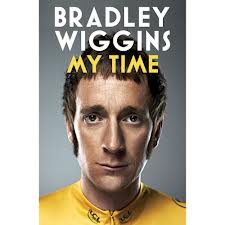
These are the books: ” My Time” by Bradley Wiggins; “Racing  Through The Dark” by David Millar” and “The Secret Race” by Tyler Hamilton.

DownloadedFileDownloadedFileDownloadedFile

I read the books in that sequence. I’ve reviewed Sir Brad’s before. With each book I sank deeper into a kind of fascinated despair for the sport. Admiring the heroism, but resigning myself to the reality. The inescapable reality.

“My Time’ is a celebration of Wiggo’s Tour de France and Olympics triumphs. It sets out the gruelling work, in the shed at home, on the road, and at altitude, that prepared him for victory. The shadow of doping is there, because inevitably people have questioned his success, in the light of past winners. Bradley is angry about this and is eloquent about why he hasn’t taken the drugs route. You either believe him or you don’t. I do. I want to. 2012 was British cycling’s greatest year and Wiggo was at the centre of it.

David Millar’s book is superb. it’s a rise and fall and rise. It is deeply personal and beautifully written. It’s a Shakespearean tragedy. The young, rather reckless man, resisting the drugs, wanting to win clean, but slowly succumbing. Encouraged by his team, but in code. There’s a moment when he struggles badly in a big race and realises that’s it. If he wants to compete he has to start doping. To be like the rest.

He’s caught out, after a member of the support team is stopped at a border and discovered to be carrying drugs. David’s house in Biarritz is raided. Some old syringes are found. He’s treated pretty severely by the French police. His saviour is Dave Brailsford, head of British cycling, who happened to be with him at the time.

Millar’s tale is powerful, affecting and ultimately optimistic. He’s very fortunate in his friends, including the British cycling establishment. They help him through the ban, help him with his rehabilitation. The story is very emotional. There are a lot of tears and self disgust. But in the end there is redemption. Millar returns, successfully, to top level cycling. He was actually the captain of the men’s Olympic road racing team in 2012.

If you are hard line on drugs, in favour of life time bans, then you won’t be happy about Millar’s story. If you believe in forgiveness, lessons learnt, understanding about the circumstances which lead to transgression, then this is an uplifting story. Take your pick. Either way, it’s a very good read.

And then there is Tyler Hamilton. Blimey! “The Secret Race” blows the lid right off. After you have read this book it is hard to believe that anyone at the very top of professional road racing wasn’t doping. EPO and then blood tranfusions. All about increasing the proportion of red blood cells, the oxygen carriers. The more you have, the better your endurance.

Hematocrit readings become everything. The obsession.

Hamilton’s book is a good read again, written in cooperation with journalist Daniel Coyle. It’s a bit more prosaic than Millar’s, but again very personal, and utterly convincing. Part of it is about the relationship with Lance Armstrong and his place in the world of doping. Suffice to say he was placed in the epicentre, and the recent confessions bear that out. And according to Hamilton, Lance wasn’t a nice man. To say the least. Well, that’s not a crime… he was a winner. Sport often excuses bad behaviour when the result is victory. Rightly or wrongly.

What I found most striking about Hamilton’s book was the inevitabilty of doping and mechanical and rather gruesome nature of it. And the subterfuge. The flamboyant doctors, the secret and rather grubby rendezvous. And just the idea of sticking needles in your arms, sucking blood into bags which are put in fridges and reinjected into you later. Horrible. David Millar’s book described some of the same things. You can’t help thinking, why did you agree to this? Why did you even agree to inject vitamins after a race (which was legal)? Injections…ugh!

And the risks. There’s a gruesome description in Hamilton’s book when a reinfusion went wrong because the blood had become contaminated.

Just to do a bit better in a stage of the Tour?….

Tyler Hamilton’s 1000 days explains it all. ‘Paniagua” means bread and water – no drugs.

Here’s an interesting number; one thousand days…. first year, neo-pro, excited to be there, young pup, hopeful. Second year realization. Third year, clarity – the fork in the road. yes or no. In or out…. One thousand mornings of waking up with hope; a thousand afternoons of being crushed. A thousand days of paniagua, bumping painfully against the wall at the edge of your limits, trying to find a way past. A thousand days of getting signals that doping is okay, signals from powerful people you trust and admire, signals that say It’ll be fine and Everybody’s doing it…. and once you cross the line, there’s no going back.

Everybody’s doing it. It’s normal. You don’t even feel it’s wrong, except for the fact that you have to hide it, comply with the Omerta, get your transfusions in grubby hotels in the outskirts of town, the night before a big mountain stage.

Staggering stuff.

So what to conclude now? Have the revelations of the last couple of years blown the drug culture away? Is the British Olympic/ Sky Procycling approach – making much more use of sports science, altitude training and so on – an effective substitute for the drugs and tranfusions? Good enough to persuade others that it’s the way forward?

I’ve no idea. But I’ve been reminded in the past couple of weeks how brutally hard professional cycling is. The Giro d’Italia has been merciless. Beautiful settings, utterly cruel passages. So many harsh climbs and frightening descents.  Exacerbated by the weather, which has made some of the descents truly perilous. Top riders, including the two pre-race favourites, Bradley Wiggins and Ryder Hesjedal, wiped out by the conditions.

It’s so tough. Drugs and doping appear to have been the answer in the past. Maybe a more scientific and rigorous approach to training could replace the easy options in future. But there is always going to be someone who thinks they can steal a march through a new and undetectable drug. It’s human nature.

I want to finish on an optimistic note though. Cycling may have been riddled with drugs, but I don’t think it stops any of the three authors of the books here from being sporting heroes. Their achievements have been immense. They have found different ways of meeting the awesome challenges.  Where they have transgressed they have come clean. They have been honest about their personalities. And they have addressed their weaknesses. They have all been winners at the very highest level. All three books are inspiring.

So I’d recommend them all and say they are well worth reading one after the other. Different perspectives on the sport and the problems it has faced. Fascinating, moving and, ultimately, proof of the soul at the heart of cycling. Despite everything.

Posted in Art, books, theatre, cinema, Sportsthoughts | Tagged , , , , , , , , , | 5 Comments

Jets in the sky, wondering where and why…

IMG_1061

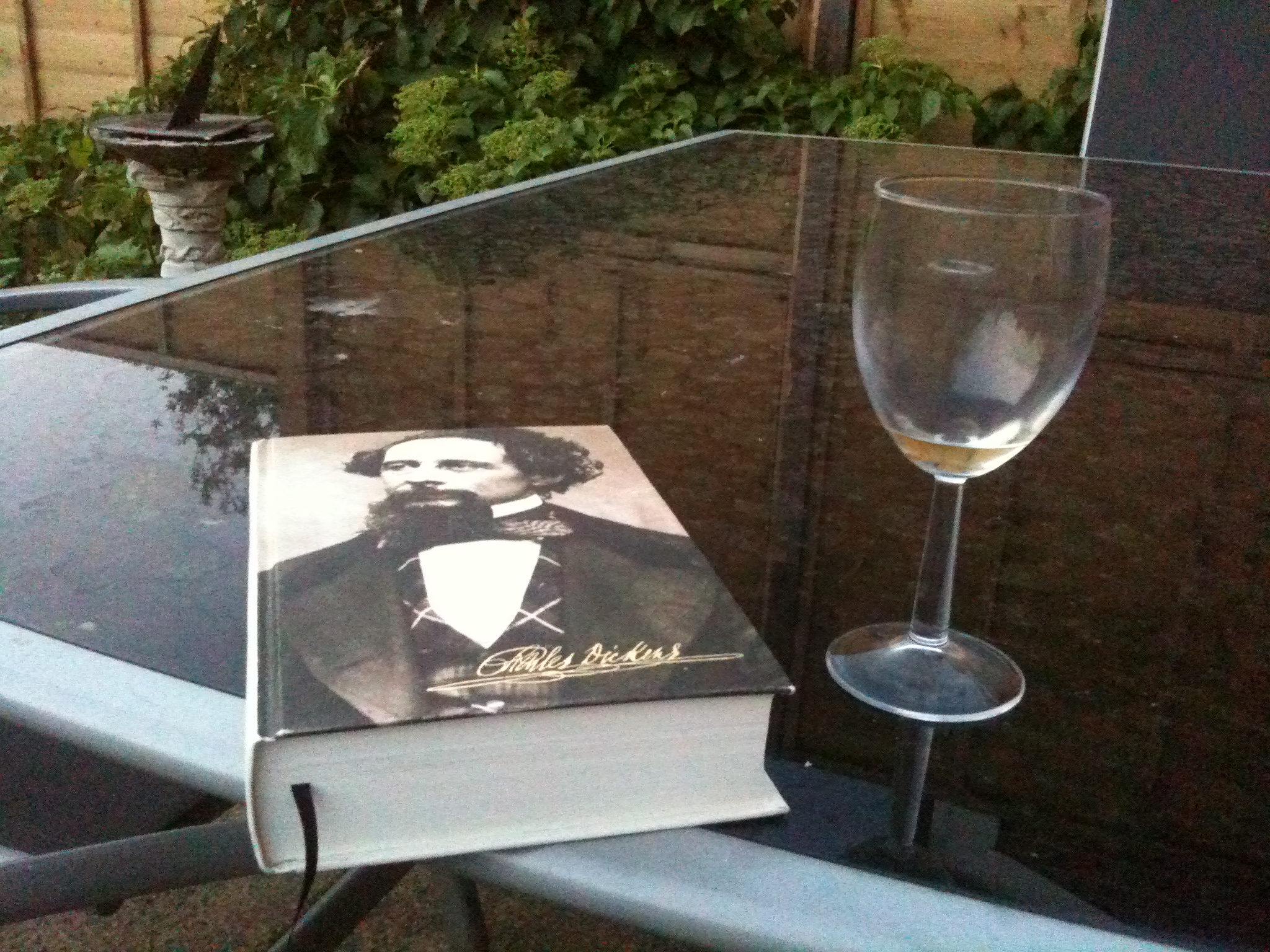
When the weather allows, and the light lasts well into the evening, I can sit in our back garden, glass of wine by my side, book in hand, watching the jets from Heathrow climbing into the sky. There’s one a minute, extraordinary numbers of people pouring into the heavens, en route to who knows where. Sometimes I’ll sit there and wonder about the plane passing by. Where is it going? Who’s on it? Why are they on it? Holiday, business, returning to family, escaping? Each life with its back history, its present concerns, its uncertain future. None of which I will ever know. A whole load of history and future just passing by, high in the sky.

Occasionally a fighter jet will appear, with its fierce emissions condensing in the cold atmosphere, an awesome vapour trail leaving trace of the searing object that was there moments before. There’s one in the photo above. It’s like a shooting star, but inside there’s a man or woman piloting that jet, one or two others aboard, in constant communication with ground control, urgent, concentrated, forever on the edge between progress and disaster. Just people, with all the same hopes and fears, daily concerns, joys, relationships. Up there, in the sky, shooting by at hundreds of miles an hour. Remote, but the same.

I wonder, I wonder.

It’s like when I’m on the tube, every working day. The Piccadilly, the District Line. The crowded carriage. The commuters, the tourists, the businessmen and women from abroad, the students, the school kids. People from so many different backgrounds, cultures, countries, races. Incredible diversity. I look around and wonder. What if I met that person, spoke to them? Would we get on, could we be friends? What might we have in common? What might we disagree about? Who knows? I will never know. Every moment, more people that come into your sphere,  and then disappear, never to be seen again. A missed opportunity? A good thing you never knew more? They might have stuck their elbow in your face, their bag may have intruded into your personal space, their beauty or style might have brightened up your journey into work. But you will never know them. You can only speculate.

Unless something happens that brings you together, you will never know what might have been. Each person is as remote as that jet pilot. And just as human. Just as interesting. If you could only know them.

What might have been.

Just something that occurred to me as I read the biography of Charles Dickens by Clare Tomalin, supped on a glass of Chardonnay and stared into the fading West London skies…

IMG_1068

Posted in London, Photos, Random stuff | Tagged , , , , | 2 Comments