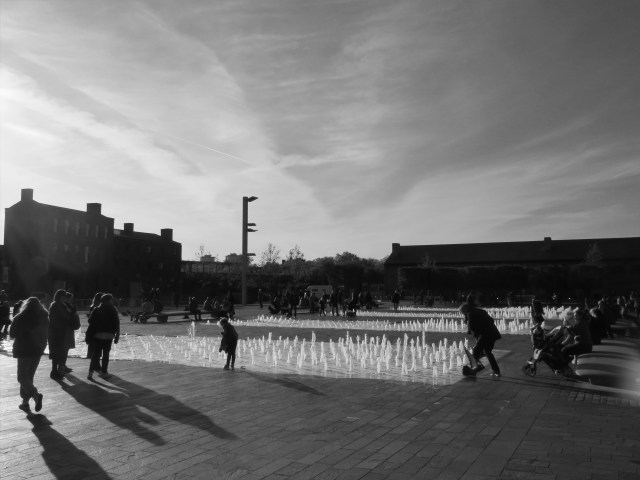
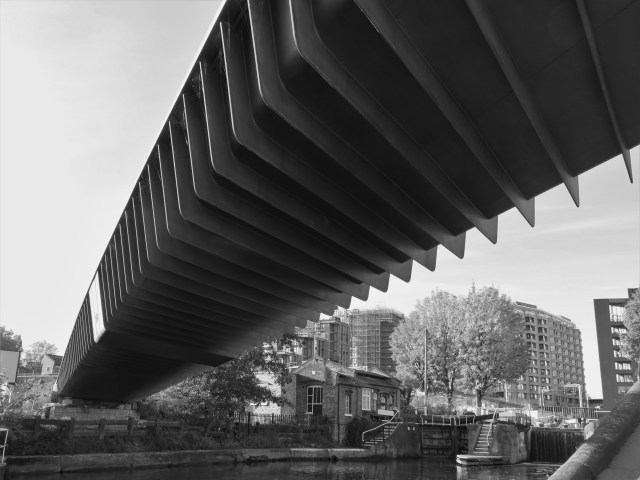
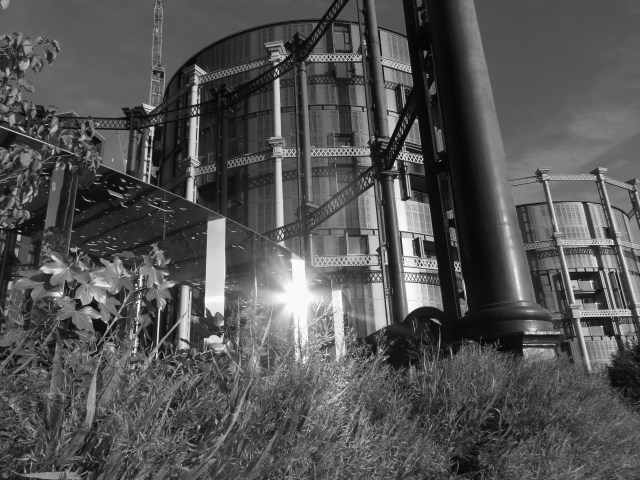
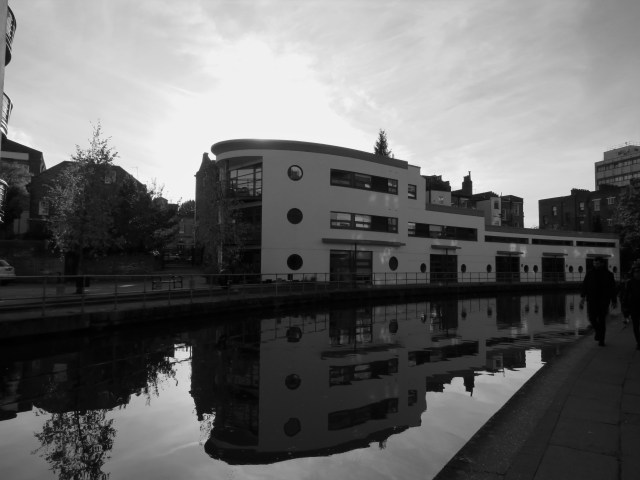
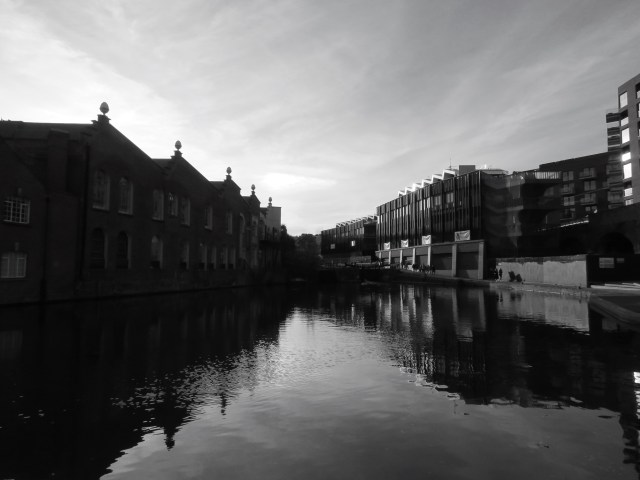
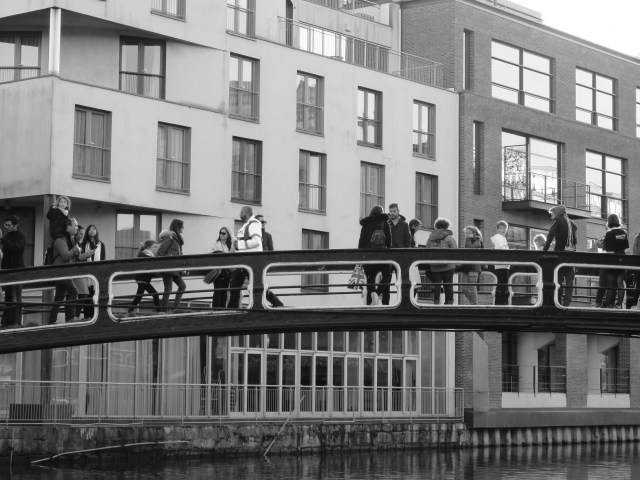
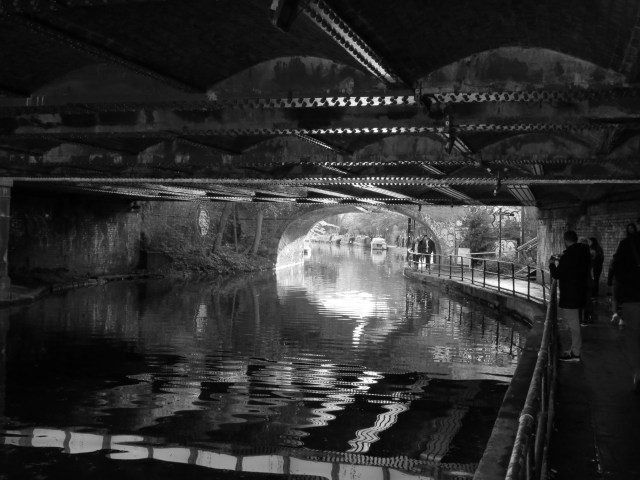
lovelondonscenes 164 – Kings Cross and Camden by the Regent’s Canal

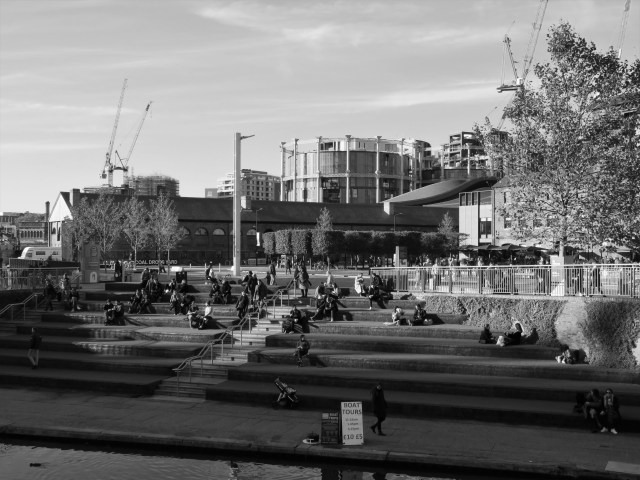
Today was autumn’s collision with winter, as the clocks went back. But it was also a lovely sunny day and not too cold. A respite after rain, rain, rain. I took the Piccadilly Line up to King’s Cross and walked from there back to Paddington along the Regent’s Canal. The walk, which is not that long, takes you through Camden, Regent’s Park and Maida Vale, including Little Venice. The photos here, turned into black and white, are from the stretch between King’s Cross and Camden, starting around Coal Drop Yard.  A lot of it is relatively new development – this is an area transformed. A place you want to come to rather than avoid. Urban beauty.

Posted in Photos - lovelondonscenes | Tagged , , , , , | 2 Comments

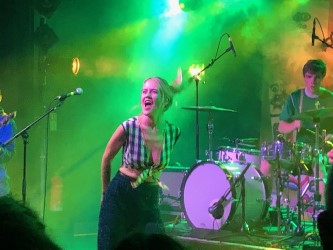
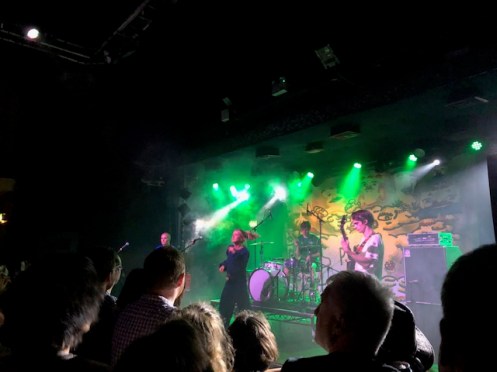
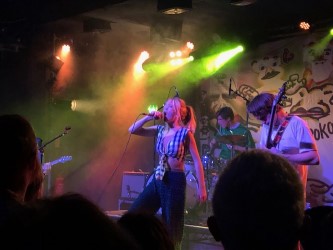
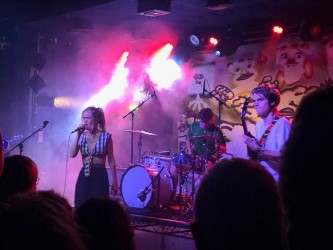
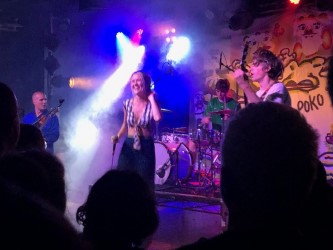
Pom Poko at the Scala, Kings Cross, 23 October 2019

Pom Poko, a Norwegian band who can only be described prog-punk, are playing their biggest UK tour yet this month. They released their debut album “Birthday” in February and this performance at the Scala in Kings Cross was the third time I’ve seen them this year. The first was at the Lexington, just up the Pentonville Road from the Scala, in April; and the second was at End of the Road in September, where I thought they were one of the highlights of the whole weekend.

The album is excellent – a mass of screeching riffs and solos, pulsating beats and endless time changes. Nothing is ever the same for long. On top of this near-chaos, singer Ragnhild Jamtveit’s high-register vocals veer from the sweet to the quirky to the slightly crazed. It’s heading for a spot in my top ten of the year for sure – and it won’t sound like anything else in there.

Live is even better because this band are just so much fun! I don’t think I’ve seen many bands who seem to be enjoying themselves so much. And this is personified by Ragnhild, who bounces around the stage at every opportunity with a smile on her face. She does stern too, but it’s only for show – she is loving it. The rhythm section of Jonas Krovel and Ola Djupvik are incredibly tight and handle all the time changes with aplomb. But the genius of the band is guitarist Martin Tonne, who gets so many great riffs out of just the one guitar, as he stands to one side in his blue boiler suit. The sound is deeper and dirtier than on record – and it rocks! It’s pretty relentless in fact – there’s really only one song, “Honey”, where they slow down for long, and even then it’s not exactly a ballad. But Ragnhild needs some rest from all the jumping around.

Yes, Pom Poko are one of my discoveries of the year without a doubt. And as a live act, despite the complexity of their music (by pop standards) they are a full-on slug of rock’n’roll with one of the most charismatic singers around. Pure enjoyment from start to finish.

Posted in Music - concerts, lists, reflections | Tagged , , , | Leave a comment

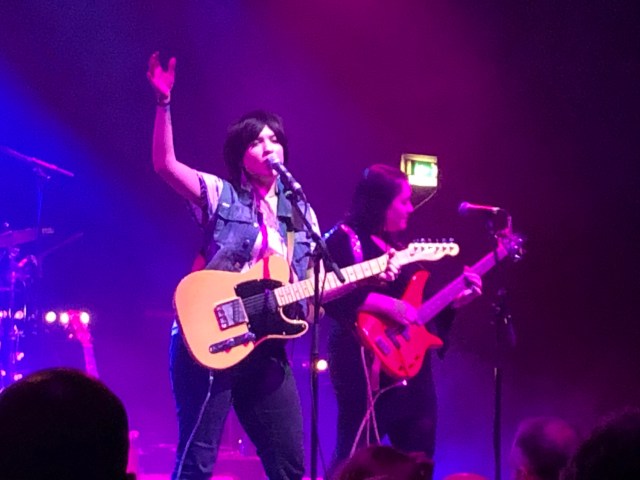
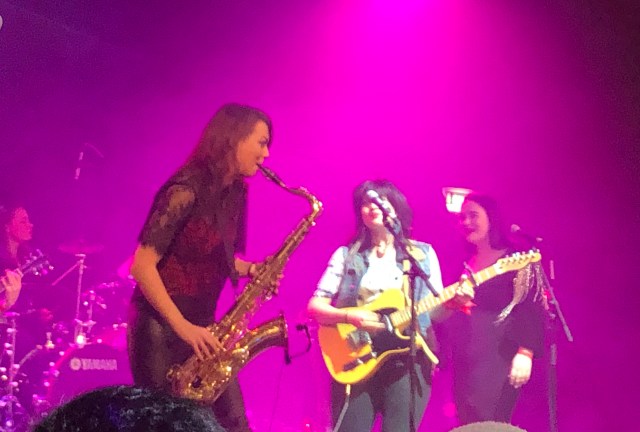
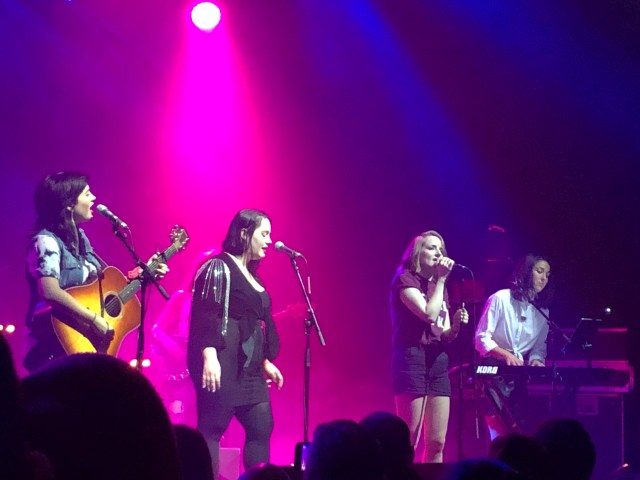
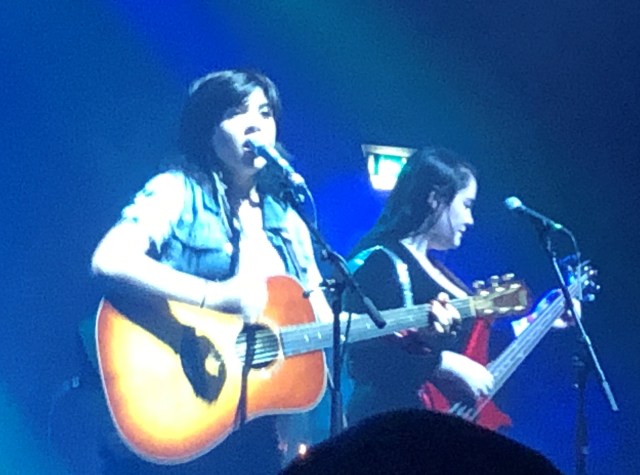
The She Street Band at the Clapham Grand, 18 October 2019

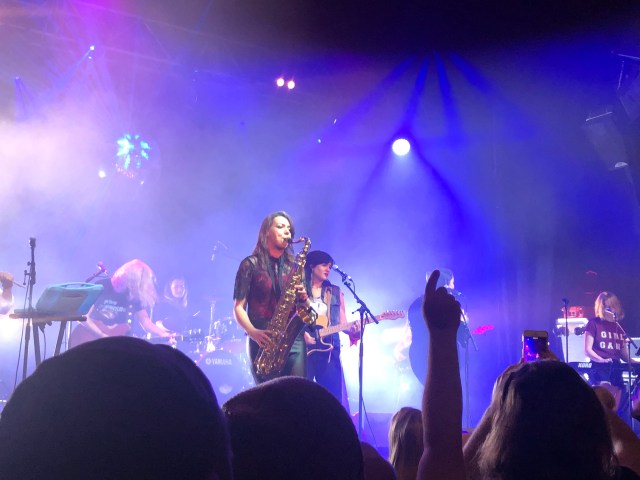
Another year, another She Street Band concert! Last year in October it was at the Scala in King’s Cross. This time it was at the Clapham Grand in south-west London. First time I’d been there and I liked the place. Another old theatre/cinema that is doing the business as a concert and club venue.

For those of you who don’t know, the She Street Band are an all-woman outfit who play the songs of Bruce Springsteen. And they do so joyously. It’s the next best thing to Bruce himself. Some people think Bruce Springsteen’s music is boys’ music. I can see why – the lyrics are nearly all from the perspective of men. But the She Street band prove that the music itself is for everyone. Music of hope, music of despair, music of defiance, music of celebration. Rooted in rock’n’roll, in soul, in folk, in the music of America.

The band was formed by bassist Judy Orsborn in 2016. They are from America, the UK, Ireland and Sweden. The vocals are shared around, Judy included. There’s another bassist who steps in for her at times when she is singing. Rhythm guitarist Mara Daniele takes the lead vocal on a lot of the songs, especially the earlier ones – the great first four albums. Last time I saw her, at the Scala, she had blonde-red hair; this time it was jet black. She often has a smile, always a joie de vivre, as she sings, like she knows she is singing some of the greatest songs ever written. And that is the thing about the She Street Band: it is a total celebration.

The core of the set, as before, was from what I think of as the second phase of Bruce’s great albums: “The River” and “Born in the USA”. And they are mostly the uptempo songs, although one of the delights in this set was when the keyboard player Lynn Roberts took centre stage for “Stolen Car” from “The River”, a beautiful and sad ballad which I have always loved. Another song which bucked the trend of rockers was “Tougher than the Rest”, which opened their second set. All the band, save for the lead guitarist – Isabell Lysell, I think –  stood at the front and sang an acapella version, with just that low key strumming in support.

My memory is a bit fuzzy already about which songs were in the first set and which were in the second. But for those of you who like your Bruce Springsteen, these were all the songs played, as far as I can recall:  Growin’ Up – Rosalita – 10th Avenue Freeze Out – Thunder Road – Born to Run – Because the Night – Badlands – Prove It All Night  – Darkness on the Edge of Town – Out on the Street – Sherry Darling – Stolen Car – Two Hearts – The River – Hungry Heart – Glory Days – Bobby Jean – Cover Me – I’m on Fire – Dancing in the Dark – Tougher Than the Rest. What a set list!

“Sherry Darling” opened proceedings, and allowed saxophonist Yasmin Ogilvie a moment in the spotlight. She had a few of course. The best? Maybe “Thunder Road”. Memories of the big man, Clarence Clemons.

The whole show was a celebration, but the last four took it to another level. “Dancing in the Dark” and “Badlands” to end the second set; and then, for an encore, “Bobby Jean” and, of course, “Born to Run”. Like I said earlier, the next best thing to Bruce himself. If you love the music of Bruce Springsteen you should catch this band.  It is an uplifting experience!


Posted in Music - concerts, lists, reflections | Tagged , , , | Leave a comment

Holly Herndon at the Barbican, 16 October 2019

Holly Herndon is an American electronic artist who lives in Berlin. She’s originally from East Tennessee and studied music in Oakland, California. She’s someone I’ve heard from time to time on BBC 6 Music – DJ Mary Anne Hobbs is a big fan – but have never really investigated. Nonetheless, I was interested in some of the publicity for a new album this year, “Proto”. Amongst other things, it featured an artificial intelligence which she and her partner had called “Spawn”. So when I read she was playing a concert at the Barbican I thought it could be interesting.

I deliberately didn’t listen much to her music beforehand. Or maybe just didn’t get around to it. Either way I figured this was the kind of concert that would be fun to come to without knowing too much, as anything could happen. Given that it was in the Barbican’s music hall, it had to be something that could fill the space. And it was going to have a lot of interesting beats, and more besides.

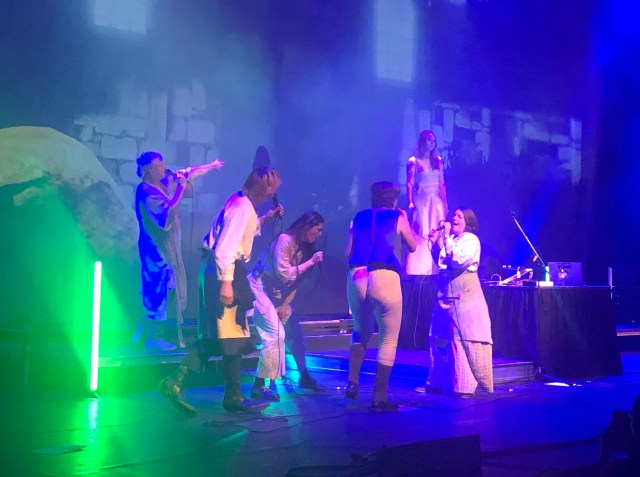
And it was an amazing show, though not quite what I’d expected. I was anticipating a pretty avant-garde display of electronica. Maybe quite discordant and challenging. But it wasn’t really like that. Holly said at one point that she had left Spawn at home; and the music was a lot more organic than I’d expected. She had five singers with her, all dressed in what seemed like mediaeval garb. Holly wasn’t so different herself. And the dominant feel of the music was choral. The voices were put through all sorts of effects and there were some pulsating bass lines that throbbed through the powerful speakers. It was a captivating show, musically and visually,  and felt like it would have been perfect echoing through the Gothic spaces of one of the great cathedrals – as long as the bass lines weren’t too much for the ancient foundations!

I listened to “Proto” again the next day. It sounded sharper and more robotic than the live rendition, though the voices were still dominant. I think I preferred the live version, but will give the album a bit more time. It could be worth it. There is something intriguing about Holly Herndon’s music which might just yield more of itself with a few listens.

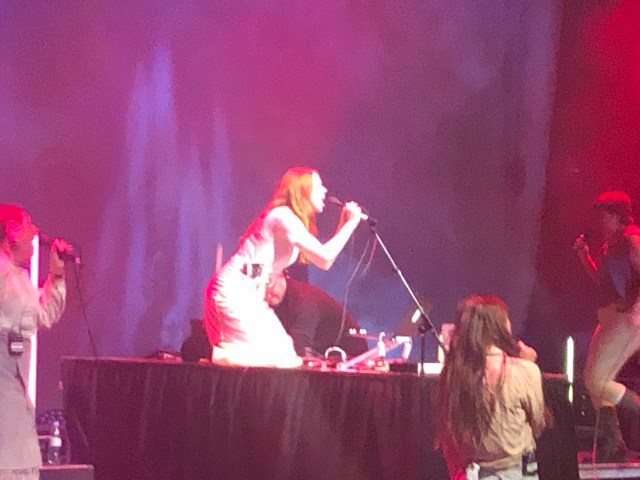
It wasn’t the sort of concert to take a load of photos, but the encore featured a more high tempo techno sound than what went before, and most people stood up. All the shots are from that moment.

Posted in Music - concerts, lists, reflections | Tagged , , , | 2 Comments

Music and Landscape – a concert and album by Caoimhin O Raghallaigh and Thomas Bartlett; a book by Richard King

Music has always been connected to its environment, and to the landscape – or the seascape, the cityscape. Environment can shape the nature of music – is it to be played outdoors or in a cathedral, in a club or a car, or through headphones? But music can also evoke the sense of being in a particular setting, and reflect our feelings about those settings. Two things – a concert and a book – have reminded me of that just recently. The concert was by Caoimhin O Raghallaigh and Thomas Bartlett, violinist and pianist respectively. It was in the Purcell Room in the Queen Elizabeth Hall on the South Bank. The book is “The Lark Ascending” by Richard King, a renowned music writer.

I’ll start with the concert, which took place on Friday 27 September.

I’d never come across Caoimhin O Raghallaigh and Thomas Bartlett before. My friend Shane suggested we go along, with a couple more of his friends, Steve and Andy. Caoimhin O Raghallaigh is in an Irish band called the Gloaming, who Shane told me are very popular in their home country. Much as I love Irish music and that sound I’ve called celtic soul, the Gloaming had, until now, passed me by. Thomas Bartlett is a pianist from New York, who is also in the Gloaming, and has played with all sorts of people, including Yoko Ono, the National and St Vincent. Together they have recently released an album called “Zona Rosa” and this is what featured tonight.

“Zona Rosa” sounds like a good title for the concert too. It was one of those performances that took you into the zone: of contemplation, imagination, the landscape. I found myself moving between admiration for the musicianship and thinking about all sorts of other things. Some were music-related, like how their music evoked the same sense of place as the great Icelandic band Sigur Ros, although in a less dramatic way. But I also found myself thinking a lot about the book I’m writing, the follow up to “The Decision”. Working title “Hope Rising”. I’d spent a few hours on it that day and my imagination was still buzzing. The music complemented those thoughts. It conjured up a picture of the Irish landscape, but at the same time gave me space to think about other things. I think others in audience might have found it an opportunity just to shut their eyes and relax after a hard day at work.

Since the concert, I’ve been listening to that album “Zona Rosa” a lot, on Spotify. It is a beautiful, serene piece of work. Never extravagant, but always evocative of that Irish landscape, be it the cliffs and the sea rushing in, or the green hills and meadows. It seems to me that the violin represents movement – the blowing of the breeze, the soaring flight of the seagull (or indeed the kestrel, title of one of the pieces), the furtive movement of a small animal, people dancing. Meanwhile the piano provides the foundation: the cliffs, the rocks the plants, the rivers and bubbling streams.  Together they form an entrancing whole.

The depiction of a bird in flight through music, surveying the landscape below, is an opening theme of Richard King’s book, “The Lark Ascending.” I came across Richard, talking about his book, at the End of the Road festival this year. Each morning they have a number of talks in the Literature tent, hidden away in the woods. They are reliably fascinating. I listened to nine of the talks this year. Richard King’s was one of three that, in different ways looked at the relationship between man and nature. The others were Luke Turner, talking about his memoir “Out of the Woods” and Max Porter, describing his second novel “Lanny”. One of the things that all three authors had in common was a view that that relationship is necessarily always evolving. People are part of nature, an integral part. We shape our environment and the environment responds – and shapes us. Right now most of us are concerned that man has abused that relationship over the last century, and especially the last few decades, and that we are now beginning to pay the price. But the theme of the three authors was not directly concerned with those dangers. It was more about how the interaction can never be static. Luke talked about how the practice of “pollarding” (cutting back) trees in Epping Forest helped their healthy growth – a bit like pruning in our gardens, I guess. That has apparently been stopped now – when pollarded the trees can look quite ugly. But they are no longer growing in the same vigorous way. Richard and others talked about the strand of “eco-fascism” which harks back to a purer, halcyon age, which probably never existed. This was strong in the first decades of the twentieth century, and perhaps not surprisingly, some of its adherents also dallied with actual fascism. In “The Lark Ascending” he writes about how these back-to-the-country movements were also attracted to English folk music. And of course factions developed: again the purists versus the evolvers. Factionalism is clearly part of the human tradition.

I found “The Lark Ascending” a fascinating read, both in terms of how people’s interaction with the British landscape has evolved over the past century (partly through government interventions which either increased or prevented access) and how the author weaves music into this narrative. The musical choices on one level are pretty random and may just be some of the music he happens to like. But the choices also make sense: they illustrate his themes very effectively – and they introduced me to some music that I’d never listened to before. That included Stan Tracey’s jazz rendition of Dylan Thomas’s “Under Milk Wood” and the book’s opening suite: Ralph Vaughan Williams’ “The Lark Rising”, a quintessential piece of English “classical” music, which I’d never knowingly listened to before. And yes, the opening violins conjure up that sense of flight, of swooping and gliding, in a similar way to Caoimhin O Raghallaigh in “Zona Rosa”. A little more mellifluous perhaps, possibly reflecting the gentler nature of the English countryside that Vaughan Williams had in mind.

For me, the most interesting parts of the book were the later chapters, which trace the development of free festivals and later on outdoor raves. Both were ultimately curtailed by the forces of law and order, often brutally. They were backed up by draconian legislation. You can blame this all on the conservative forces in society; but there is also an unfortunate logic to the growth of both festivals and raves, whereby they begin quite small and idealistic, become more popular, attract less savoury participants (and criminals), upset the local communities, clash with the police, get stopped. But what has then emerged are more commercial, better organised and safer festivals. The type of events all sorts of people go to – myself included! At End of the Road, the authors always appear at the Rough Trade tent at 12.30 to sign copies of their books. I bought “The Lark Ascending” and asked Richard how he viewed festivals like End of the Road and their interaction with the countryside they occupy. “They charge us a lot for it,” was all he said. I was disappointed with that response and didn’t pursue the conversation any further. I guess Richard is a believer in a more natural, organic relationship between music and the landscape which finds its expression in “alternative” cultures; but as he notes in other contexts, that relationship inevitably changes over time.

The last musical references in the book are to the Scottish electronic band, Boards of Canada. I enjoyed being reminded of their music, which has a pastoral, ambient feel to it, perhaps reflecting the location of their studio in the Pentland Hills, south of Edinburgh. I have a few of their albums from the late 90s and early 2000s. My favourite is “The Campfire Headphase”. The title says it all really. There’s an EP, too, called “In a Beautiful Place out in the Country”. Worth a listen if you haven’t come across them before.

Music and Landscape, I called this piece. Both evolving, both evoking feelings of awe which are sometimes hard to put adequately into words – though plenty of us try!  And where words might not always be up to the task in portraying the wonders of nature, of the landscape, music can capture an essence, an undefinable feel. In their different ways, Caoimhin O Raghallaigh and Richard King have done exactly that.

Posted in Art, books, theatre, cinema, Music - concerts, lists, reflections | Tagged , , , , , , , | 4 Comments

Barrie Masters of Eddie and the Hot Rods – a tribute

We got the news today that Barrie Masters, the lead singer with Eddie and the Hot Rods, had died suddenly. He was 63. The Rods were still performing until recently, although he was the only remaining member of the original band. 

You may never have heard of Eddie and the Hot Rods. Their moment of chart fame was short-lived. But for a generation of mid 70s teenagers who would soon discover punk, they were important. They, along with Dr Feelgood, got us loving two, three minute rock’n’roll songs again, as I explain in the extract below from my music book “I Was There – A Musical Journey”. In my case there is no doubt that they paved the way for punk, and that paved the way for so much more. 

And Barrie was a wild ball of energy on stage, the likes of which I hadn’t seen before. I’ve seen a few since, and still do today; but Barrie and the Rods were the first in my world.

This is what I wrote. It was mixed up with Dr Feelgood.

They called it pub rock. It changed everything.

Suddenly all those extended solos, those high pitched harmonies, those stories of demons and wizards seemed a bit… turgid.

We didn’t ditch metal overnight, and some, like Flob, never lost the faith in Sabbath and Heep. Good on him. A loyal man, knew what he liked and stuck to it. But the Feelgoods took me on a ride that ended, as for many others, with punk. The music was familiar enough – not hugely different to Quo really; in the same mould as The Faces as they bashed out “Pool Hall Richard”. As we moved into ‘76, Eddie and the Hot Rods emerged and took us even closer to what would become punk. They were like the Feelgoods, from the same South Essex area, but younger and even faster. They put out a four track EP, “Live at the Marquee” featuring Bob Seger’s “Get out of Denver” which became the soundtrack to my school life. I played that tune every morning before I did my “A” levels in 1977. It was just so upbeat, so defiant – with that song firing me up I could achieve anything. The rest of the EP was a rumbustious delight too: Q and the Mysterions’ “96 Tears” and a rowdy medley of Them’s “Gloria” and the Stones’ “Satisfaction”.

We went to see Eddie and the Hot Rods at Leicester Poly in 1976. It was the sweatiest, raunchiest gig I’d ever experienced. The Rods’ album “Teenage Depression”, was just out of this world – razor sharp rock’n’roll, with, for a 17 year old, lyrics that were just perfect for sticking two fingers up to the world. It included a great live version of The Who’s “The Kids are Alright”, though the one I loved most was “All I Need is Money”. Hundred miles an hour riffing, laddish lyrics blurted out at the same speed. Comic book macho. But so upbeat – to this day it makes me smile whenever I hear it, either out loud, or just in my head…

… The Rods went a bit rock after “Teenage Depression”, but in doing so made the one single which they will always remembered for: “Do Anything You Wanna Do”. It reached No 9 in August 1977. It was a real rallying cry, with a riff lifted from something by the Who – probably the “Kids are Alright”, which they’d covered on “Teenage Depression”, as a live take. I loved the single at the time, with its simplistic themes about doing your own thing and fighting the system, but it wasn’t the same Rods who’d paved the way, like the Feelgoods, for the punks. It was a pop song, their one big shot. It didn’t lead to a pop breakthrough, and the punks coming through stole their rock’n’roll thunder. They went on for a while like the Feelgoods, but they’d had their moment. A moment to be proud of though: a seminal, catalytic moment.

Rest in peace Barrie, and thank you for your inspiration.

Posted in Music - concerts, lists, reflections | Tagged , , | 4 Comments

“The Beatles: Hornsey Road” by Mark Lewisohn, Bristol Redgrave Theatre 23 September 2019

I went down to Bristol yesterday to see the author Mark Lewisohn’s presentation about the making of the Beatles’ “Abbey Road” and their final days at the Redgrave Theatre in Clifton. I’d read about it in the Guardian a couple of weeks ago and the London shows had sold out. So I looked at what was still available, and it came down to a choice between Bristol and Maidenhead. Sorry Maidenhead, no contest!

The show is called “The Beatles: Hornsey Road”. This is because there was an EMI studio in Hornsey Road in North London which at one point was mooted for the recording of what became “Abbey Road”. The title of the album came quite late in the proceedings, apparently.

The format was essentially a presentation – very slick and with lots of musical interludes as well as insights into the lives of all four Beatles, based on Mark’s meticulous research. He has written extensively about the Beatles and is working on a comprehensive trilogy which he intends to be the definitive work on the band. The first, “All These Years: Volume One: Tune in” (catchy title) takes us all the way up to 1962! I must say I’m tempted to buy it, but Volume Two will really get us into the Beatles’ glittering years. One thing the show did last night was to remind us about the phenomenal output and revolutionary music that the Beatles put out in only six years of the 60s. And none of them were out of their twenties when the band split. Incredible – there has never been anything like it.

Yesterday’s show was a lovely combination of nostalgia and discovery. Each track on the album was analysed, both in terms of the inspiration behind it and the constituent parts of the music. Some of the backing tracks – often taken from a Beatles-endorsed music game –  were very revealing. The individual vocals, the harmonies, the beats, the solos. A band at work, committed to their music, even as things fell apart legally and financially. It was inspiring, and the first thing I did when I got back to my hotel room was to play “Abbey Road” on Spotify!

I won’t go into detail as there may be readers who have booked to see the show, perhaps in London. But I will share just one example of the research that Mark does. He was able to tell us that “Mean Mr Mustard”, part of that wonderful suite of short songs which is the highlight of “Abbey Road”, is based on a real person who was called Mr Mustard. (Maybe others know this, but I didn’t). He was a civil servant, originally from Scotland, whose divorce made the Daily Mirror and other papers, including a Spanish one, on account of his alleged meanness. Lewisohn had obtained a copy of his will which maybe contradicted that notion of meanness – he’d left all his money to the ex-wife.

What was so good about the show, ultimately, is that it was a celebration of what we must surely acknowledge as the greatest band of all time and a reminder of how restless and ahead of the game they always were. And the number of songs they recorded every year of those six years was amazing. “Abbey Road” was state-of-the-art stuff, amid the occasional silliness – step forward “Maxwell’s Silver Hammer” and “Octopus’s Garden” – and who knows what they would have achieved if they’d stayed together. Apart, they produced some great music, but nothing like they had done as the Beatles – they were the classic example of synergy. Better together.

And while there was certainly plenty for the Beatles nerd (which I’m not, really) what shone through most of all was Mark’s love for what he was doing. That was infectious and often rather moving, particularly as the story neared its end – and “The End”. Good luck to him in completing his three volumes of Beatles history – it is clearly a monumental task!

Mark had access to a tape of a meeting at which the Beatles, with John Lennon to the fore, were discussing a possible new album to follow “Abbey Road” (and, I assume, what became “Let it Be”, which was recorded before “Abbey Road” but released afterwards). John was insisting that the Lennon-McCartney accreditation should end – the two of them and George Harrison should each have four songs, with Ringo getting two if he wanted them. Paul was confessing that he didn’t think much of George’s songs, casting doubt on the equal allocation. They were also discussing a 1969 Christmas single. Lewisohn wasn’t able to play much of the recording for legal reasons, which is a shame. It suggests that there is still more to come out about the end of the Beatles, if everyone involved agrees with it. Perhaps they never will, but it may still come out one day. Someone will spill the beans.

Does it matter whether we know or not? Perhaps not – maybe we should just enjoy the extraordinary music between 1963 and 1969 that the Beatles gave us. But what might have been…

Posted in Music - concerts, lists, reflections | Tagged , , , | 2 Comments

The rule of law strikes back!

When I first saw the news today about the Supreme Court’s judgement on the prorogation of Parliament I experienced an unfamiliar emotion when in comes to anything related to politics: happiness. As I went onto Twitter and read more – yes, from all the people I agree with – I felt a tear in my eye. Something great had happened that not so long ago no-one could have expected: the rule of law had prevailed over the executive dictatorship that Boris Johnson and his supporters had tried to impose on our politics, our country. The last three years have been so grim politically that my expectations had become very low. In recent times, almost on a daily basis, some aspect of our traditional way of doing things had been brushed aside, traduced, in the name of achieving Brexit, “do or die.” The Supreme Court judgement shows that there is some life in our way of doing things after all.

Our way of doing things. Our unwritten constitution. A constitution that is a jumble of convention, laws and precedents. A constitution that can be added to, re-worked, quietly modified and even ignored. But one that has, over the centuries, worked pretty well, and allowed the three branches of the constitution – the legislature, the executive and the judiciary – to adapt to changing times. It is deeply flawed in some areas, not least the electoral system, which was suited for a two party, capital v labour era, but which has proved wholly unsuited to reflecting popular opinion in these more complex, variegated times. Parties have achieved large majorities with way less than 50% of the vote and then gone on to change Prime Ministers through internal elections involving memberships with tiny numbers of the electorate. In the modern era, when the role of Prime Minister has taken on a presidential hue, this is absurd and dangerous, as we have seen recently. But flawed though it is, the unwritten constitution has had an ability to correct the worst anomalies, through an acceptance by the majority of those concerned that there are some fundamentals which cannot be ignored.

The most fundamental of these tenets are parliamentary sovereignty and the rule of law.

The sovereignty of parliament is lent to it by the monarch, who then, at least publicly, stays out of things. We vote for our MPs, and for better or worse they form a government, which puts laws to Parliament and runs things day-to-day. Few of us will agree with everything that a particular party sets out as its policy, but we accept that we vote for the MP closest to our own values and beliefs and they take it from there. None of us can have everything we want, so in effect we optimise. Our electoral system can exaggerate swings in public mood, but when we don’t get what we want, we grumble a bit and wait for the next election. Referendums cut right across the concept of parliamentary sovereignty, as a vote on a single subject is put directly to the voters. I used to think this was important for major constitutional matters, but Brexit has shown how dysfunctional referendums can be. There is no denying that a majority of those voting chose to leave. There is also no denying that Parliament itself passed the laws allowing the referendum and the question that went with it. But the referendum indicated nothing about how we should leave, what consequences we were prepared to accept, and so on. It allowed a small majority of those who voted to mandate a change with massive consequences for the whole population. It was the tyranny of the majority in action. And then when Parliament resumed the leading role assigned to it by the unwritten constitution, and failed to agree on what sort of Brexit should happen, there were cries of it ignoring the will of the people. Cries encouraged by an irresponsible government that was desperate to get its deal through. Never mind the fact that the will of the people is something that all the most heinous dictators through history have laid claim to.

And that brings us to the rule of law. This is so fundamental to everything that makes the UK to this day a civilised country in which people of very different backgrounds and beliefs can live alongside each other, in the knowledge that, for the most part, disputes can be resolved, crimes will be punished and politicians cannot act as if they are above the law. If they do it will catch up with them. And this was the thing that I found most disturbing about Brexit and the effect it has had on our politics. Citing the will of the people, the government, especially since Boris Johnson took control ( in that election by a tiny minority of the people) showed a flagrant disregard for not only parliamentary sovereignty, but the rule of law. It said it would disregard the act of Parliament – the law – requiring a delay to Brexit if a deal couldn’t be agreed with the EU by 19 October; it said that it might just prorogue Parliament again if the Supreme Court found against the first prorogation. Ignore the Supreme Court! Its authority is in the name. But the government still said it might ignore it. So it would disregard the orders of both the fundamental institutions of our unwritten constitution because Brexit – whatever it is, which no-one knows even now – must happen by 31 October.

Well, now we will see. The Supreme Court has thrown down the gauntlet, in a unanimous judgement, that the government has acted unlawfully. Parliament will be back tomorrow. Are Boris Johnson and his gang really willing to override Parliament and the Supreme Court, on the basis of the will of the people? A concept alien to our parliamentary democracy, but very familiar to the countries of Europe and elsewhere that suffered so horribly during the 20th century? Really? And does Johnson even have the power to do this? Will the civil service be willing to take orders from a government that has been deemed to be acting unlawfully by the Supreme Court? Will a police van turn up at 10 Downing Street to arrest the Prime Minister for being in contempt of court? We are truly in unchartered territory.

So, can there be anything like a happy ending to this Shakespearean combination of farce, horror and tragedy? Well, I’d happily see Article 50 revoked, but that is highly unlikely. I’m in two minds about another referendum, simply because of the deleterious effects the first one had, both on our unwritten constitution and the political discourse. It could be justified on the basis that the first was an in-principle vote and a second would be taking place now that we know a lot more about the likely consequences – if there is a deal agreed by Parliament on the ballot paper. It would be completing unfinished business. But I’d accept a parliamentary vote on a deal too, on the basis that that would be most in tune with our way of doing things. The way that works. It will be worse than staying in the EU, but we just have to accept that we had a referendum and the vote was to leave, under the rules of the game ( a requirement of super majority of two-thirds would have been better for such a momentous decision). I wouldn’t be that surprised if there was a deal, with a Northern Ireland-only backstop, although it would be called something else. After all the DUP don’t hold the balance of power any more in Parliament. The irony is that that was the EU offered the British government in the first place. What a shambles!

Still, we are where we are. The fun and games aren’t over yet, I’m sure. But at least today the Supreme Court gave us hope that our unwritten constitution, rickety though it is, is alive and putting up a fight. The rule of law has struck back; now over to Parliament.

Posted in Politics and social | Tagged , , , | Leave a comment

My Top 50 Albums 2000-18

The Guardian recently published a list of the Top 100 albums of the 21st century. It was pretty good, but nothing like what my list would be. So I thought I’d do my own 50. I must stress that this isn’t what I think the most important or popular 50 albums are. It’s just the ones I’ve loved. And there were so many candidates that if I did the same thing next week it could be quite different. The other thing that comes from just selecting albums is that a lot of the dance/rap/soul that I’ve liked doesn’t make it, as that tends to be single tracks rather than whole albums. Cue another list some time?

The Guardian list seemed wary of recent albums. My tendency was the other way, so I tried to remember what moved me back in in the early years of this century. There’s probably still a bit of bias towards recent albums. I’ve cut it off at 2018, as trying to place this year’s great albums in context is premature. There’ll be a top ten for 2019 of course.

So here’s my top fifty, today!

1 – Babes Never Die by Honeyblood

2 – In Rainbows by Radiohead

3 – The Bones of What You Believe by Chvrches

4 – Honeyblood by Honeyblood

5 – Cigarettes and Truckstops by Lindi Ortega

6 – Golden Hour by Kacey Musgraves

7 – A Dream Outside by Gengahr

8 – Lost in the Dream by The War on Drugs

9 – The Rising by Bruce Springsteen

10 – Is This It? by The Strokes

11 – My Love is Cool by Wolf Alice

12 – Kid A by Radiohead

13 – Fading Lines by Amber Arcades

14 – Stories from the City, Stories from the Sea by PJ Harvey

15 – All That You Can’t Leave Behind by U2

16 – Don’t Let the Kids Win by Julia Jacklin

17 – Light on Our Limbs by Daisy Vaughan

18 – Talk of This Town by Catherine McGrath

19 – Channel Orange by Frank Ocean

20 – Light Up Gold by Parquet Courts

21 – Let England Shake by PJ Harvey

22 – Dear River by Emily Barker and the Red Clay Halo

23 – Dead & Born & Grown by The Staves

24 – The King of Limbs by Radiohead

25 – Room on Fire by The Strokes

26 – Adore Life by Savages

27 – Same Trailer, Different Park by Kacey Musgraves

28 – Little Red Boots by Lindi Ortega

29 – Tramp by Sharon van Etten

30 – Party by Aldous Harding

31 – Where Wildness Grows by Gengahr

32 – Masterpiece by Big Thief

33 – Waiting for the World to Turn by Palace Winter

34 – Fixed Ideals by Muncie Girls

35 – James Blake by James Blake

36 – Faye Webster by Faye Webster

37 – Writing of Blues and Yellows by Billie Marten

38 – Bashed Out by This Is The Kit

39 – Alvvays by Alvvays

40 – Blonde by Frank Ocean

41 – See the Morning In by Grand Drive

42 – Trouble Will Find Me by The National

43 – Royal Blood by Royal Blood

44 – Teens of Denial by Car Seat Headrest

45 – If You Wait by London Grammar

46 – Glasvegas by Glasvegas

46 – Soul Journey by Gillian Welch

48 – Antidotes by Foals

49 – Silver Dollar Moment by The Orielles

50 – Goat Girl by Goat Girl

I’ve put together a Spotify playlist of the albums in the fifty. I’ve disciplined myself and allowed only two songs from each album. Nerdy point: for some reason Spotify has started adding “Kids” to the title of Honeyblood’s “Cruel”.

Posted in Music - concerts, lists, reflections, Music - Top Tens | Tagged , | 3 Comments

lovelondonscenes 163 – Another Hammersmith sunset

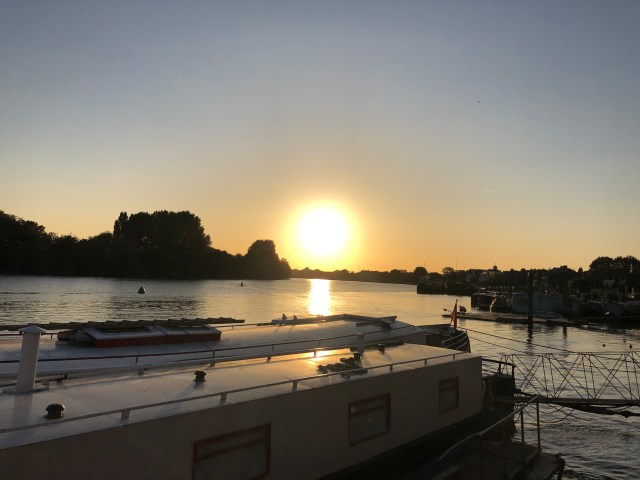
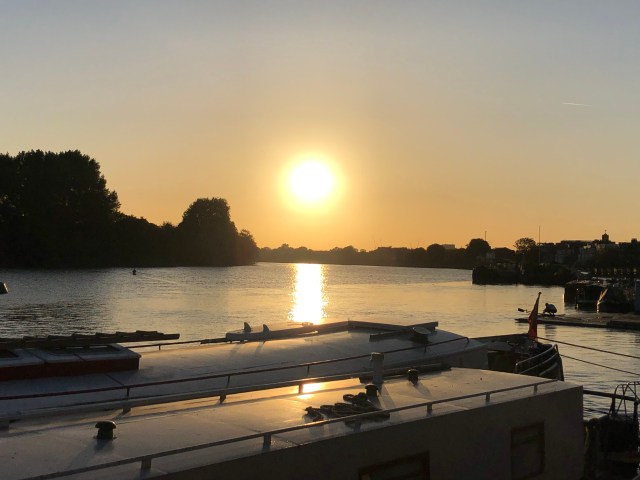
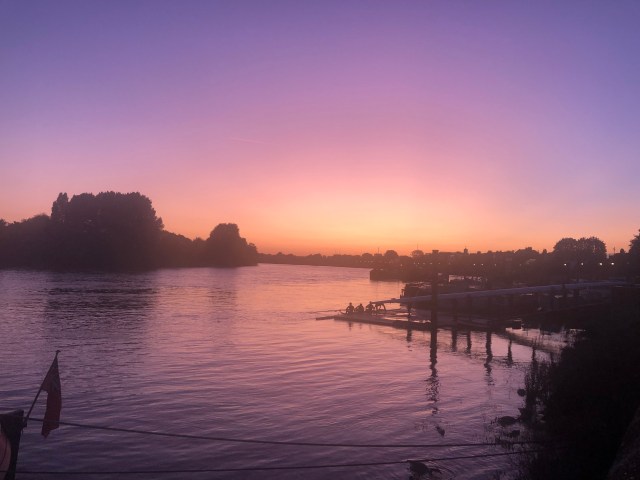
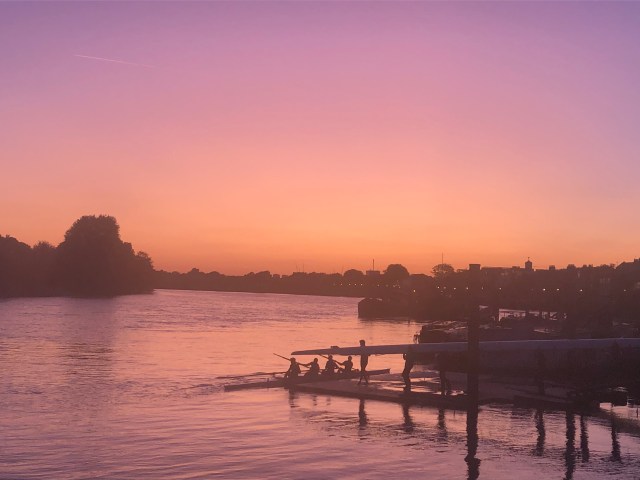
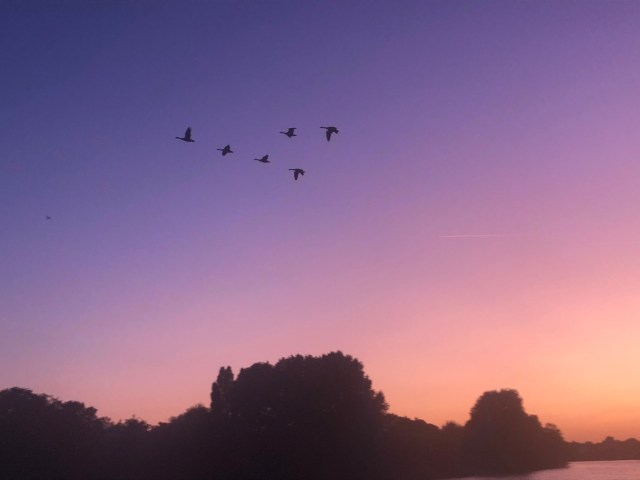
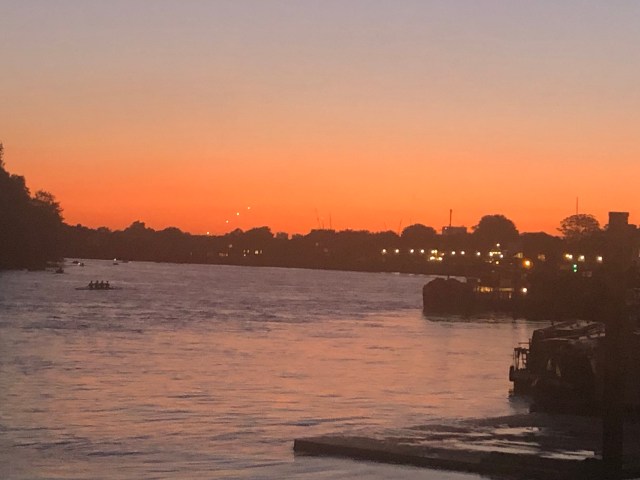
Yesterday I had a couple of beers with my friend Jon E at the Rutland Arms, on the river by Hammersmith Bridge. The sun was beginning to set as we arrived at 6.30 and had slipped behind the trees by the time we moved on. I’ve photographed this scene many times, but I did love the change in colours last night over quite a short space of time. It had been a sunny and windless day and there was a bit of haze. Aka smog, but we won’t worry about that just now.

The photos are in sequence, though it looks like the second should be the first. That’s just a trick of the camera as I zoomed closer to the sun on the second, and it seemed to rise and get smaller!

Posted in Photos - lovelondonscenes | Tagged , , , , , | 4 Comments