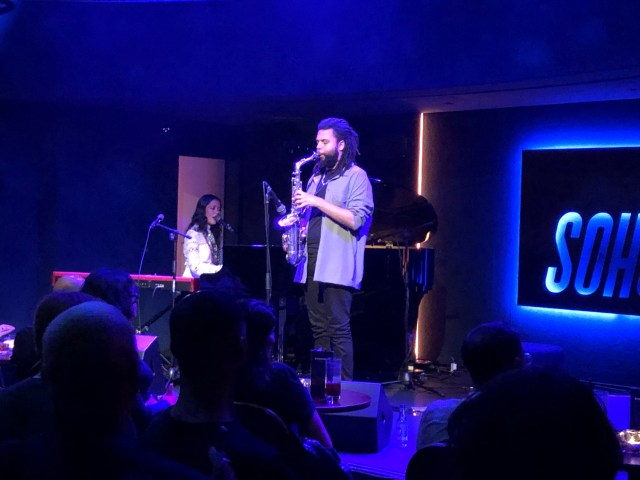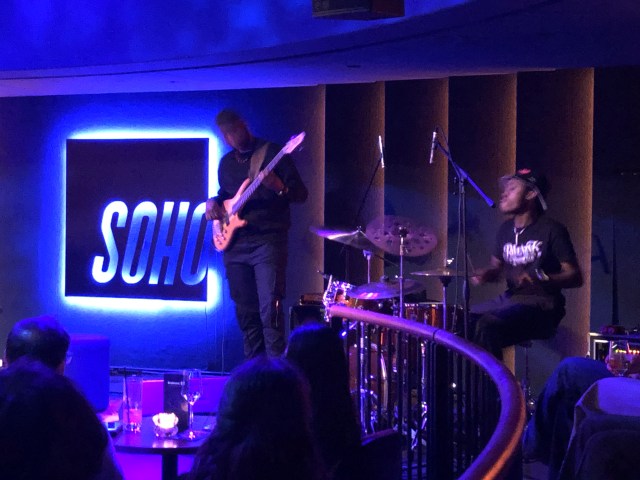
Music Roundup 03: 24 May to 22 June 2023

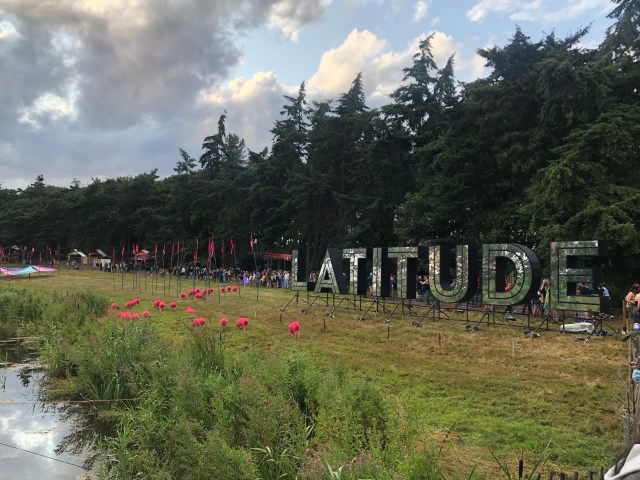
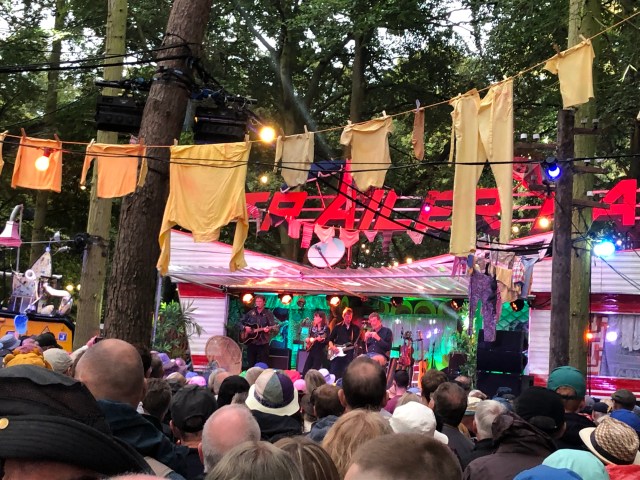
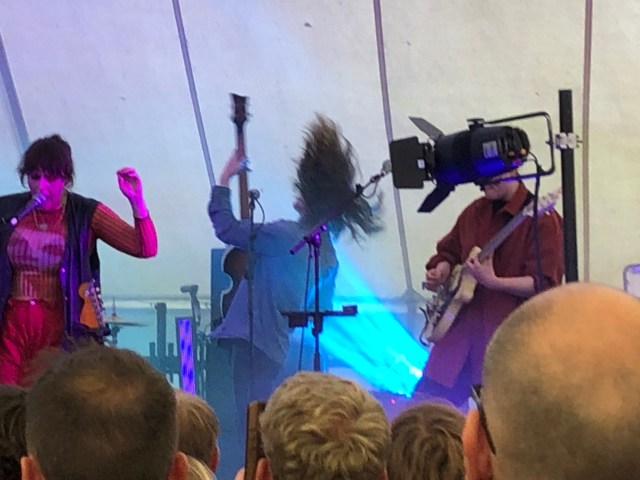
Featured this time: Glastonbury (on TV); Alvvays; Arooj Aftab, Viyay Iyer and Shahzad Ismaily; Wednesday; Kokoroko; Emmeline, BINA and Tendertwin; The Beat, Bow Wow Wow and London Calling (Clash tribute band); and Matyas Gayer (jazz pianist)  

Seven concerts to report in this latest roundup. Add to that Wide Awake festival, which I reviewed separately, and just this weekend, Glastonbury festival – courtesy of the BBC – and it has been an interesting month of music.

Let’s start with a few observations on Glastonbury. We all know what a great festival it is. Never been myself – the scale of it seems too vast, and it’s difficult to get tickets anyway. I’m happy to sit back, watch a few shows live and catch up with the rest on the BBC2 highlights and the iPlayer. I didn’t watch a lot of shows in real time this year, but I did see all the Pyramid headliners:

Arctic Monkeys on Friday were a bit of a mixed bag – the recent stately ballads and bar room crooning don’t really do it for me, though I did like 2007’s 505, which they played towards the end of the main set. And the performance was interspersed by plenty of the old favourites like Do I Wanna Know, Mardy Bum and best of all I Bet You Look Good on the Dancefloor in the encore. So really, fair play to them, taking new directions but without shunning past glories.

Saturday was the turn of Gun’n’Roses, which seemed an odd choice of headliner. I think this may have been the night when the organisers were hoping to get Taylor Swift – next year maybe? Many would argue that Gun’n’Roses are a bit past it, a caricature. But I have to say I really enjoyed the show. It rocked big time, with Slash imperious on guitar. All the favourites were played as far as I could tell – I was never a massive fan. And it’s hard to beat Sweet Child o’Mine as a rock anthem. Other highlights for me were Welcome to the Jungle, Knocking on Heaven’s Door and the closer Paradise City, with everyone’s favourite rocker, Dave Grohl, guesting. An unexpected delight, this one.

A more expected delight was Elton John on the Sunday. His last ever gig in the UK? Yeah, maybe! But if it was, what a way to go out. A magnificent journey through the best of his back catalogue. As a teenager in the 70s I was never much of a fan of Elton, though I usually quite enjoyed the singles; but I have come to appreciate the quality of so many of his songs, particularly those from the 1970s. Some of the best pop music of all time. Highlights for me were Bennie and the Jets, the sequence of Your Song and Candle in the Wind – fully back to Marilyn – and the final two: Don’t Let the Sun Go Down on Me and Rocket Man. Throughout Elton displayed his love of music and his fellow artists – there were no silly antics, just very fine music. The guest appearances generally didn’t add much, but again they showed his inclusivity and generosity of spirit. A Glastonbury classic.

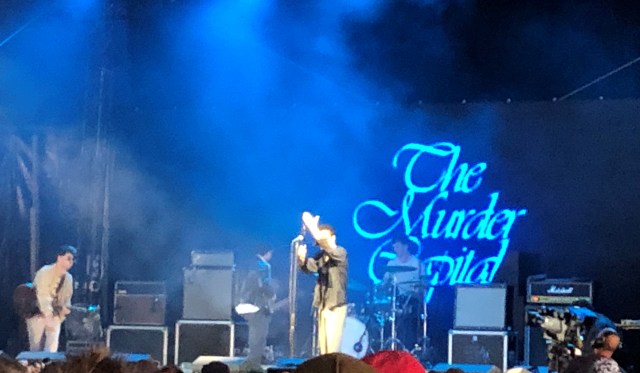
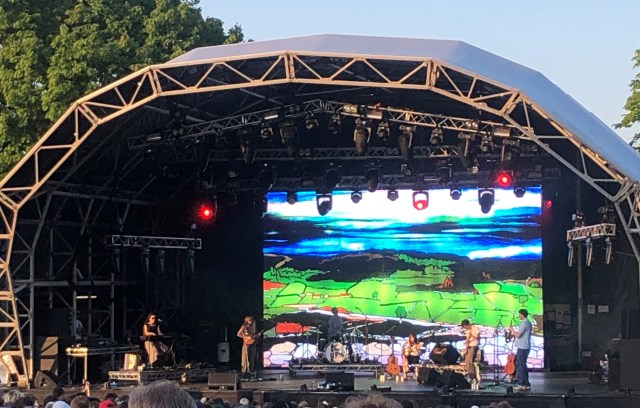
Through the weekend I’ve also caught up a few of the shows I most wanted to see. Best of all, I think, was The Murder Capital in what is now called the Woodsies tent – the old John Peel tent. I thought their performance was breathtaking – the one most likely to emulate Turnstile from last year, which I ended up watching five times! Jockstrap were excellent on the Park Stage on Saturday, though the Glasto afternoon crowd didn’t sing along quite as much as the Wide Awake audience. The Comet is Coming were awesome on the same stage on Friday. Shabaka Hutchings’ sax playing is truly a thing of wonder. And The War on Drugs were predictably superb on the Other Stage on Sunday, with the closer Under the Pressure as epic as ever. Lots more still to see, including Chvrches, Ezra Collective, Black Country New Road, Loyle Carner and Queens of the Stone Age. And I guess it’ll be hard to resist seeing how Blondie, the Pretenders and Generation Sex fared. Punk/new wave is now a nostalgia business!

The late night highlights programmes on BBC2 were as good as ever too. One band that really shone on their rooftop live appearance was The Mary Wallopers – Irish folk-punks, which immediately makes you think of the Pogues. They’re on at both Latitude and End of the Road so I’ll definitely be looking them up later in the summer.

The iPlayer shows are available for 30 days, so catch up while you can!

Onto the concert roundup then, starting with one that came just before Wide Awake.

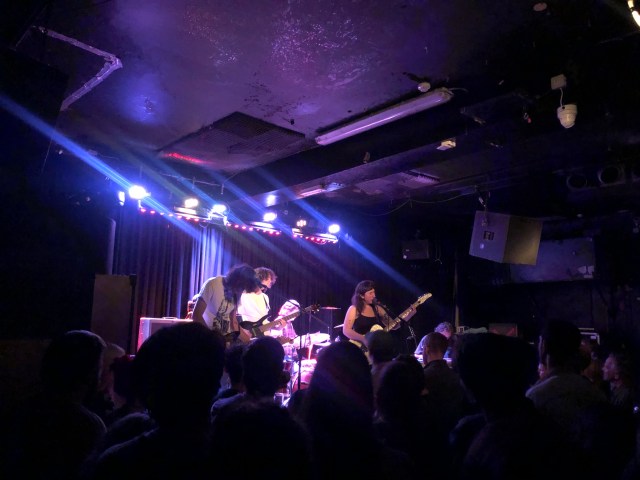
Alvvays at the O2 Forum, Kentish Town, 24 May

Back in 2018, I loved the sound of Alvvays, having seen them at End of the Road the previous year. They played a triumphant gig at the Roundhouse in February 2018, when the singalongs to Dreams Tonite and Archie, Marry Me were amongst the best I can remember. But then they disappeared from view, and only re-emerged last year, with a new album, Blue Rev, which didn’t really grab me. A bit of the Blondie/Elastica punkiness was gone and the melodies weren’t as memorable. It grew on me a bit, and I was happy to go along with friends Dave and Gordon to catch them at the Forum. We had some excellent cheese and charcuterie with some very decent wines beforehand at Authentique wine bar and epicerie up near Tufnell Park tube station; and to be honest, that turned out to be the highlight of the evening. The gig was fine, but not very exciting. The new material dominated, and it all seemed a bit routine and samey. When they played Dreams Tonite it took me a while to realise they were doing so; and while Archie lifted the spirits a bit, it didn’t feel anthemic in the way it did in 2018. Was it them or was it me? Or indeed, was it the effect of Authentique? I blame Gordon…

Arooj Aftab, Vijay Iyer and Shahzad Ismaily at the Barbican, 2 June

This is a bit of a ambient jazz supergroup. They first came together in 2018 and apparently played some live shows based on improvisation. This year they released an album called Love in Exile, a beautiful meditative work that combines the music of south Asia with modern electronica. Arooj Aftab is a singer and musician who released a wonderful album called Vulture Prince in 2021 – a jazz fusion with music from around the world. A track from that album, Mohabbat, won a Grammy in 2022. Vijay Iyer is a renowned jazz pianist and keyboard player. I saw him play at the Queen Elizabeth Hall in 2021 – the show was mesmerising. Shazad Ismaily I hadn’t come across, but he is an acclaimed bassist and synth player.

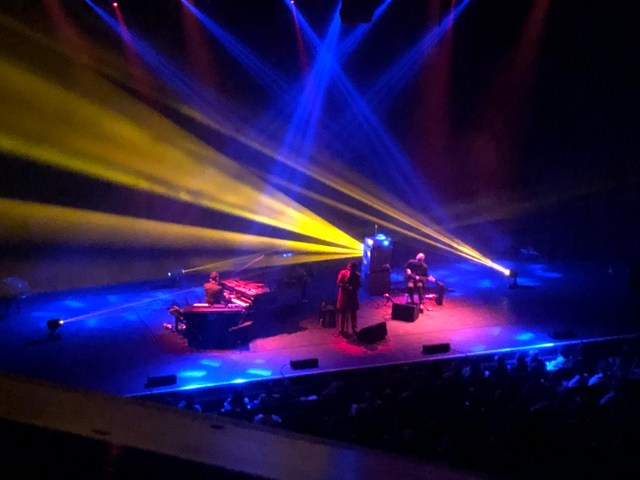
We were six for this show, and continuing the French dining theme, we ate beforehand at a great restaurant called Café du Marché on Charterhouse Square. The joke was that after the fine food and wine, there’d be some snoozing during the performance as the mellow sounds wafted around the hall. That proved correct in certain cases, but certainly not in mine, nor Jon’s. We were agreed that it was a completely engrossing hour and a quarter. Indeed, Jon described it as an intense experience. The show was based on Love in Exile. Arooj Aftab’s vocal were pure and resonating, spiritual even. But she had time for humour in between songs, contrasting London and New York, where she is based. Vijay weaved his magic spells on piano and keys, with some astonishing sequences of virtuosity. A dream-like atmosphere interspersed with those moments of intensity. And Shahzad Ismaily created subtle, unobtrusive but vital beats that underpinned the whole thing. There were no drums – they weren’t needed. This was music on a higher plane – to luxuriate in. And even to shut your eyes and drift away…

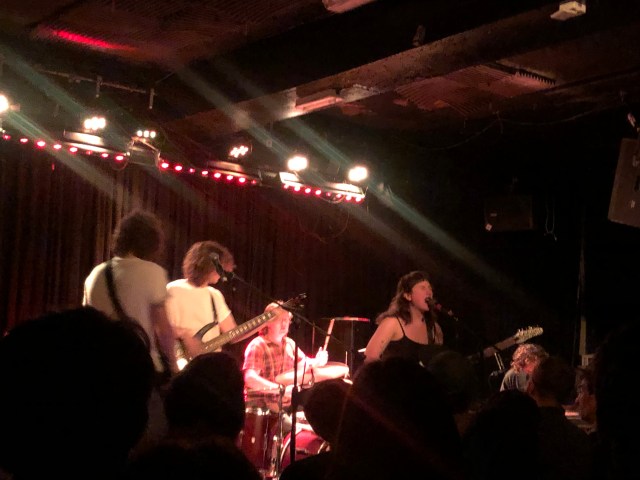
Wednesday at the Lexington, 6 June

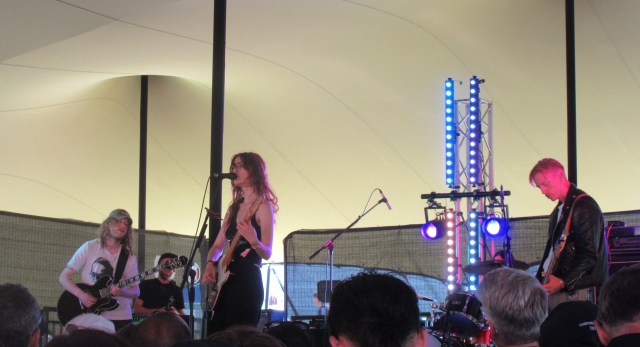
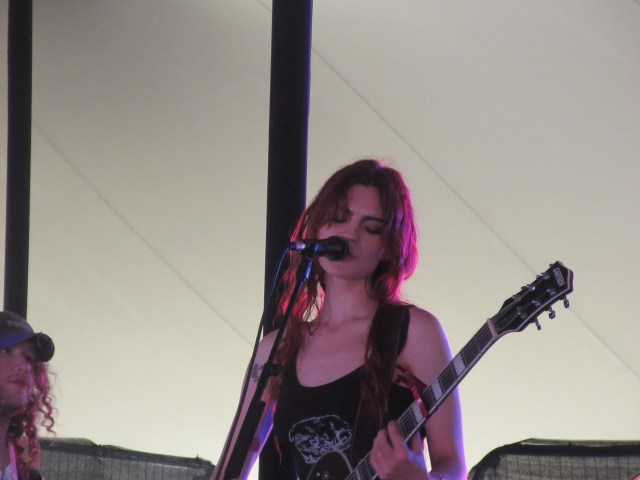
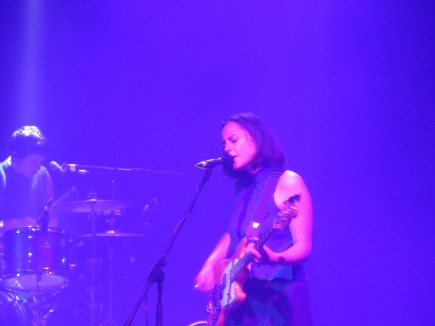
Wednesday are my latest new favourite indie band. They are from North Carolina in the US and are fronted by singer/guitarist Karly Hartzmann. Their music is a collision of grunge and shoegaze with country and Americana. Only in America! I have the Spotify algorithm to thank for introducing the band to me. I’d been playing some country music, probably Kacey Musgraves or Lindi Ortega, when the album ended and a song called How Can You Live If You Can’t Love How Can You If You Do came on. Bit of a mouthful that! But what a lovely wistful song. I had to hear more and checked out the 2021 album Twin Plagues which that song was on. To my surprise country didn’t feature all that much; instead there were raging guitars, reminding me sometimes of Nirvana, occasionally of Neil Young, and in one particular case, One More Last Time, My Bloody Valentine. My favourite song was Birthday Song, which combined a listless melancholy with bursts of those angry guitars. It seemed to encapsulate a mood which would have been so prevalent in the pandemic, and coming out of it. Later I listened properly to the lyrics and realised they were memories of Karly’s about taking LSD at school and someone breaking his foot! A good example of why listening too closely to lyrics doesn’t always pay. Hasn’t stopped me loving the song though – just makes it even more of a mish mash of feelings.

A new album, Rat Saw God, came out this year. And it is good! More Americana, a bit less grunge, though the second track, Bull Believer, is brutal, with Karly howling at the end. And then – at last! – they announced they were playing a few gigs in the UK as part of a European tour. The London gig was at the Lexington on the Pentonville Road. Capacity about 200, so I snapped up a ticket as soon as I heard. The gig was sold out – mostly people in their 20/30s, dress code mostly quite scruffy. Plaid shirts were in evidence! The band came on and rocked out from the start. And they really seemed to be enjoying themselves – smiles all round rather than the traditional indie nonchalance or scowl. Karly told some stories and laughed a lot. A few songs in she announced that they were going to do some country music. It was Chosen to Deserve from the new album – more Lynyrd Skynyrd than country, but a great song. One of my favourites of the evening along with Quarry, also new and also in the Americana mode. My favourite country style ballads – How Can You Live etc and another new one called Formula One – didn’t feature; nor did Birthday Song. But I loved the set – great raging guitars throughout. Last song was inevitably Bull Believer, and I feared for Karly’s voice if she is performing that sustained shriek every night.

The concert lasted just over an hour and it was one of those I really wished would go on longer. It was only 10.15, so I went down to the pub for another beer before making my way home – with Wednesday on the iPhone of course!

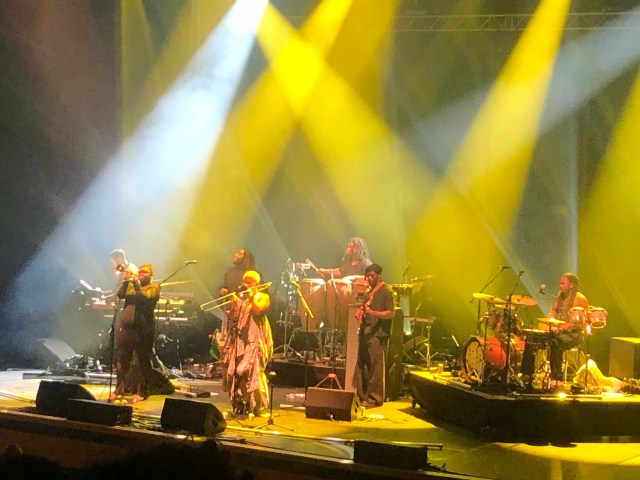
Kokoroko at the Royal Festival Hall, 14 June

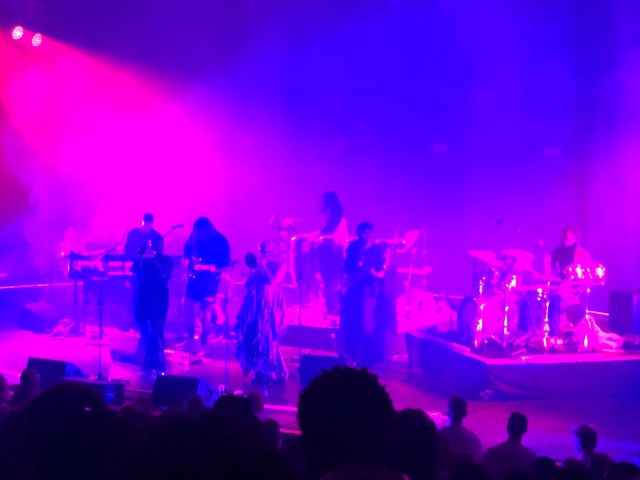
This concert was part of the annual Meltdown festival at the Southbank, which was curated by Christine of Christine and the Queens this year. I thought it would be nice to go along to something, and Kokoroko seemed just right for a summer’s evening. They are a London-based collective who play what you might describe as Afro-jazz-funk. It’s lovely upbeat music. I saw them play at Green Man festival a couple of years ago. They were on the main stage and I was just passing by, but their rhythms were so infectious that I stayed and watched for a while. I made a mental note to try and catch a full show sometime.

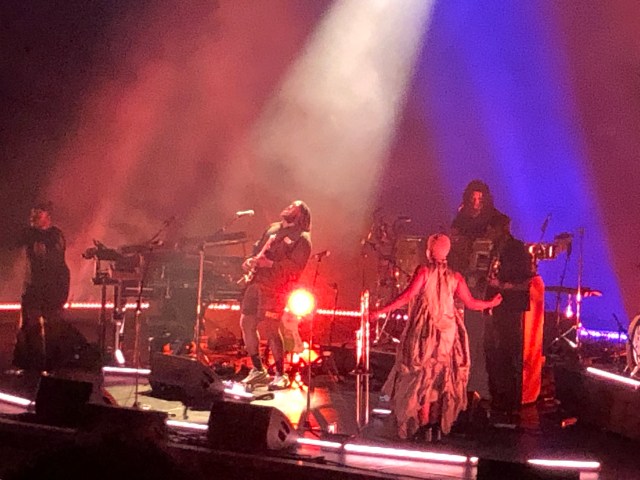
Kath and I had a bite to eat at Brasserie Blanc then headed up to the river for a beer before the show started. It was a beautiful sunny evening and the Southbank was buzzing. One of those love London moments. The concert was scheduled to start at eight; in the event the band came on at 8.20 and played until ten. And it whizzed by. Those infectious rhythms very much in evidence again. But there were some silky ballads too, embellished by the trombone and trumpet of the two vocalists, two women. And, to my surprise and delight, there were some searing guitar solos too. I think the guitarist was displaying his love of Prince as he hit the heights.

Overall, the songs were fairly mellow to start and the tempo built up over the concert. For the last few songs just about everyone was up out of their seats and dancing. The African influences were at their strongest in the dance tunes. Right at the end the tempo came down again with a lovely slower piece, which may have been Ti-De from their 2019 debut EP Kokoroko. It featured some beautiful cornet-playing* by the trumpeter. A new song finished the show – sounded good. It was a simply joyous show.

And those City lights looked wonderful as we crossed Hungerford Bridge on the way back to Embankment station. Yep, love London.

*Other possibilities are French horn or pocket trumpet.

Emmeline at the Roundhouse Studio Theatre, 15 June

The day after Kokoroko it was up to north London to see poet-rapper Emmeline. This was a speculative one – I’d only come across her a week or so beforehand when I heard her being interviewed on Cerys Matthew’s Sunday show on 6 Music. She talked in an interesting way about her poetry and music, which is apparently described as slam poetry – a new one on me! She played one song on Cerys: Sabrina. I liked it so had a look at what she had on Spotify. There were a few singles, some of which were pulled together in a 2022 EP, Satellite Navigation System, and a new single called Small Town Girl. An easy comparison would be with Kai Tempest, but less intense and downbeat than Kai is these days. I could hear a bit of early Biig Piig too. I put the songs on a playlist, and when that came to an end the Spotify algorithm came up with Pip Millett, which was interesting.

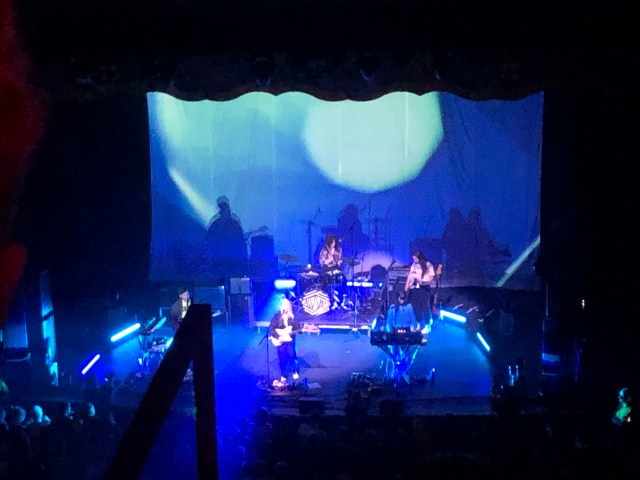
Cerys mentioned that Emmeline was playing at the Roundhouse’s Last Word festival, a vehicle for up-and-coming performers. Tickets were only £8, so I thought I’d give it a try. The venue, which probably holds 150-200 standing, is a pleasant, airy space – I saw Gretel Hänlyn play there at the Pitchfork festival last year. I got there in time for the two support acts. The first was a duo billed as Tendertwin. In fact that’s the stage name for the singer/guitarist Bilge Nur Yilmaz. She was born and raised in Istanbul, but has spent time in Philadelphia, London and now Oxford. She was accompanied by a cellist, which gave the music a feel of Nick Drake – no bad thing. There were only about twenty of us in the room for this show, but there was no sense of disappointment – they gave a very committed and accomplished performance, which was well-appreciated by the select audience.

Tendertwin

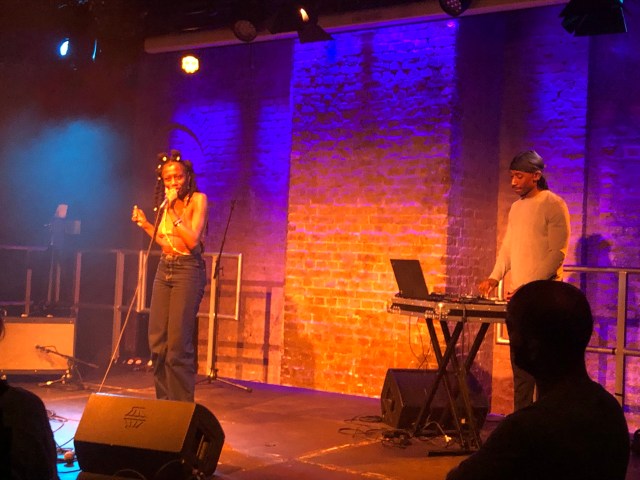
Second on was BINA. She’s a south London soul-jazz artist. She was accompanied by an unassuming guy on keys/laptops who provided the music as she sang. I liked her sensuous soul sound a lot and she had a strong stage presence. She received an enthusiastic reception from the crowd, which had grown to 50-60 for this show.

BINA

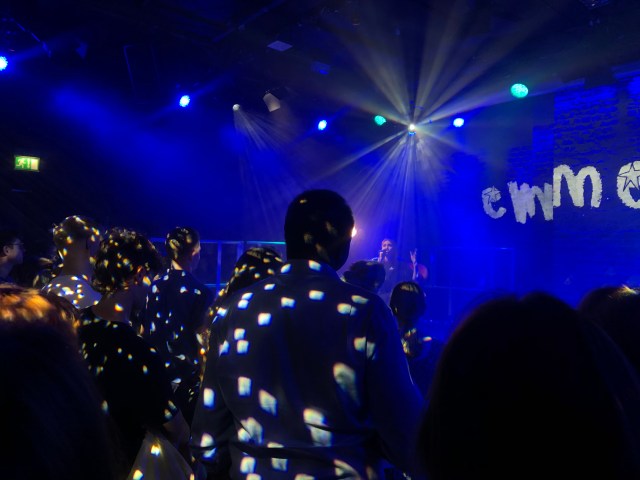
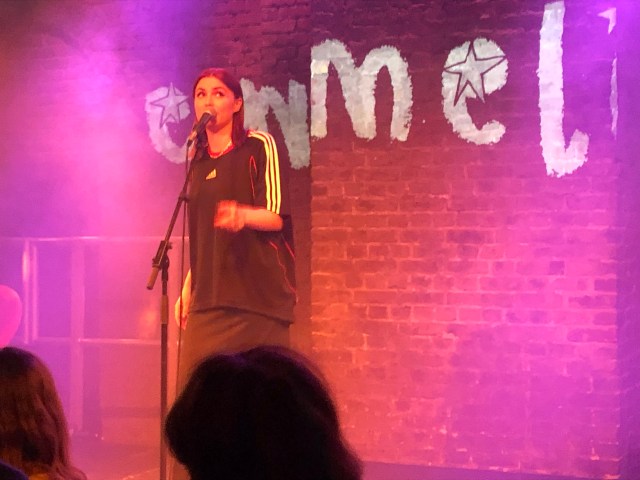
And then, after the break, it was time for Emmeline. The show was sold out, I think – there were a lot of people in the bar beforehand. I bought a beer and went back in early to get a decent spot – tall last minute arrivals permitting! Soon after I returned a group of people about my age came in and stood near the back. One of them looked remarkably like the Poet Laureate Simon Armitage. I remembered that Emmeline had mentioned rather coyly on Cerys that her parents were poets. It was easy to put two and two together – it was him. The room started to fill up and a lot of people seemed to know each other. This was Emmeline’s first headline show, I think, and it was fair to assume that family, friends and colleagues had turned out to support her. It made for a really good atmosphere during the show. And Emmeline came bouncing on and delivered a lively, punchy set of songs, in a hip hop style for the most part.

Emmeline

The beats were played from the mixing desk as Emmeline covered every inch of the stage. Sabrina and closer Small Town Girl were highlights, and I liked the defiant Girls Write Rhymes. As I write this it did occur that while it’s ostensibly about the male-dominated business, there might be a gentle message to her Dad too. Just before the show started I found myself standing next to Simon and a friend, who’d come up and spoken to me earlier about the book I was reading (Tracey Thorn’s excellent My Rock’n’Roll Friend). So I took the opportunity to say to him, “You must be proud.” “And nervous too,” he replied!

A really enjoyable evening – three very talented young artists. And a rousing performance from Emmeline. I’m sure her connections won’t do any harm to her prospects; equally she won’t want to make a big thing of it, I’m sure.  As she sang, girls write rhymes too.

The Beat at the Roundhouse, 16 June

Can’t get enough of the Roundhouse – I was back there the next day! This time in the main hall for a bit of late 70s/early 80s nostalgia. Brummie ska-pop band The Beat supported by Bow Wow Wow of Go Wild in the Country fame. Or so it was originally advertised: on the day we had a very welcome bonus – renowned Clash tribute band London Calling.

There were three of us for this one; me, Jon E and another university friend, Jon L. The Three Johns – there was an indie band of that name in the early 80s! Being in Camden we had to eat at Sushi Salsa by the lock of course. An old favourite, and as good as ever. We made sure we finished in good time to see, we thought, Bow Bow Wow. In fact it meant we got to see the whole of London Calling’s set. And a very good thing that was too! They were excellent, playing with a passion and quality that did the Clash proud. The Clash are one of my favourite bands of all time, so this was an unexpected delight. I made a note of the songs they played. This isn’t in exact sequence, though they did open with Tommy Gun and ended with a rousing White Riot. Ah the memories!

Tommy Gun – Safe European Home – Stay Free – English Civil War – Clash City Rockers – Complete Control – White Man in Hammersmith Palais – Should I Stay or Should I Go – train in Vain – London Calling (of course) – White Riot.  

Quite a strong emphasis on the second album Give ‘Em Enough Rope and the singles which followed the eponymous debut album. I loved it and will be looking out for when they next play in London.

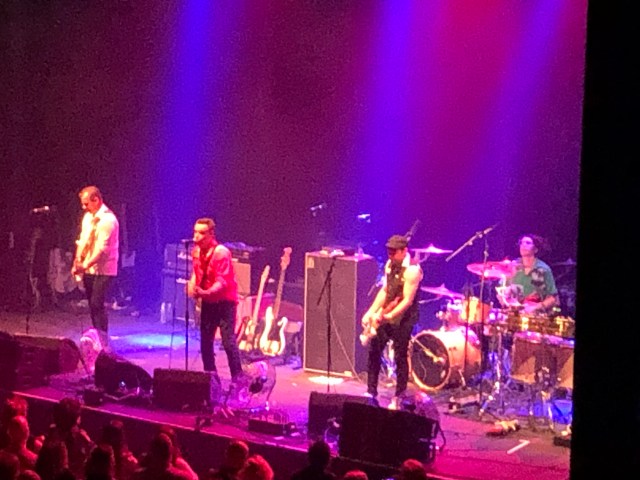
London Calling

Bow Wow Wow were an early 80s Malcolm McClaren creation. The sound combined punky guitars and African drums. They were fronted by Annabella Lwin, who was 13 when they started. Others were members previously of Adam and the Ants, who also had a heavy drum sound. They didn’t exactly set the world alight, but had one or two catchy hits, notably Go Wild in the Country, C30 C60 C90 Go (for any younger readers they were cassette lengths) and I Want Candy. Their first incarnation didn’t last long, but there have been various reformations. Tonight they were a three piece: Annabella, now in her 50s and really giving it some; a guitarist who looked like he’d been in ZZ Top and created a wall of sound; and a very rhythmic drummer who played her drums standing up. It was an enjoyable set, with Annabella exuding positivity. C30 C60 C90 Go kicked things off, Go Wild in the Country livened up the half way stage, I Want Candy ended the show. Half an hour and they were off – no overstaying their welcome.

Bow Wow Wow

The Beat were part of the Two Tone movement, although they were only briefly on the label. Their first single, in 1979, was an uptempo cover of Smokey Robinson’s Tears of a Clown. It got to No 6 in the charts. Their biggest hit was Mirror in the Bathroom which reached No 4. Their first album I Just Can’t Stop It came out in 1980, and was a modern ska classic, with pop and rock elements and a lounge crooner, Andy William’s Can’t Get Used to Losing You. One of the songs, Whine and Grine/ Stand Down Margaret had a real political resonance, and despite the specific references to Thatcher, has stood the test of time. It still had a lot of the crowd singing the chorus tonight: there’s still a Tory government we want to see the back of. The original band didn’t last that long – they managed three albums between 1980 and 82. Later the band split into two: one, known as the English Beat in the US, was headed by Dave Wakelin, original singer, guitar and writer of the songs. The other was fronted by Ranking Roger, who was the original band’s toaster (a reggae version of rap – pre-dating and influencing it). A few of us saw the Ranking Roger version of the band in 2015 at Under the Bridge, a venue at Stamford Bridge, home of Chelsea FC. It was a lot of fun. Sadly Ranking Roger passed away in March 2019.

Tonight this was The Beat with Dave Wakelin in good health and spirits. And what a celebration it was. All the hits – except Can’t Get Used to Losing You – and more besides. We had seats, but it was amusing to watch all the balding geezers below in their Fred Perry T-shirts getting on down. There was even some moshing towards the end. And the reggae/ska roots of the band were palpable.

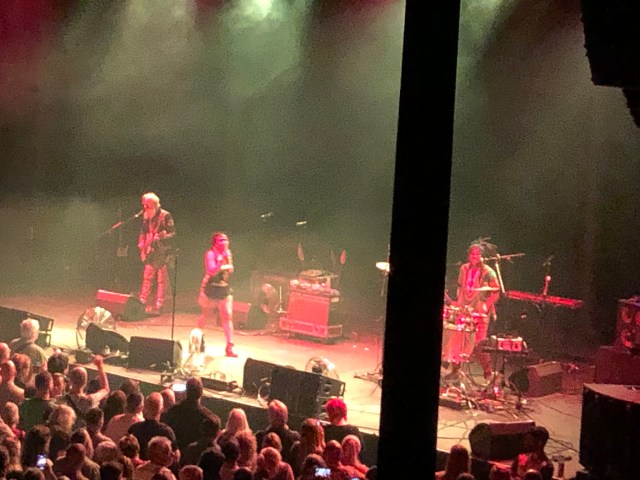
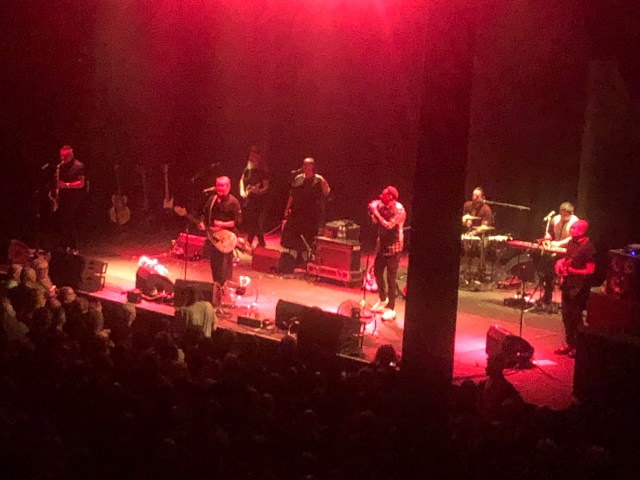
The Beat

A number of ex-band members have passed away in the past few years, and Dave paid tribute to them all, including Roger. Old enmities forgotten. We loved this band back in the 80s, and the three Johns have a treasured memory of them headlining the University College ball in the summer of 1980. As incongruous a combination as you could imagine, but it worked a treat!

So yes, this was a great trip down memory lane. Afterwards Jon E and I felt like continuing the celebrations for a while and stopped at the Oxford Arms on the way back to Camden Town tube. We didn’t get out of there until one o’clock. At one point a couple of lads in their early 30s – I know this because they told us – came up to us and asked if we’d been at the Beat. What made them think that? Obvious – we were the oldest people in the place and I too had a Fred Perry T-shirt on! They’d been there too and we had a good chat about the concert, music, football. All the unifiers. And then the night tube took us home. Did I say I love London earlier?

Matyas Gayer at St Mary’s Perivale church, 22 June

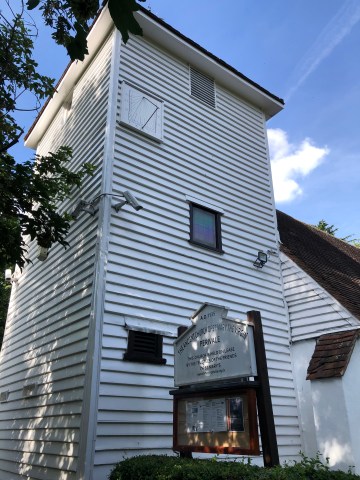
Hosting concerts is good business for churches all over London. Recently Kath heard about those at St Mary’s Perivale. The church is in North Ealing, sandwiched between the A40 and Pitshanger Park, and surrounded by Ealing golf course. The River Brent runs nearby. I’ve cycled and walked past it so often without realising that it puts on music. Part of the church dates back to the 11th and 12th century, and unusually it’s partly clad in white timber. There’s almost a look of an old watermill to it from the outside. Most of the music is classical, but once a month there is jazz. The concerts are free, but donations are encouraged, as it is all self-financing.

St Mary’s – didn’t take any photos inside

There was some jazz on the 22nd, so Kath and I decided to go up there and see what it was like. It featured a jazz pianist called Matyas Sayer. He is Hungarian, but has settled in London and has played with all sorts of jazz luminaries. He played for an hour – mostly improvisations based on pieces by notable jazz pianists from the past and present. One example was Thelonius Monk’s classic Monk’s Dream. He also played a lovely version of  Chopin’s Nocturne in E Flat Major. I’m not a great classical expert, but I have always thought that a lot of Chopin’s music leads you into jazz, and this confirmed it. The church is beautifully decorated inside and has a Yamaha piano on the stage, which Matyas purred over. It was a lovely way to spend an hour on a Thursday afternoon. We’ll be going back for more.

Matyas has a 2018 album (a trio with bass and drums) called Never Ending Story. I bought the CD afterwards, and have been enjoying it since. It’s on Spotify if you want to listen. He has a new album out soon, I think.

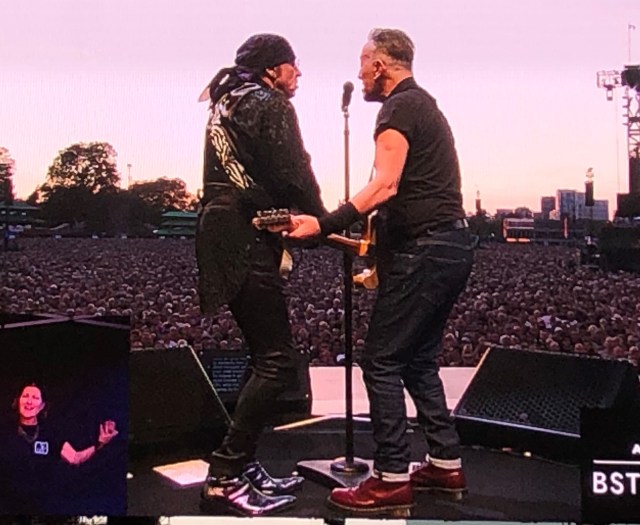
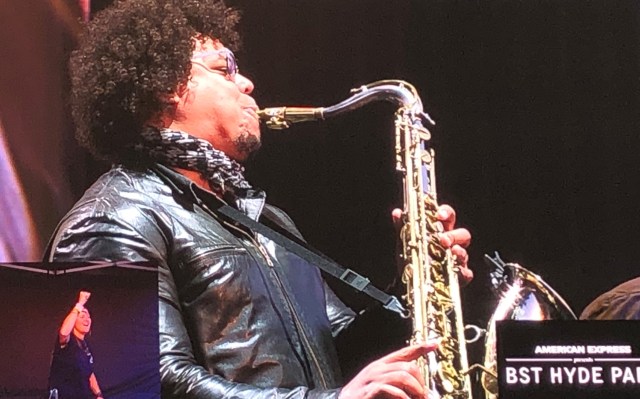
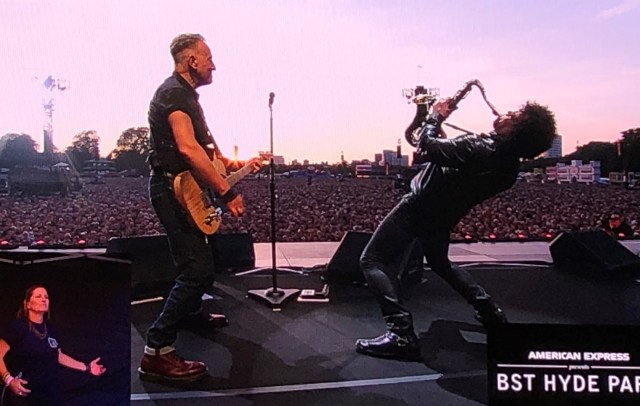
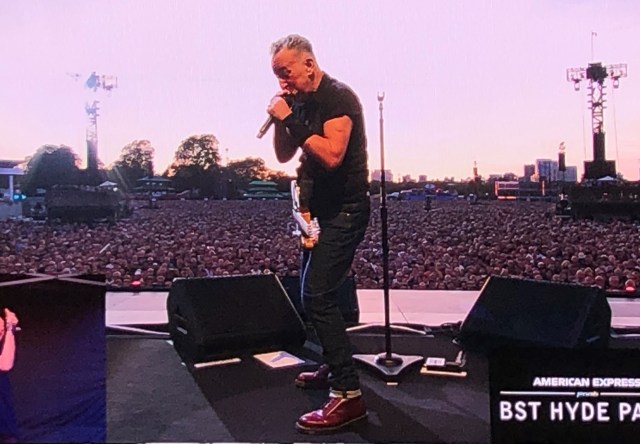
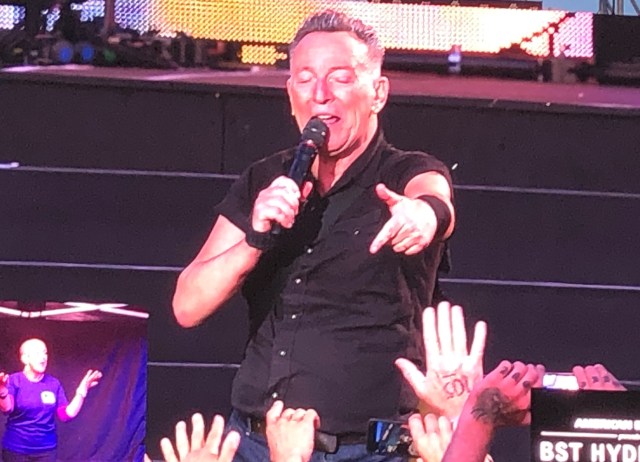
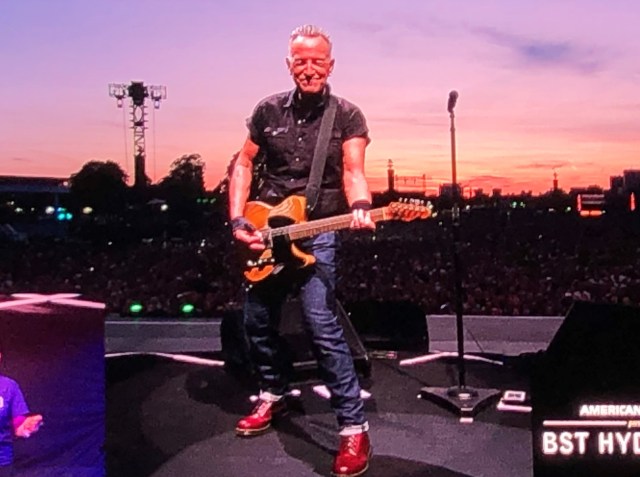
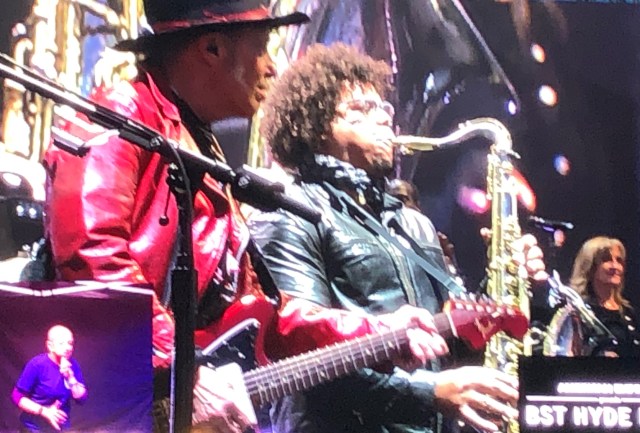
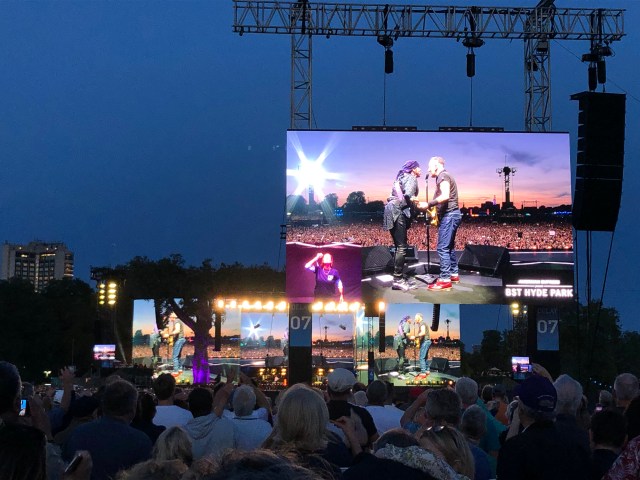
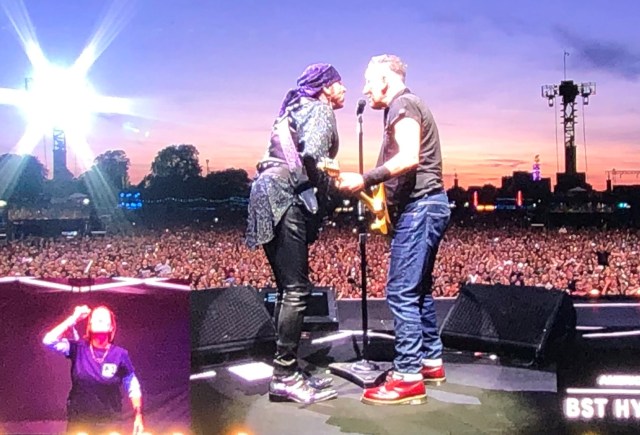
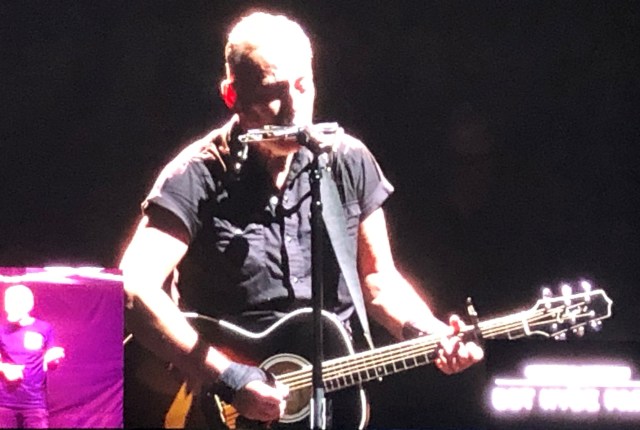
So that’s it for now. Next up is a trio of nostalgic concerts, the first of which is the Boss himself, Bruce Springsteen on 6 July. That’s followed by Southside Johnny and the Asbury Jukes the next day. Might Bruce and/or Steve van Zandt make a guest appearance? And then a couple of days later, its Daryll Hall  – minus John Oates but plus Todd Rundgren. Bring it on!

Posted in Music - concerts, lists, reflections | Tagged , , , , , , , , , , , , , , , , | 4 Comments

Sportsthoughts (173) – those 2022-23 Premier League predictions

So the season ended with Man City beating Inter Milan 1-0 to win the Champions League for the first time, as well as the Premier League and the FA Cup. The treble – only won once before, by Man Utd in the 1998-99 season. I’ll leave it to the Mancs to argue which one was better, because, you know, I don’t care!

I have a lot of admiration for Man City, because of the quality of their football – though Inter disrupted that in the final and had the chances to win – and because Pep Guardiola is a brilliant manager, and along with Arsène Wenger before him, has revolutionised English football. But I’m worried. The Man City machine is now consuming all before it, including four Premier League titles out of the last five. We are in danger of becoming like Germany, where Bayern Munich win it every year. Although Borussia Dortmund came incredibly close to winning it this season, Bayern still prevailed. The danger is that every other club becomes a bit fatalistic, setting their sights on a top four place in order to qualify for the Champions League, but no more.

That said, Arsenal gave it a good go this season, before a sloppy run of draws eroded their one-time eight point lead and their confidence ebbed away. They were also well-beaten by City in both their head-to-heads. So the best team won again – as it always does.

The predictions didn’t work out so well this season. But it was a good thing. The established Big Six order got a bit of a shaking up. And none of the teams promoted from the Championship went straight down again – that is very rare.

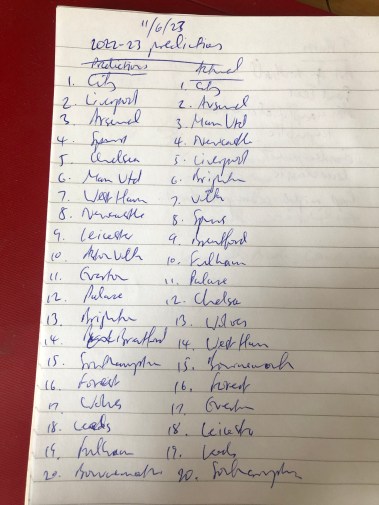
So here are my predictions, with the outcomes in brackets. I only got two spot on: Man City as champions, which hardly took much foresight; and Nottingham Forest in 16th. That’s random; but at least I was right in predicting they wouldn’t be relegated, which a lot of pundits thought was likely.

Winners: Man City (winners); 2. Liverpool (5th); 3. Arsenal (2nd); 4. Tottenham (8th); 5. Chelsea (12th);  6. Man Utd (3rd); 7. West Ham (14th); 8. Newcastle (4th); 9. Leicester (18th); 10. Aston Villa (7th); 11. Everton (17th). 12. Crystal Palace (11th); 13. Brighton (6th); 14. Brentford (9th); 15. Southampton (20th); 16. Nottingham Forest (16th); 17. Wolves (13th); 18.Leeds (19th). 19. Fulham (10th); 20. Bournemouth (15th).

Let’s run through each team, in order of predictions, with numbering prediction/outcome.

1/1. Man City: Bit wobbly before the World Cup break; a relentless machine feeding the goal monster Haaland throughout. Grealish back to his best. John Stones reinvented as Franz Beckenbauer. They kept going, Arsenal cracked.

2/5. Liverpool: Erratic season. Beat Bournemouth 9-0 and Man Utd 7-0 in the craziest result of the season. But had some surprising home defeats. Hit by injuries up front, missed Mane, didn’t replenish their midfield when it was clearly needed. Trent had an existential crisis in defence, but was amazing in midfield at times. Some serious re-thinking needed. Has Klopp still got the burning desire? We shall see.

3/2. Arsenal: objectively a fantastic season, coming second after a few years outside the top four. Subjectively, gutted at not winning the League after being eight points ahead of City in March. It all went wrong in April: draws against Liverpool and West Ham – 2-0 up in both of those – and Southampton (the worst team in the league) and a 4-1 defeat to City. But before that they were magnificent – transformed from last season. The two buys from Man City – Jesus and Zinchenko – hugely boosted confidence early in the season. Saka, Martinelli and Odegaard reached another level. Saliba, back from Marseille, made the defence a different proposition. Ben White was brilliant at right back, Ramsdale in goal made everything alright. City’s relentlessness got to them in the end, but if they get Declan Rice from West Ham, another striker and centre back, they might just go all the way next season.

4/8. Tottenham: Unlike many West Ham fans I’m not a Spurs hater, but they were farcical this season. Manager Conte was frustrated at the lack of investment – he usually is – and eventually flounced out. (In fairness, he also had some personal health issues and lost some very close friends – football managers are ordinary people too). His deputy, Stellini took over for a while, then coach Ryan Mason. Meanwhile, the team floundered. Harry Kane brilliantly still scoring 30 goals; but no-one else excelling. Surely he must leave?

5/12. Chelsea: If Spurs under-achieved, how do you describe Chelsea? Under new chair Todd Boehly they spent some phenomenal sums – more than the German, Spanish, Italian and French leagues put together. They gazumped Arsenal for the Ukrainian Mudryk. Manager Thomas Tuchel was sacked early on. They brought in Brighton’s Graham Potter. Great reputation – future England manager. Couldn’t cope with the Chelsea madness and was out by April. Unbelievably, Frank Lampard, who’d been sacked by Everton, was brought back. He lost a string of games, including in the Champions League. They ended 12th with only 44 points – four above West Ham, ten above relegated Leicester. They have now appointed Mauricio Pochettino as manager. They have an incredibly talented squad. So next season the only way is up.

6/3. Man United: had a shambolic 2021-22 season, and despite the appointment of Erik ten Hag as manager, I wasn’t convinced this season would be a whole lot better. Ronaldo was still there, thinking only about Ronaldo, overshadowing Bruno Fernandes, who’d been star player and talisman before Ronaldo arrived. They had a poor start, losing at home to Brighton and being thrashed 4-0 by Brentford. But then they won four on the trot, including games against Liverpool and Arsenal. And then Man City hammered them 6-3!  Things settled down after that, though they did lose 7-0 to Liverpool at Anfield in March – probably the most remarkable game of the season. The crucial development in the season was Ronaldo leaving by mutual consent in November. Thereafter the team could breathe; Ten Hag’s authority wasn’t being constantly challenged. Marcus Rashford hit a great scoring run after the World Cup, where he was one of England’s stars. So an up and down season, but they finished third, helped by the erratic form of Liverpool, Chelsea and Spurs. Can they now kick on? Things may depend on who the next owners are.

7/14. West Ham: the happy Hammers weren’t too happy most of the season. After a poor start things got better in October, but then they got worse again. For much of the season the team were hovering just above the relegation zone. £150m was spent in the summer to take the team onto the next level after two top seven finishes. It had the opposite effect. Italian striker Scamacca achieved little other than to put Antonio in a sulk about not being first choice. And he seemed very injury-prone. Moroccan Aguerd, a centre back, was injured in pre-season and didn’t play until just before the World Cup. He starred for Morocco at the World Cup, but was injured in the quarter final. Once fit he formed a strong centre back partnership with Zouma, which contributed to the revival towards the end of the season. Brazilian midfielder Paquetà took a while to make an impact; but after the World Cup he came good, and was a real star at times. The demands for David Moyes’ sacking were frequent – I must admit I came around to that view after an abject 4-0 defeat to Brighton in March. The 5-1 home defeat to Newcastle in April was even worse. But then things turned: 1-0 at Fulham, 2-2 against Arsenal (after going 2-0 down) and 4-0 away to Bournemouth, who’d been going well. A 1-0 victory over Man Utd in early May all but confirmed PL survival. And the Board stuck with Moyes – credit to them for that. All the while, the team kept on winning in the Europa Conference League. And they made the final against Fiorentina in Prague. And won 2-1! The first trophy in 43 years. All the bad times were largely forgotten as thousands of people lined the East End streets for the victory parade. I was there, and it felt good. Tempered by knowing that Declan Rice, our main man, will be leaving (hopefully for Arsenal). He has been heroic the last few seasons. Good luck to him.

8/4. Newcastle: I fancied the Toon to do pretty well – another step in the steady rise up the table over the next few seasons, backed by the Saudi money. But they surprised most punters with a really outstanding season – with not that many new players. Eddie Howe has proved (again) what a good manager he is. Newcastle played with real attacking verve and passion, but in contrast to Howe’s Bournemouth, also had a very well-organised defence. That Saudi money does seem of dubious provenance and that may temper their popularity in time. But for now, Newcastle are a refreshing addition to the top table and merited that fourth place, which will take them into the Champions League next season.

9/18. Leicester: Oh dear! Who saw relegation coming? A team that has won the PL title and the FA Cup in recent years, and twice just missed a top four place, took its eye off the ball and found itself in the bottom three without noticing until it was too late. Call that complacency if you like. Leicester’s transfer model has been to sell on one or two top players at a profit each season, and find good replacements. They stopped doing the latter. And Jamie Vardy finally hit the wall – his goals were sorely missed. And the defence was shocking. I like Brendon Rodgers as a manager, but he seemed to lose his mojo and was sacked at the start of April. It didn’t save them. I suspect they will have learnt their lesson and will be back after a season in the Championship.

10/7. Aston Villa: Villa had a poor start to the season – they even lost at home to West Ham! Manager Stephen Gerrard, Liverpool and Rangers hero, was sacked in October. Spaniard Unai Emery was brought in. Arsenal fans sniggered at that – it hadn’t worked out for him there. But he had a good season with Villarreal in 2021-22 and has really sorted Villa out, getting them properly organised. They rose stealthily up the table, and ended a very respectable seventh. That gives them a Conference League place – and West Ham have shown what a good thing that can be.

11/17. Everton: It could have been Everton rather than Leicester who went down with Leeds and Southampton. It went down to the last game of the season. They spent much of the season in the bottom three. Frank Lampard was sacked as manager in January. Their big problem was scoring goals. They sold Richarlison to Spurs in the summer and didn’t replace him. Star centre-forward Calvert-Lewin was injured most of the time. The defence, strong on paper, lost confidence. Feisty Sean Dyche came in and restored enough of the dogs of war ethos to keep them up. Must do better.

12/11. Crystal Palace: promising bunch of players – Eze and Olise to the fore. Well thought-of manager, Patrick Veira. Doing OK, then hit a bunch of tough fixtures in the New Year and lost a lot of ground. Viera was sacked in March and old trusty Roy Hodgson was brought back. Easier run of fixtures – revival. Finished mid-table, as expected.

13/6. Brighton: one of the successes of the season. Much-lauded manager Graham Potter was tempted away by Chelsea in September and replaced by little-known (in England) manager Roberto De Zerbi. He turned a decent Brighton side into an attacking, fearless team that could beat anyone. They shrugged off the loss of Trossard to Arsenal in January and continued to impress. They finished sixth and it could have been higher. Of course a lot of their best players will now be sought by bigger clubs – Argentinian midfielder McAllister has already gone to Liverpool, and Caicedo will most likely move on too. But they seem to have the knack of finding exciting young replacements – like the Paraguayan Enciso. Just like Leicester always did – until this season. Let’s see if they can sustain it.

14/9. Brentford: the Bees, like Brighton, had an excellent season, playing well-organised, attractive, aggressive football. In Thomas Frank they have a positive, intelligent manager, who knows how to get the best out of his players. They were the only team to do the double over Man City! They are a model for any club coming out of the Championship on how not only to survive, but to build solid foundations. Just the one dark cloud – striker Ivan Toney’s eight month ban for gambling offences. They did alright without him towards the end of the season, but a twenty goals-a-season striker won’t be easy to replace.

15/20. Southampton: the Saints have been treading water for a few seasons, flirting with relegation. But manager Ralph Hasenhüttl always seemed to be able to get just enough out of a squad weakened by sales over the years. I expected more of the same, but things caught up with them this season. They sacked Hasenhüttl in November, and replaced him with the mouthy Nathan Jones of Luton. His stay was disastrous and he was out by February. Ruben Selles from the backroom replaced him. There was some improvement – I saw them win impressively at Chelsea – but they just weren’t good enough, despite having one or two promising players.

16/16.Nottingham Forest: many fans of a certain generation have a soft spot for Forest, harking back to the Clough/Taylor years, with a League title and two European Cups. So it was good to have them back in the Premier League, after a long spell away. Only problem was: they got promoted with quite a few loanees, who needed to be replaced. And of course the team needed to strengthen. So the management went out on a shopping spree that became comical by the end. Not surprisingly it took them time to adjust and work out what the best team was; but they have a good manager Steve Cooper, who they stuck with when they languished in the bottom three. They began to gel and with strong home form made it to 16th – as predicted!

17/13. Wolves: what to say about Wolves? So dull. They seemed on the decline to me – hence the low placing. They had a poor start to the season and manager was gone by November. He was replaced by ex-Spain manager Julian Loptegui – quite a coup for the club. Gradually he turned them around and they rose to mid-table. Zzzzz…

18/19. Leeds: Leeds diced with relegation in 2021-22, and the American manager Jesse Marsch – replacement for the sainted Bielsa – had his critics. Their two best players were sold in the close season: Phillips to Man City and Raphinha to Barcelona. They still hadn’t quite shaken off the Bielsa legacy, which included a very porous defence. I didn’t fancy their chances this season. They weren’t helped by star striker Bamford being injured for much of the season; but again they were their own worst enemies. Often exciting going forward, the end product wasn’t there – and that defence still floundered. Marsch was sacked in February – too late for many Leeds fans. He was replaced by Javi Gracia – who he? – and he lasted two months, until, in the ultimate panic measure “Big Sam” Allardyce was appointed. At that point any sympathies I had for Leeds, on account of their exciting football, evaporated. They ended a well-deserved 19th.

19/10. Fulham: I had Fulham going down, influenced by their showing in 2020/21 after promotion. They did look better this time, having won the Championship by some distance, with Serb striker Mitrovic on fire, scoring 43 goals. But could he do it in the Premier League – he’d flopped before? He could, particularly in the first half of the season. And Fulham were a lot better than I gave them credit for. Well-organised under Marco Silva, and with two excellent midfielders: Andreas Pereira – a bargain buy from Man Utd – and hard-tackling Joao Palhinha. They fell away a bit at the end, but can be happy with the first season back in the PL.

20/15. Bournemouth: Most pundits had Bournemouth nailed on for relegation when they bounced back into the Premier League after two seasons away. They didn’t seem to have invested much in the close season and simply didn’t look good enough to survive. Manager Scott Parker clearly didn’t think so either, making his views known in public after the team were thrashed 9-0 by Liverpool in late August. He was sacked three days later! Gary O’Neil, from the coaching staff, took over as caretaker. They steadily improved and were mid table by the World Cup. O’Neil was made “permanent” manager – an oxymoron, if there ever was one – and started with five defeats in six when the season resumed. Bournemouth again looked doomed, with O’Neil’s removal inevitable. But the club stuck with him, and the team responded with some fighting performances. They were clear of relegation well before the season ended. A laudable achievement.

So yes, a remarkable season that confounded a lot of expectations – except for who was going to win the title. And even that was in doubt for a long time. The World Cup was undoubtedly a disruptive factor, but a very exciting one! And so many sackings: four clubs even sacked two managers. Did it work as a saver from possible relegation? The jury’s out. Arguably yes for Villa, Everton, Palace and Wolves. No for Leicester, Leeds and Southampton. And it’s notable that three clubs – Bournemouth (who appointed O’Neil after only four games) West Ham and Forest – stuck with their managers and survived.

The only conclusion to be drawn is that so many clubs are at risk of relegation each season as the overall quality of the players rises, and the difference between the majority of teams narrows. Further, so many clubs have taken huge risks either to reach or remain in the Premier League that the financial stakes are incredibly high. Club boards are therefore liable to panic as soon as the team loses a few matches on the trot. Add the massive egos of many club owners to the mix, and the position of managers/head coaches is very precarious.

The new Premier League season starts on 12 August. In the meantime we can have fun speculating about transfer comings and goings. Will harry Kane go to Man Utd or even Real Madrid? Will Arsenal beat Man City to Declan Rice’s signature? Could Neymar possibly come to Chelsea? Will West Ham spend the money from Dec’s transfer wisely? I think I know the answer to that one.

Watch out for next season’s predictions just before the start. Dare I put Arsenal first…..?

Posted in Sportsthoughts | Tagged , , , , , | 4 Comments

Sportsthoughts (172) – Happy Hammers’ East End party

On Wednesday 7 June West Ham did something that they haven’t done since 1980, when I was still at university. They won a major trophy. In 1980 it was the FA Cup, beating Arsenal 1-0 with a Trevor Brooking header when they were in Division Two, as it was called in those days. Since then they have won a few promotions from Division Two/the Championship after relegation, and were one of three Intertoto Cup winners in 1999 (the others were Montpellier and Juventus). But that’s it. The Boys of 86 came third in Division One (pre-Premier League) but at that time English clubs were excluded from European competition after the Heysel disaster. So we didn’t kick on. There was an FA Cup final against Liverpool in 2006 which we came within minutes of winning, but Gerrard scored a late equaliser and we lost on penalties. There have been dalliances with the Premier League top four under various managers – Harry Redknapp, Slaven Bilic, current manager David Moyes – but we have always fallen away at the end, and finished 5th, 6th, 7th. Before sliding down the table again. While this is better than most clubs, the lot of a West Ham fan has been mostly disappointment at potential unfulfilled. Never more so than around the turn of the century when Rio Ferdinand, Frank Lampard, Joe Cole, Michael Carrick, Jermain Defoe – all England internationals – came up through the ranks and all got sold. In 2003 we were relegated with the highest points tally, 42, of any relegated club since the Premier League began.

So, a history of promise and frustration. But a team that have been fun to follow, which I have done since the age of seven, when World Cup hero Geoff Hurst scored his hat trick and converted me to the Irons. I don’t remember a conscious decision, but before that I wasn’t that interested in football. What I do remember is living in Cyprus from 1967-70, hanging onto West Ham’s results on the Forces radio every Saturday afternoon. And once Hurst scored six in an 8-0 defeat of Sunderland. I was hooked.

My Dad was an Arsenal fan. My children are all now Arsenal fans after flirtations with West Ham in their younger years – when I had some influence! My wife’s family are all Arsenal. They have always been very much my second team, my team for winning the League, as West Ham have only once ever shown any sign of doing that – in 1986. This season, as Arsenal threatened to usurp the Man City machine, my allegiance grew stronger. Especially when West Ham’s season was so poor until the revival at the end which staved off relegation. And after spending £150m on players pre-season.

I was accused by friends, in a friendly way, of switching sides. But, of course, I never did. When West Ham drew 2-2 with Arsenal late on in the season after being 2-0 down, I was elated – while being apologetic to my son for the damage done to Arsenal’s title chances. There is only one team I truly feel for. It will always be: come on you Irons!

And so to the Europa Conference League, a tournament that I’d dismissed as a waste of time since it was launched a few years ago. West Ham qualified this season by coming seventh in the previous Premier League campaign. We also reached the semi-finals of the Europa League – the second tier competition after the Champions League – that season. There were superb victories over Sevilla and Lyon; but we fell in the semis to Eintracht Frankfurt, who weren’t as good as those two. A loss of nerve. Victory in that tournament would have given us a place in the Champions League. Another opportunity missed. So it was the Conference League instead. Better than nothing, though it meant all those Thursday games, which might have affected the team’s performance at the weekends. But the club took the tournament seriously, and we progressed. And as it entered the knockout stages, we, I, started to care. We’d seen the positive impact it had on Roma this season – in the end they made the final of the Europa League, before losing on penalties to Sevilla.

The semi-final against AZ Alkmaar of the Netherlands was tough, but the team was resilient and won both legs: 2-1 at home and 1-0 away. Which meant a final against Fiorentina, who finished 8th in Serie A this year and lost to Inter Milan in the final of the Italian Cup. The game was in Prague in a 20,000 stadium, the home of Slavia Prague. The club that two of our players, Tomas Soucek and Vladimir Coufal, were at before they joined West Ham. Only 6,000 tickets for Hammer’s fans, though a lot more went over and watched on screens in the fan zone. Me, I watched on my iPad while cooking and eating, before the denouement. It was another hard game. Fiorentina dominated possession, especially in the first half. West Ham, as is the Moyes way, sat back and looked to break, but the long balls up to Antonio didn’t work. Close to half time time Fiorentina had a goal disallowed for a marginal offside. We were lucky to go into the break at 0-0.

The second half was better. We were more aggressive. We won a penalty in the 62nd minute, which Said Benrahma despatched brilliantly. 1-0. But Fiorentina came back and scored five minutes later, with a superb cushion and shot by Giacomo Bonaventura. 1-1. The game ebbed and flowed from there, and looked like it was going to extra time. But in the 90th minute Lucas Paqueta had his one moment of genius in this game and threaded a superb ball into the path of Jarrod Bowen. One-on-one with the keeper. Time stood still. Could he score? He slotted it past the keeper into the net. Brilliant, just brilliant! 2-1. The BT Sport commentator declared we had won the game.  Ridiculous – there were five minutes added-on time, which became eight. Nervous moments, but the team held firm. We did it! Champions! The place erupted. And I watched with joy. West Ham had actually won something! For the first time since I was a student. Unbelievable. Hey, I know it’s only football, but when you win, it’s a very special feeling.

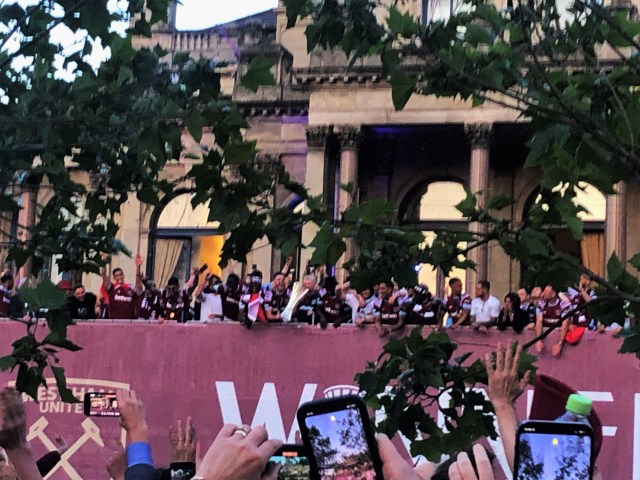
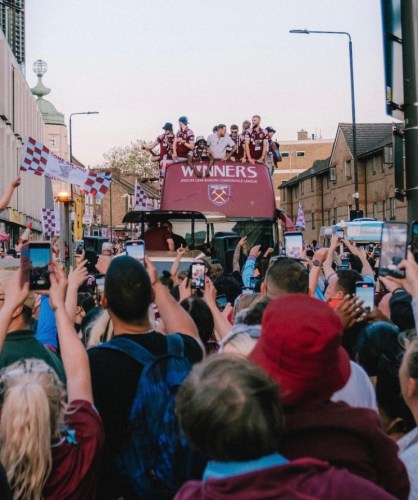
I was still feeling elated the next morning, when I received a text from the club about a victory parade that evening. Thursday. Starting near the old Boleyn Ground in Upton Park, by the statue of Moore, Hurst and Peters – West Ham 4 West Germany 2 – and proceeding to Stratford Town Hall. I had to go. The bus was leaving Upton Park at seven. I figured it might take half an hour to get to Stratford, so best to try to get there myself by around 6.30.  I took the Elizabeth Line – do we not love it? – from Ealing Broadway to Stratford and joined all the fans walking through Stratford shopping centre to the town hall. They were singing the song that became the evening’s mantra: West Ham are massive, everywhere we go! At first it sounded moronic; later, I couldn’t get it out of my head!

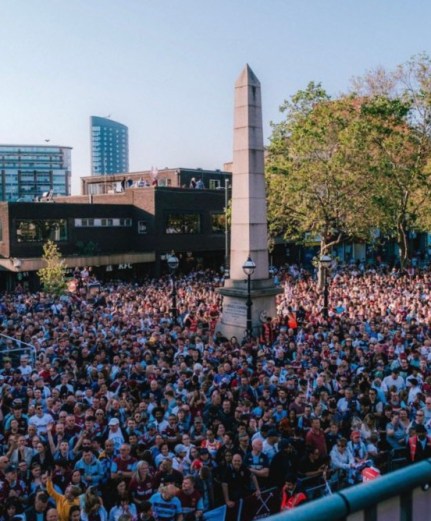
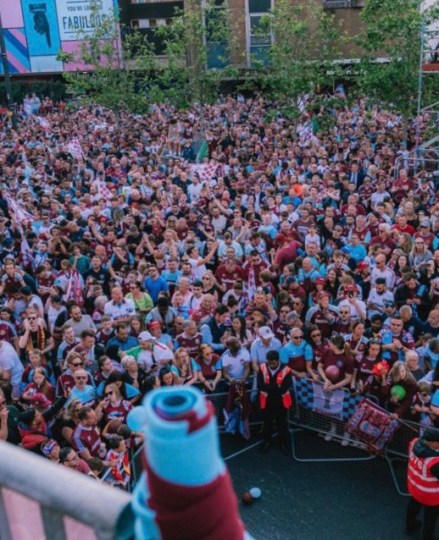
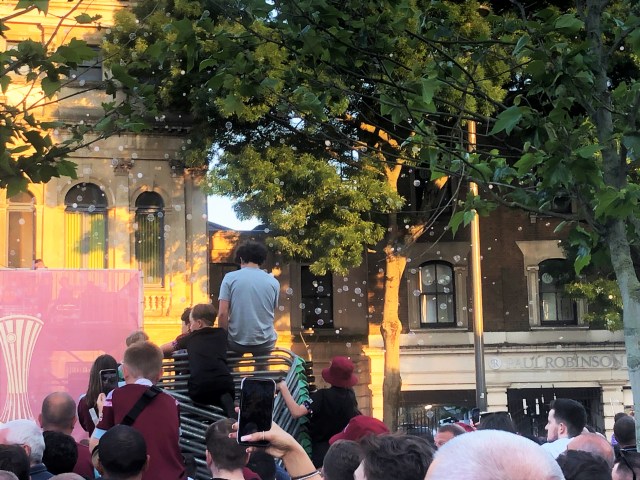
I found a decent position opposite the Town Hall, near some trees. The streets were heaving with claret and blue. I had my retro shirt on – Cup Final 1975 (we beat Fulham 2-0). Young lads were sitting on the roof of the bus shelter, little ones were on their parents’ shoulders. All ages were there. There was a carnival atmosphere – incredibly good-natured. A DJ played popular tunes. There were rounds of I’m Forever Blowing Bubbles of course, plus paeans to Jarrod Bowen (a euro-disco thing), Said Benrahma (White Stripes’ Seven Nation Army) and Lucas Paqueta (I didn’t recognise that one). And West Ham are massive, everywhere we go! Sweet Caroline got an airing of course, as did Spandau Ballet’s Gold, poignant with the passing of chairman David Gold a while back.

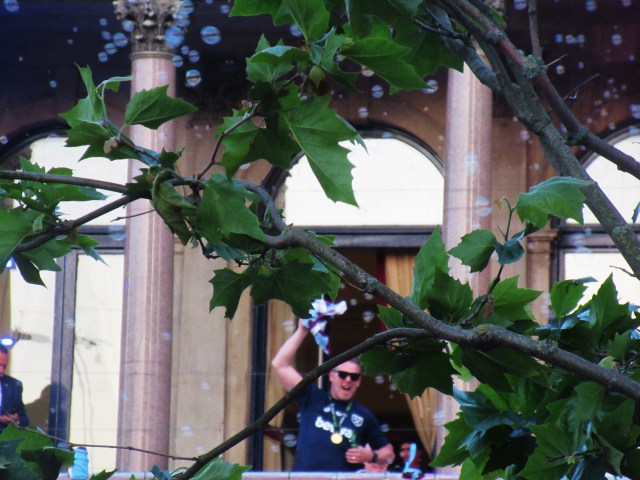
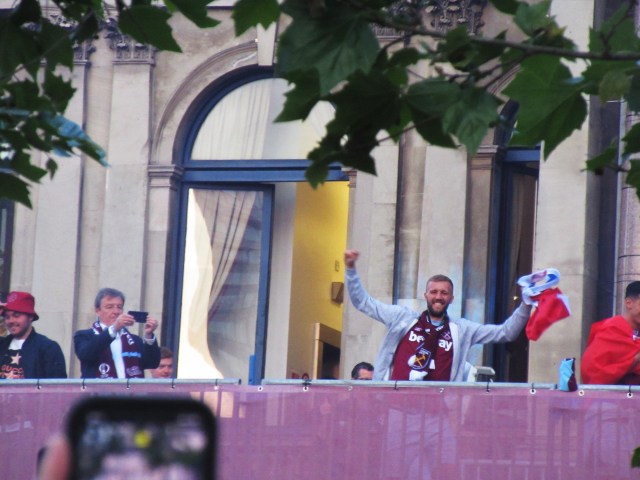
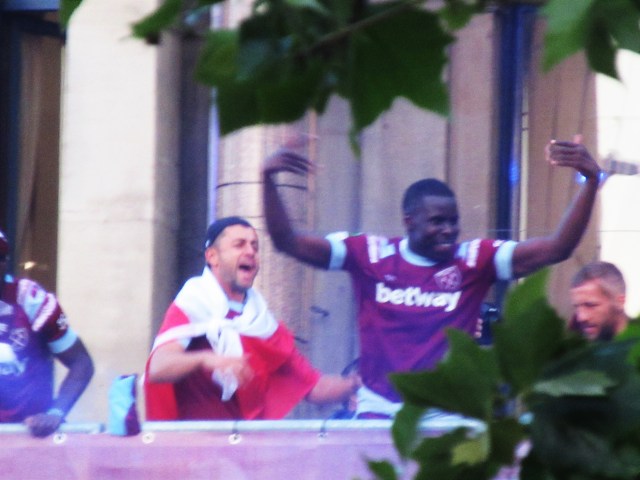
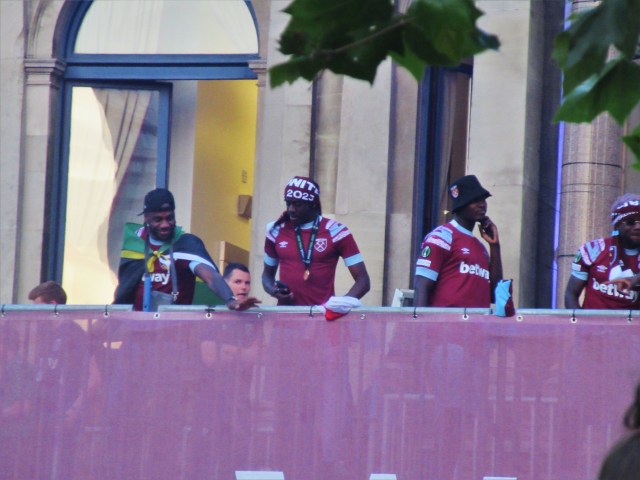
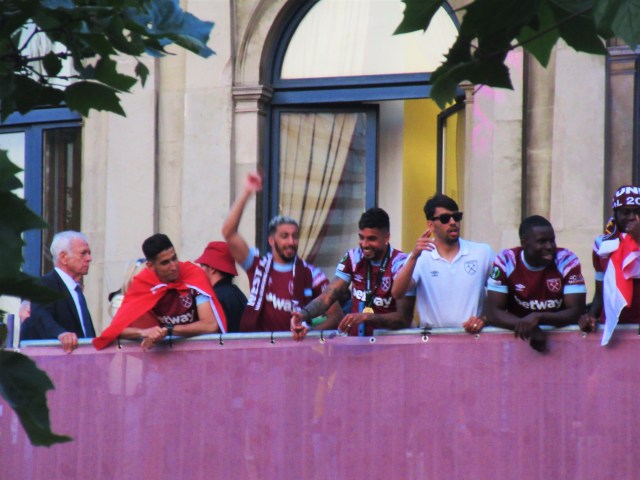
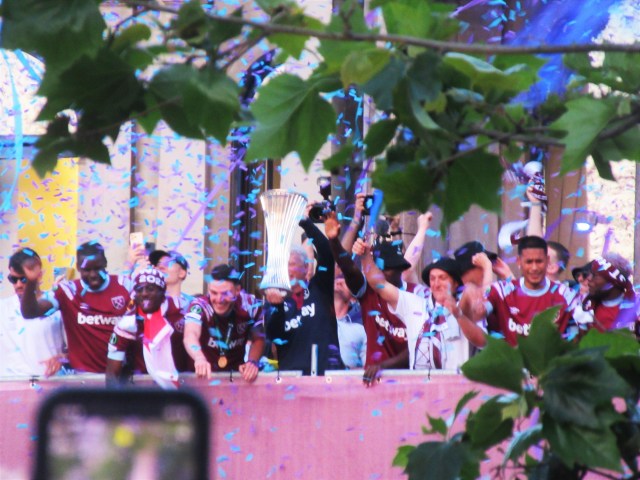
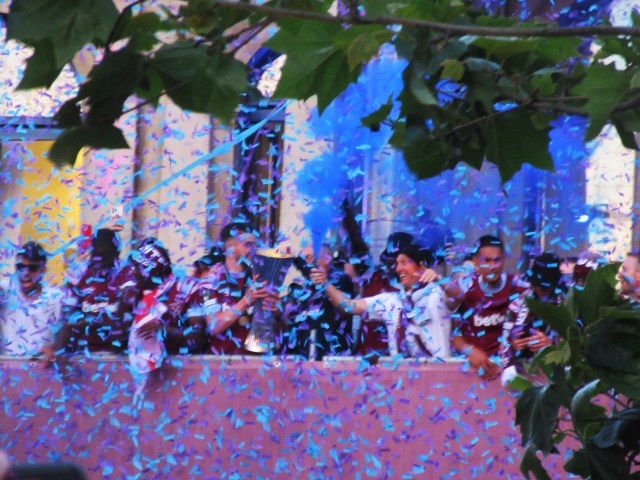
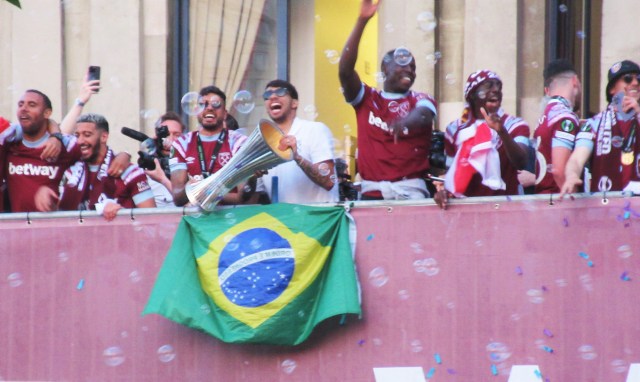
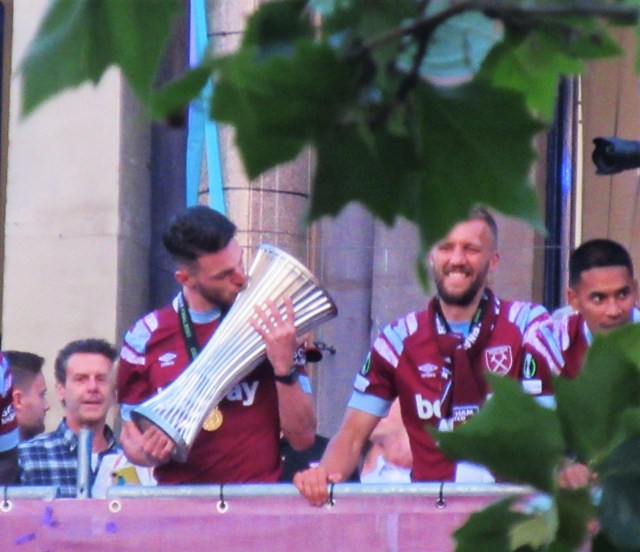
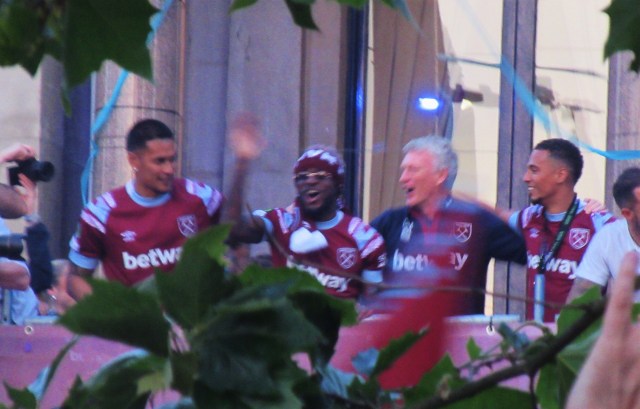
The mayor and chief executive of Newham were interviewed on the balcony and were respectfully received. The chief exec was a big Irons fan. The MC said the bus was due at eight. That deadline passed and he said another fifteen minutes. People were getting a bit restless, but kept up their spirits, singing along to the repeated tunes. 8.30 – my feet were hurting! 8.45: the team finally started to appear on the balcony, the first being coach Kevin Nolan, who gave it some. And then they were all there, and the party started. All the same tunes as before, with the squad bouncing up and down with the crowd, loving every moment. The Cup appeared, with Dec I think, and got passed around after that. Pablo Fornals was passionate, Lucas Paqueta did some nifty dance moves and produced a Brazilian flag, Kurt Zouma was bigging it up, Thilo Kehrer led some singing, Dec caressed the cup and everyone just rocked! It was joyous to behold. There were brief interviews with Jarrod Bowen, Dec, Moyesey and Mr West Ham, Mark Noble; but mostly, everyone just danced.

I can’t remember exactly when I left – 9.30 maybe. It took a while to shuffle into the shopping centre, but it was all smooth from there. Central Line to Holborn and Piccadilly home. Knackered but buzzing. A wonderful evening. I replayed some of the videos I’d taken – the Jarrod Bowen song was the one that really bounced. As a football fan you spend most of your time moaning about your team, unless it’s super-successful. And even then you get nervous, as I know from my friend Jon G, who is a long-standing Man City fan. But on Wednesday night and then Thursday evening I could only feel the love. For the team, and all my fellow fans in Stratford.

Call me sentimental – I can only reply: Come on you Irons!

And, of course: West Ham are massive, everywhere we go!

A few photos below. The first three I’ve copied from the West Ham Instagram feed. The rest are mine. The only criterion is that they are the ones that are just about in focus!

This explains why the bus took so long!

View from Town Hall balcony

I’m somewhere just behind the two middle trees!

Bubbles blowing

Kevin Nolan leads them out!

Midfield rock Tomas Soucek

Lukasz Fabianski and Kurt Zouma

Antonio in Jamaica flag, with his future successor Divin Mubama

players L-R: Aguerd, Benrahma, Emerson, Paqueta, Zouma

David Moyes with the cup

West Ham legends: Dec hands the cup to Nobes

Our new star, name of Paqueta!

Dec gives the cup some love!

Moyesey with L-R: Areola (keeper in the final), Cornet and Kehrer


Posted in London, Sportsthoughts | Tagged , , , , | 4 Comments

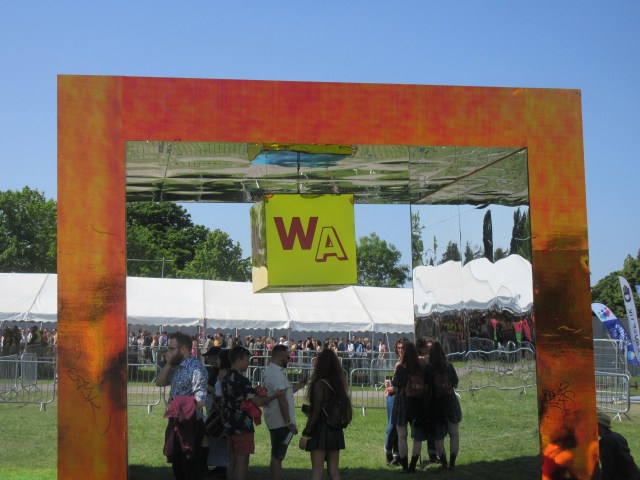
Wide Awake Festival, 27 May 2023

First festival of the year, and a perfect day for it. Temperature around twenty, sunshine with a bit of cloud and a cooling breeze. Most of all, a superb lineup, established and new. Lots of artists I really wanted to see, so that when the splits came out there were inevitably clashes. Gretel Hänlyn or The Bug Club or Arooj Aftab? Butch Kassidy or Tirzah? Daniel Avery or Osees to finish? Two bands absolutely not to miss: Jockstrap (who were so brilliant in Nottingham) and Black Country, New Road (who I’ve never managed to see live before).

I went down to Brixton with Jon G, and we had some breakfast in a little Italian deli/café in the covered market before heading up to Brockwell Park for around 12.30. We met Louis and Gab and a few others there, bought cans of lager and wandered over to one of the smaller outdoor stages, named after the Shacklewell Arms – a pub/music venue in East London. Most of the stages were sponsored by music venues that feature up-and-coming bands, as well as various magazines. Some of our favourite venues in fact: the Moth Club, Village Underground, the Windmill, as well as the Shacklewell Arms. The band, who had just started, were Civic. Aussie punks, with an old school sound. A bit more guitar soloing than the average punk band. Warmed up the ear drums for sure!

Having had one dose of Aussie punk, we went over to the Windmill stage – open air but under cover – for another. This time it was CLAMM – a band I’ve heard Steve Lamacq play on 6 Music. I rather like some of their songs, notably Liar and Bit Much. Some good fast riffing in those two. They both got an airing. The rest followed a similar pattern and got the crowd going. The sound was problematic at the Windmill throughout the day; in CLAMM’s case it distorted the riffs a bit, so they weren’t as distinct as on record. But it was an enjoyable set – I’d happily see them again.

Next up were Canadian band Cola on the Moth Club stage, which was a large tent holding a few thousand. Their sound is post-punk/indie, with some distinctive basslines on record which inevitably lead to Joy Division/Cure comparisons. A bit of Velvet Underground too. I saw them on the Tipi stage at End of the Road last year and enjoyed it. In this larger and pretty crowded venue, I found them a bit samey and dull, to be honest. Louis will regard this as heresy, but it is what it is!

Gretel Hänyln got the nod over The Bug Club and Arooj Aftab. I’ve enthused about her music and live performances a few times previously. She combines a dynamic rock’n’roll beat with some catchy riffs and good singalong tunes. What’s not to like? Motorbike, Apple Juice and It’s the Future, Baby were three of my favourite songs of 2022, while newer tunes like Wiggy and Drive pack a punch. But things didn’t quite work out today. The band started ten minutes late, though it didn’t look like it was their fault – they were all on stage, ready and waiting. And then, as they started with Apple Juice, you could barely hear the guitars. That was rectified for the next song, but along the way, Gretel’s voice faded away a few times, and the insistent bass riff on Motorbike seemed a bit underpowered. Gretel and band soldiered through all of this. Drive was rousing, and there was a hard-driving version of Slugeye. Last song was appropriately Today (can’t help but cry). They were allowed to continue beyond their allotted time, which confirms that the delay wasn’t their doing, but I sensed that Gretel was a bit anxious about it all. A stoical performance.

Jon went to The Bug Club and reported that they were very entertaining – and the Moth Club stage was rammed. As it was to be for Jockstrap later…

I caught the last five minutes of Arooj Aftab down on the main stage. She’s touring at the moment with two other illustrious jazz musicians, Vijay iyer – a dazzling pianist – and bassist Shahzad Ismaily. They’ve made an album together called Love in Exile. It’s a lovely, rather soothing work. Soporific even. It looked like they’d had a good reception. I’ll be seeing them at the Barbican in early June, so that will be in my next roundup.

Then it was back to the Windmill for Butch Kassidy, who won the vote over Tirzah. I seem to keep missing Tirzah, whose music I really like; but it had to be the lads. But they are no longer just lads – they have added a female violinist. Jon and I have seen the band a few times now, though not as often as Louis. Two of the band – frontman Fionn and bassist Tom – are old schoolfriends of his. They’ve been building up quite a reputation over the last year or so – the fact that they were playing at 4.15 rather than in the early slots is an indication of that. Their music is a veritable wall, even squall, of sound. There’s not much you could call a tune; but the riffs and beats build powerfully and become quite hypnotic. Sometimes they slow down, Mogwai-style; and sometimes it gets very fast, Black Midi-style. Cue some serious moshing in the crowd. There’s the occasional vocal from Fionn and the other guitarist, but you can’t really hear them. The violinist adds subtlety and colour, and I’m sure will be more prominent when they record some music. This was a really driving performance, although the dynamic drumming fell victim to the Windmill’s sound problems. One or two people retreated from the onslaught; but the bulk of the crowd were loving it. A triumph.

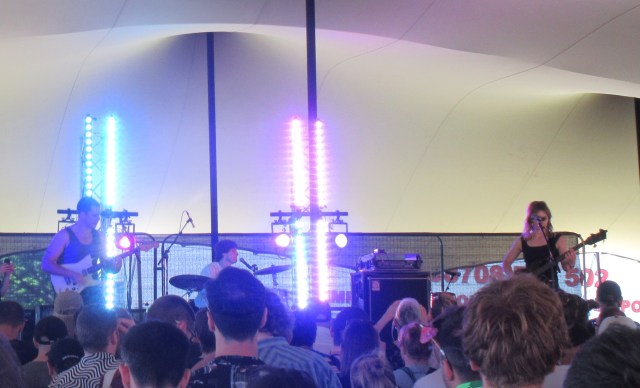
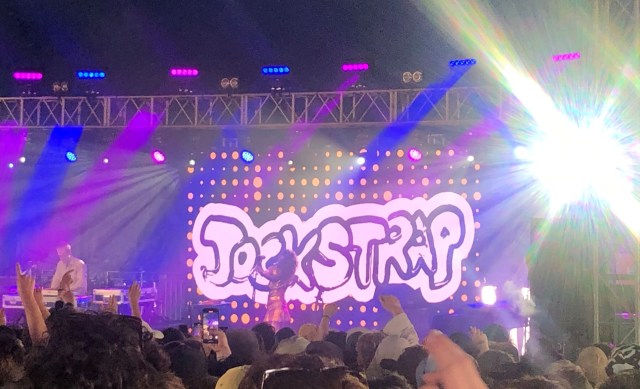
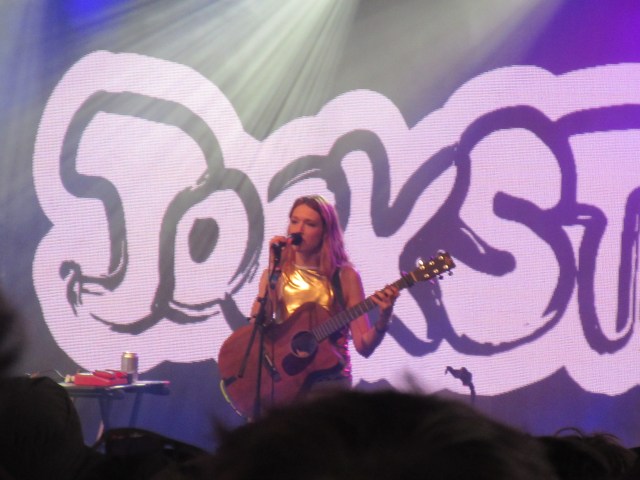
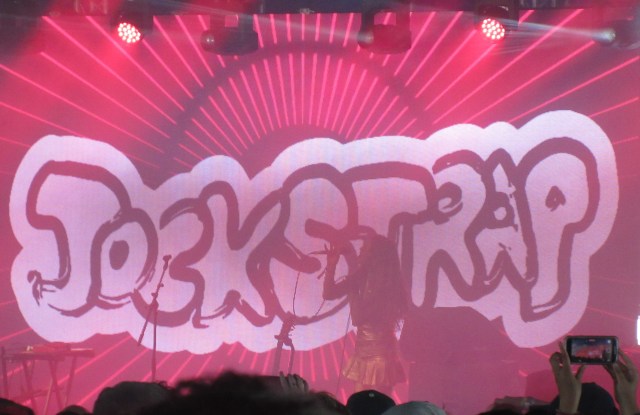
And talking of triumphs, it was time for Jockstrap in an absolutely heaving Moth Club tent. Five minutes before the start I still had a decent view of Georgia and Taylor. Five minutes later, I was craning my neck to see very much at all. That aside, it was a fantastic show. The duo have really honed the show after extensive touring and the crowd reaction was amazing. All of their songs are pretty complex, combining catchy melodies with variegated beats, swirls of cinematic sound, beeps and squiggles, disembodied voices and much more. Out of this melange, three or four of the songs have become real singalong anthems, notably Glasgow and Concrete Over Water. The subject matter is often quite dark, but the sound is joyous. And while Taylor hunches over his array of keyboards and consoles, Georgia, if not playing guitar or violin, dances elegantly around the stage, communing with the front rows. It is quite a spectacle. Those singalongs are genuinely uplifting. And to lift things even higher, they finished with the awesome 50/50, heralded by the nonsensical, but now communal cry: aheh-ooh-ee-ah! Amid Taylor’s electro wizardry, the techno beats and the rib-thumping bass had the place rocking. Incredible stuff. We shuffled outside into the sunshine on a real high.

There was a bit of downtime before Georgia’s other band, Black Country New Road took the stage at 7.20. I got myself a white wine and went down to the main stage to sit on the grass. The Viagra Boys were about to come on. I stuck around for fifteen minutes or so, and quite enjoyed the show, from a distance. Their take on punk/pop doesn’t really do it for me – I find the sound a bit hackneyed – but they put on a lively show. The singer strutted around bare-chested, displaying his copious tattoos. The saxophonist hooted energetically. It was all very energetic, and was going down very well. Louis and his mates were somewhere near the front. I stayed until 6.45, then strolled up to the Shacklewell Arms to watch DJ/producer Erol Alkan lay down some very infectious dance beats. His own music, not other people’s records. Constantly switching consoles, twiddling dials, pushing buttons, eking out another change in rhythm and sound. I really enjoyed it and could happily have stayed for the whole set; but it was time for BCNR. I met Jon and we strolled over to the Bad Vibrations/Desert Daze stage, the second biggest at the festival.

Viagra Boys

Erol Alkan

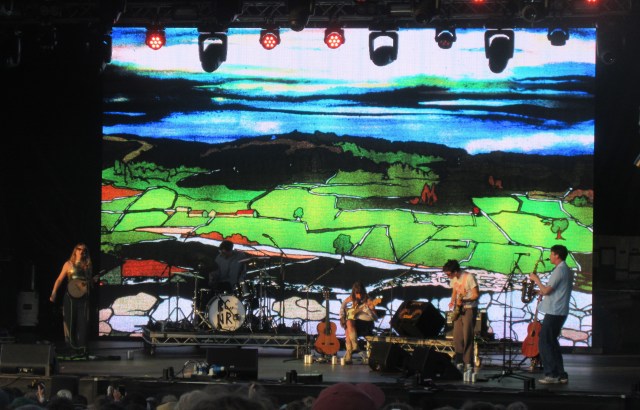
Black Country, New Road are an ever-evolving band. Their sound is hard to pin down. They are described as post-punk and post-rock on Wikipedia, but any time you might be thinking folk, jazz, psychedelia, cabaret. But unlike Jockstrap, they don’t venture into electronica or dance sounds. And pop melodies are sparing. I liked their first album For the First Time, which brought together their work up to that moment, a highlight the reworked version of the crazed masterpiece Sunglasses. Their singer Isaac Wood left the band days before their second album Ants From Up There was released, and they stopped touring for a while. I was due to see them play the Roundhouse, but that was cancelled. I never quite managed to get into the second album, but was still fascinated by them. They regrouped and shared out the singing duties between band members, mostly the three women on the evidence of today’s show. There are no songs from the first two albums in the set – out of respect for Isaac Woods, who had been struggling with mental health issues. They recently released a live album, recorded at Bush Hall, on which much of the show today was based; but I hadn’t heard it beforehand. So the songs were unfamiliar, but subtly engrossing. There were bursts of cacophony, but mostly the music was quite gentle, like a certain type of English prog/folk from the early seventies. Whether it’s consciously modelled on that, who knows. The countryside artwork which formed the backdrop hints that maybe it was. Early Genesis? An intriguing show – not as celebratory as Jockstrap, but my second favourite of the day (with Butch Kassidy running them close).

After Black Country, New Road Jon and I decided to call it a day. We both regretted missing Daniel Avery, who I think put on a spectacular show at the Village Underground tent. Osees would have been rousing; and main stage headliner Caroline Polachek would have been entertaining too, I’m sure. But after eight hours on our feet, the limbs were aching, and the attraction of beating the rush to the tube gained greater appeal. Got to pace ourselves these days!

What a good day out though. Wide Awake is a really top notch festival. I’m sure we’ll be back next year.

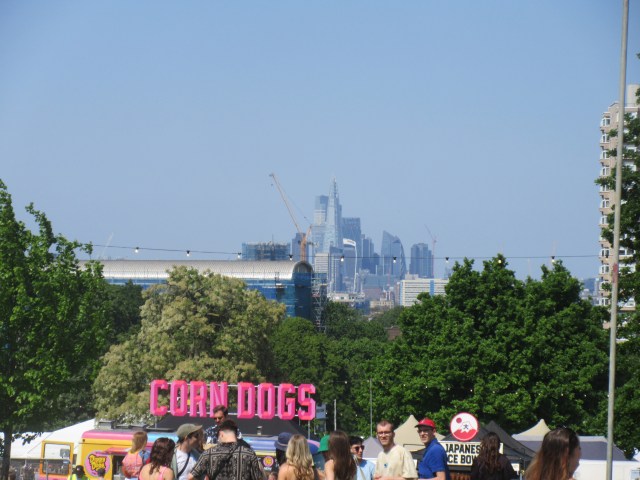
The Shard and the City loom from the top of the hill

Posted in Music - concerts, lists, reflections | Tagged , , , , , , | 3 Comments

Music Roundup 02: 16 April to 5 May 2023

Featured this time: Stanley Dee, Aladdin Sane, Kyle Eastwood, Indigo Sparke, Tara Lily, Matt Schofield.

Tara Lily at the Boulevard Soho

Six concerts to report in this period, with something of a jazzy theme. The delights of a comfortable seat, a glass or two of wine and some high quality music. What’s not to like? Is the era of standing, watching loud bands, view usually restricted by the tall people in front of you, distracted by all the people talking rather than listening to the music, coming to an end. Is age catching up with me? Not entirely, but I think this is likely to be a year of transition towards a better quality of experience. That is exemplified by the fact that Jon G and I have decided to glamp at both the weekend festivals we are going to this year: Latitude and End of the Road. Adds to the price, improves the comfort and convenience. We’ll see if it’s worth it.

Onto the concerts, starting with a tribute act, but a very good one, who I was seeing for the third time. For some of our number it was pretty much double figures…

Stanley Dee at the Half Moon, Putney, 16 April

The day got off to a good start with West Ham coming back from 2-0 down to Arsenal after about ten minutes to draw 2-2. Arsenal missed a penalty, but we had the chances to win. A real confidence-booster for West Ham in the fight to avoid relegation; a real confidence-drainer for Arsenal in their bid to beat the remorseless Man City to the Premier League title.

Straight after that, over to Putney for a very nice pre-concert meal at the Holy Cow Indian restaurant on the Upper Richmond Road – highly recommended. We were six tonight: me, Dave, Jon, Tony, Colin – he of the double figures for Stanley Dee! – and a friend of Colin’s. The crowd for Stanley Dee at the Half Moon seemed bigger and livelier than ever – they have built up a strong reputation and an enthusiastic following. The formula? Play great songs by a great band really well. And show you’re enjoying it – it catches on!

One big change to the band – a new guitarist. The previous one, who was very good, was poached by rivals Simply Dan apparently. It’s brutal in world of Steely Dan covers bands! His replacement was also very accomplished technically, which you have to be, playing Steely Dan, especially some of those early guitar-driven rockers like My Old School, Reeling in the Years and Bodhisattva – all of which got an airing tonight. He was playing off an iPad screen, which suggests he’s still fairly new to the world of the Dan. But he certainly seems to have mastered all the songs.

As ever, the two sets ranged across the classic Steely Dan albums – essentially the 1970s canon. And Steely Dan were imbued in jazz as well as American soft rock. Rikki Don’t Lose That Number borrows a bass line from Horace Silver’s Song for my Father; Aja classics like Black Cow and Deacon Blues gave me an entry into jazz music back in the day. All rendered impeccably tonight. And what a rousing finish: Do it Again, Kid Charlemagne, Bodhisattva and Reeling in the Years! We were buzzing. Enough for me, Jon and Colin to stick around in the pub for another hour analysing the performance and talking music generally. Got one of the last trains home, but it was worth it!

Aladdin Sane Live at the Royal Festival Hall, 21 April

Anna Calvi sings

This concert was part of the celebration of 50th anniversary of David Bowie’s iconic album Aladdin Sane at the Southbank Centre. Along with the concert there’s a photo exhibition on Level 1 of the RFH, called Aladdin Sane: 50 years. That’s well worth a visit – only £5 entry. I really enjoyed it; lots of photos and memorabilia of the early 70s; a selection of the work of photographer Brian Duffy, who took the photos for the album cover; and a variety of photos from that shoot as well as some earlier shots of Bowie for the Ziggy Stardust album, which weren’t used. He also took photos for The Lodger and Scary Monsters and Super Creeps albums. In the case of the latter, his work was partially painted over for the final cover, which led to a falling out between Duffy and Bowie. Those artistic differences!

I decided to go to the concert at the last minute, and bought the last available ticket online. Decent view, about half way up. The songs were performed by a variety of artists, backed by an orchestra – there was a guitarist, but he didn’t exactly do a Mick Ronson! The show was enjoyable, slick, but ultimately a bit underwhelmimg. The songs weren’t sung in the order on the album; I assume each artist was assigned – or chose – two songs, and the order was determined that allocation. The last song of the set was Jean Genie, which is understandable – the only problem was that it was performed rather feebly by the electropop singer Lynks, in one of his masks and an extravagant outfit based on the one the V&A featured in its Bowie exhibition a few years ago. A missed opportunity that, when Anna Calvi could have picked up her guitar and given us something in her trademark visceral style.

As well as those two the cast included Jake Shears of Scissor Sisters, who bounced around enthusiastically, and two modern soul singers: Tawiah, who I saw recently at the Barbican, and Roxanne Tatei, who was new to me. I’m a big admirer of Anna Calvi, but felt she was wasted somewhat, confined to singing Lady Grinning Soul and Time in a cabaret style. You could say Aladdin Sane is a fusion of cabaret and rock’n’roll; tonight’s show erred towards the cabaret and never really gave us the rock’n’roll, though Jake Shears did his best on Let’s Spend the Night Together.

The highlights for me came in the second half, with a soulful Aladdin Sane by Roxanne Tatei, backed by some lovely piano, and an unexpectedly anthemic rendition of Drive In Saturday by Tawiah. A reminder of where Radiohead drew the inspiration from for Karma Police! There was an encore of Rebel Rebel, featuring the whole ensemble. Again it didn’t really rock, but it was a nice way to end the evening.

So, I’m glad I went, but it was a bit of a 6/10 show. The photo exhibition though – a must for any Bowie aficionado. It’s on until 28 May.

Kyle Eastwood at Ronnie Scott’s, 27 April

OK, let’s get it out of the way: Kyle Eastwood is the son of actor Clint Eastwood. He is also a very fine jazz bassist and bandleader, which I didn’t know until Dave suggested going along to one of his shows at Ronnie’s. We caught the 6.30 show, which gave us time for dinner afterwards. The music was mostly from Kyle’s 2019 album, Cinematic, which features jazzy interpretations of film soundtracks. I listened to the album afterwards and liked it; but is live that this music really comes into its own – in particular, Kyle’s bass sounds, which were strong and vibrant live, but much more mixed down on the album recording. He played an electric double bass, with the bottom third scooped out. What the idea behind that is, I don’t know – maybe it just makes it lighter to bring on tour. Anyway, it sounded great, and our table was in a good position to study his playing.

He was joined by a very accomplished band: Andrew McCormack on piano, Quentin Collins on trumpet, Brandon Allen on sax and Chris Higginbottom on drums. All British, I think, working with him while he is over here. I didn’t know this beforehand, and could have sworn that when they were playing a version of Taxi Driver, the trumpet and sax players were straight out of Little Italy, New York. They really had a feel for the tone of the music. I loved their duetting throughout the show; another highlight was some pretty wild improvisation during a rendition of the Bond theme tune, Skyfall. Kyle mentioned his father a couple of times, but only in the context of the music – one piece was a take on an early Clint Eastwood film, The Eiger Sanction. The most fun was when they launched into the theme from The Pink Panther. Who doesn’t love that tune?

This was music of the highest quality and the hour and a quarter whizzed by. I think we would all have enjoyed more. But there was another show at 8.30. The six of us went off to a very good Italian restaurant called Bocca di Lupo on Archer Street in Soho. Not been there before, but will definitely return. Lovely regional dishes, and a very interesting wine list. Pretty noisy on a packed Friday evening, but, hey, this is the heart of London. Good food, good wine and good music – what more do you need?

Indigo Sparke at the Slaughtered Lamb, Clerkenwell, 28 April

If you are a regular reader of this blog, you’ll know that Indigo Sparke is one of my favourite singers at the moment. She’s Australian, but based in New York. Her last album, Hysteria, was my No1 in 2022, while its predecessor, her debut Echo, made No2 in 2021. It’s classic indie-folk, singer-songwriter music, but performed with a subtle power. The instrumentation is sparse, but the melodies are rich, the emotion is strong. She’s just done a few dates in the UK supporting Weyes Blood, and took the opportunity to play this solo show at the Slaughtered Lamb. It’s a pub in Clerkenwell, just north of Farringdon. It’s a lively pub, with a music space downstairs. Holds around 150, I think. I’ve been there once before, to see Faye Webster in 2018. It’s a nice place to enjoy an acoustic show.

I went along to the gig with my friend Shane. We got there quite early and had a couple of beers outside on the street, as it was a bit noisy inside. Then down to the basement, where we managed to nab a couple of stools to sit on, with some help from a member of staff. There’s some scattered seating near the small stage, but mostly people stand. There was support from a singer called Joanna Warren, also New York-based, and a friend of Indigo. She crept on around 8 o’clock and began singing unaccompanied. She had the voice to pull it off. The rest of her show was with acoustic guitar. She apologised if her finger-picking wasn’t up to standard, as she’d broken a thumbnail, and couldn’t glue another one on – not something I realised anyone ever did! In fact her playing sounded pretty good. She had some nice tunes – anguished ballads in a similar vein to Indigo. Near the end she played a song which involved her screaming all of a sudden. Rather disconcerting after we had all settled into a mellow vibe!

Indigo came on around 9.15. Again unannounced. Picked up her guitar and started to play. The first song was the wonderful Colourblind, from Echo; but the majority of the set was taken from Hysteria. She was in fine voice – when I last saw her, in Bristol, she had flu, and had to play a fairly short set. The songs were beautifully played and sung – I’ve listened to them so much that there were endless special moments for me. All my favourites from Hysteria were there: Sad Is Love, Burn, Real, Why Do You Lie? Carnival, from Echo was another highlight. Oddly, she doesn’t play Pressure in my Chest, which was one of the lead singles from Hysteria. Maybe that’s one where she feels it needs a full band to do it justice. There was a new song called Opulent Blue, which sounded good. She introduced the songs with good humour and some engaging stories. So it was a bit surprising that she ended with Everything Everything, which is a lovely atmospheric tune from Echo, but rather downbeat – all about the world dying. And with that she was off, to get over to the merch table. That’s where you make your money, in this difficult age for up and coming performers.

Indigo’s playing End of the Road this year – a good chance to get some wider exposure. With luck she’ll be able to bring her band over – I’d like to hear how the songs sound live with a full band. Perhaps Aaron Dessner of the National, who co-produced Hysteria and helped write some of the songs, will pop in for a guest appearance!

Tara Lily at the Boulevard Soho, 3 May

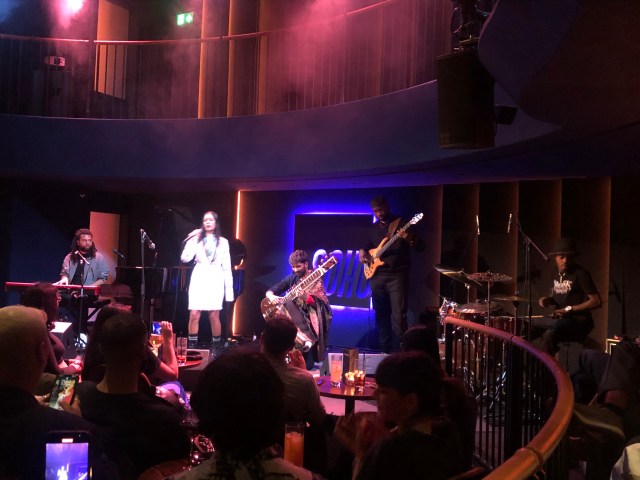
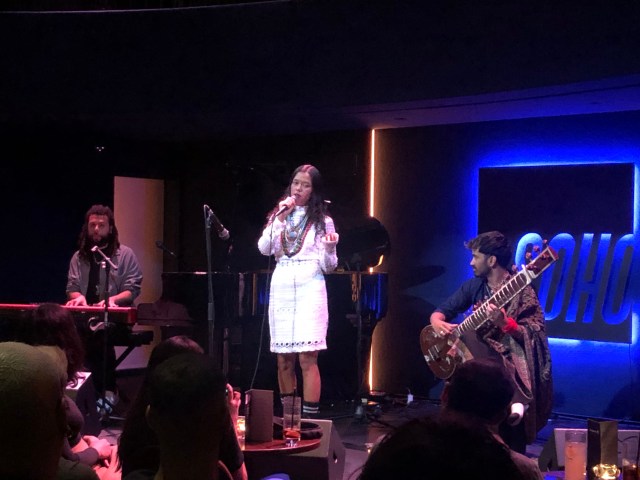
Tara Lily is a British-Bengali artist, born in Peckham, south London, who makes music that fuses jazz with soul and the sounds of South Asia and Latin America. Worldwide music. She was the first artist signed to Motown’s new British label and has made two EPs so far:  2021’s Lost in London and last year’s Last Flight Out. There’s some beautiful, soulful music on both. I especially enjoyed some of her cover versions: adding vocals to Miles Davis’ Blue in Green, and John Coltrane’s Naima; and turning Billie Holiday’s Don’t Explain into a drum and bass dance tune, with a bit of a Latin vibe. All work superbly. I first heard her on 6 Music, and immediately loved her voice; then by chance, she was on the bill at the celebration of International Women’s Day at the Barbican back in March (as was Tawiah) which I reviewed in the first of these roundups. She only played three songs that day, so I was pleased to have the chance to see her and a full band play at the Boulevard Soho.

The Boulevard is a new venue, at the bottom of Berwick Street in Soho. I’m not sure what was there before, but it may have been a less salubrious form of entertainment. It’s been refurbished very stylishly, the main space a combination of fixed seating in the round, with tables and seats below. It struck me that it could become a more modern – and cheaper – alternative to Ronnie Scott’s, perhaps for less-established artists. The gig was sold out, and the audience quite youthful and a lot more diverse than most of the concerts I go to. A pretty cool crowd in fact – with a few exceptions!

As for the music – wonderful. Tara sang and played keys in the first half of the show. The Things You Do and Hotel Amour stood out, with a Sade vibe on the latter. She was accompanied by some excellent young musicians playing sax and keys, mellifluous bass and drums that gave me a feel of Moses Boyd. That’s seriously good. In the second half she was joined by her sitar player, with an extended version of Naima one of the highlights. There were a couple of new songs, which sounded good; overall we were treated to an exhibition of cool, worldwide jazz. The band have just been touring India – to enthusiastic receptions Tara recounted – so there was a real togetherness about them. They ended with a rousing version of Don’t Explain which, in a different setting, would undoubtedly have people up and dancing. But the appreciation was fulsome.

So Tara Lily is definitely someone who I’ll be looking out for in future; and the Boulevard a venue that could become a regular haunt. A great evening’s entertainment all round.

Matt Schofield at Ronnie Scott’s, 5 May

I’d not heard of Matt Schofield before Colin, who loves his virtuoso guitarists, suggested going to see him and his band at Ronnie’s. I was expecting jazz, but in fact it was what you might call rocking blues. A sound you associate most with the late 60s and early 70s, but a timeless sound. One for the aficionados, especially on record; but live it can be – and was – enthralling.

Matt and his band – a keyboardist, who also lays down the bass lines, and a steady-as-it-goes drummer – have been touring together for over twenty years. They’ve played various clubs in Soho over the years, but this is their first time at Ronnie’s. Recognition of the level they are currently operating at – that is, a very high level. This was an engrossing show: Matt is a stunningly good guitar player. One of those times when you look admiringly at the guitarist and think, I wish I could do that! One of the things I’ve noticed about ace guitarists over the years is that they often only have the one guitar: no array of finely-calibrated instruments, no fussing about tuning and re-tuning after each song. They plug in and get on with it! Assisted by some good pedals, no doubt; but they are simply masters of their craft. Matt played a blue Fender Stratocaster if you are interested – I had real guitar envy!

At times I got a bit of Rory Gallagher from the music, and there were definitely shades of Jimi Hendrix. Not quite as wild as the great man could be, but edging into similar territory. There was a touch of funk, but mostly it was that hard-edged blues which formed the basis of the sound. A few perfunctory vocals from Matt, but this was all about letting rip on that guitar. Every conceivable sound, every part of the fretboard explored – magnificent stuff.

Back home, I tried some of his recorded output on Spotify. It was OK, but I think I’ll stick with Rory and Jimi if I fancy a burst of that rocking blues – or Led Zep, for that matter. His most recent album, Far as I Can See, dates back to 2014, which is telling. It’s all about the live performance. That’s where Matt Schofield is spellbinding.

I’ve had a couple of weeks off from gig-going since Matt Schofield – ‘tis the time for football viewing – the business end of the season. Normal service resumed next week, with Alvvays at the O2 Forum, Kentish Town. And then, on Saturday 27th. Wide Awake Festival. What a line-up that has this year! There will be a full report.

Until next time…

Posted in Music - concerts, lists, reflections | Tagged , , , , , , , , , | 1 Comment

Music Roundup: March/early April 2023

Thought I’d try a different approach to concert reviews and other musical reflections, having a round up from time to time rather than trying to write up each concert individually. I might make exceptions for some really big names – like Bruce in July this year – while the festivals are of course round ups in themselves. I’ve three festivals planned for this year at the moment: Wide Awake at the end of May, Latitude in July and End of the Road in August/September.

So let’s start with some of the things I’ve been listening to recently. It’s been a bit retro over the past month or so, with something of a U2 revival. That was sparked by the Murder Capital, who I saw in late February. I mentioned in my review of that concert that I heard a bit of U2 in their music – the best of U2. The period which encompassed The Unforgettable Fire, The Joshua Tree, Achtung Baby and Zooropa. What great records they are: the peak of U2’s first cycle, culminating in the epic Joshua Tree, and then what I think of as the band’s Berlin period, although I’m not sure all that much of the music was actually recorded in Berlin in the end. It was probably when Eno’s influence was at its height, with more use of electronics and a darker, more alienated feel to many of the songs. In that respect there’s some connection with David Bowie’s Berlin period: Low and Heroes especially, though The Lodger has its moments, and you can also bring the earlier Station to Station into the equation. And for completeness, add a bit of Iggy Pop: the best tracks from The Idiot and Lust of Life. It makes for a great playlist: U2, Bowie, Iggy, a bit of Kraftwerk – a strong influence on them all – and for good measure some Velvet Underground and Lou Reed. That’s been my latest listening – called Berlin, of course. It’s a notion.

I also found myself wanting U2 on in the background as I read Bono’s autobiography Surrender. It’s a very good read, and I’ll return to it alongside a couple of other music bios I’ve read recently. Watch this space…

A lot of my other listening has been based around concerts I’ve been to, notably Biig Piig, Jadu Heart and the Orielles. I’ve been to seven in all since the beginning of March, so let’s move onto those.

In Her Words at the Barbican, 8 March

This was a celebration of International Women’s Day, with artists mainly from the jazz/ soul world. The headliner was Maddison Cunningham, whom I assumed was from that world too. The other artists were Rosie Frater-Taylor, Tara Lily, Tyson and Tawiah. I’d heard a bit of Tara Lily recently, and really liked her voice, while Tawiah took me back to a great song from 2010 called Watch Out, which I’d first heard on one of Gilles Peterson’s Brownswood Bubblers compilations. It’s an anguished piece of jazzy soul, reflecting the anxiety of an affair that is getting too deep.

The evening was split into two, with the first four artists sharing the first half, and Maddison Cunningham taking over after the interval. Rosie Frater-Taylor was solo, just her and her guitar. She was good, but only had time for two songs. Tara Lily was next and she managed three! She played keys and was accompanied by a sitar player. Her music is rooted in jazz, but spans the globe. I loved her sung version of John Coltrane’s Naima, with the sitar gently propelling the song. That’s on her most recent EP, Last Flight Out. It includes a version of Billie Holiday’s Don’t Explain, too. The highlight of the evening, for me.

Tyson followed – four songs for her! Accompanied by a console, she sang modern soul in the vein of Jorja Smith. I liked it. And then Tawiah, who performed a cycle of new songs, moving from birth to death, with key life events in between. It was powerful, if a little contrived. I preferred the stark simplicity of Watch Out, though in fairness that was a long time ago.

Maddison Cunningham walked on with a band and electric guitar, and proceeded to play a set of rock music with a hint of folk and a touch of jazziness in the guitar playing. In that respect I was reminded of Ryley Walker, who I’ve enjoyed a couple of times at End of the Road. I can’t say it was what I expected, but I hadn’t done my homework! It was entertaining and went down well with the audience, who were mostly there to see her, I suspect.

So, a bit of a mixed bag, but all enjoyable. Main follow-ups for me will be Tara Lily – who’s playing at the Boulevard in Soho on 3 May – and Rosie Frater-Taylor. I’d like to hear a bit more of that guitar.

Gwenifer Raymond at St John on Bethnal Green, 11 March

Gwenifer Raymond has a PhD in astro-physics, designs games by day, and plays American primitive guitar by night. It’s a percussive folk-blues, which has elements of flamenco and imparts a feel of the Welsh mountains. Gwenifor is from Wales, so that’s an easy inference, but there’s something in her playing that reminds me of side two of Led Zeppelin III, which was recorded in Bron-y-Aur. I saw her playing in the woods at End of the Road last year, and she was utterly captivating. She doesn’t say much – her guitar does the talking. She looked a bit lost in the space of the church, but the sound resonated. Check out her 2020 album Strange Lights over Garth Mountain if you’re curious.

Killing Joke at the Royal Albert Hall, 12 March

The day after Gwenifer Raymond – talk about contrasts! Killing Joke were – are – a post punk/goth band whose heyday was in the early 80s. They passed me by at the time, but Dave and Tony were keen to go along. Jon and I were tempted by the pre-concert meal at Polish restaurant Ognisko as much as the music. But it was good – very loud, relentlessly rocking, verging on metal. There was a dramatic video backdrop – all fire, wars, marching. A bit obvious, but a good match for the music. They played most of their key songs – Requiem and Follow the Leaders stood out for me, probably because I’d liked them when I mugged up before the show. Singer Jaz Coleman looked a bit like Ozzy Osbourne from our seats high up in the Raising Circle. Plenty of aging goths were present in the audience. A fun, if ear-bashing evening.

Biig Piig at the Electric Brixton, 23 March

Biig Piig is the stage name for West London-based Irish singer Jessica Smyth. Her concert at Hoxton Hall last November was one of the most enjoyable of the year, combining an irresistible dance energy with jazzy soul, some of which is sung in Spanish, Jessica having lived there as a youngster. Tonight was a repeat of the Hoxton Hall formula, with a bigger audience at the sold out Electric. The crowd seemed more youthful too – I think her popularity is growing, and deservedly so. Once again she got the mix of her older, mellower tunes like Shh, Perdida and Roses and Gold and the more recent bangers just right. And that full-on, engaging energy was never more apparent than when she and the band ramped it up for the mighty Switch. It was the first Biig Piig song I heard, back in 2020; and while it isn’t typical of her sound, it is awesome live. I loved the celebratory sense of Feels Right at the end of the set too. Jessica is having the time of her life and she wants to share it with us. Onward and upward!

A word for support act Yune Pinku. She plays electronic dance, which combines modern beats with an occasional burst of house music. She sings too, though her vocals, which sound good on her recorded output, were rather drowned out by the beats on the night. One to watch.

Jadu Heart at Islington Assembly, 30 March

I’m a bit late to Jadu Heart. They’ve been going since 2016 and last year’s album Derealised was their third. I heard them for the first time last year when 6 Music played the single I Shimmer a fair amount. It’s a classic bit of melodic 90s shoegaze, complete with anthemic guitars, and I’m a sucker for that sound! So when I saw they were playing Islington Assembly, which is a great venue – really well turned out compared with most – I thought I’d give it a go. Wise move, because it sold out pretty quickly. They’re a duo – Diva Jeffrey and Alex Headford – with backing band. They’re not all shoegaze – there is a variety of indie rock sounds. Most of the set was from Derealised and 2020’s Hyper Romance, which are both worth a listen. I enjoyed the set, though the sound was a bit murky, and Diva’s keyboards broke down about two thirds of the way through, which naturally disturbed the momentum. Good show, good band though.

Support act gglum, who I saw with Gretel Hänlyn at Bermondsey Social Club last year, played an enjoyable set of indie-pop and got things off to a good start.

Lee Ritenour at Ronnie Scott’s, 3 April

Lee Ritenour is a jazz guitarist, who has been playing professionally since the late 60s. He’s worked with the likes of Dave Grusin and Larry Carlton, and played on Tom Browne’s Funkin’ for Jamaica and even on Pink Floyd’s The Wall! I’d not come across him until a friend, Colin, who is a fan, suggested the gig, and a few of us agreed to go along. Like quite a few artists at Ronnie’s he played two sets that evening and we went along to the 6.30 show. That gave us a chance for a nice dinner afterwards at an excellent tapas place in Soho called Maresco. Rock’n’roll, eh? This was top quality jazz music – mellow for the most part, but hitting a jazz rock vein towards the end, which provided a showcase for his excellent young band, which included his son Wesley on drums. I was particularly impressed by the bassist, Serbian Pera Krstajic: driving the beat, but capable of real intricacy. There’s a nice story attached to this: Lee started a competition called Six String Theory back in 2010 for young guitar players from across the world. It was extended to bass, drums and piano and is now biennial. Pera Krstajic won the bass competition in 2018, and joined Lee’s band soon after. Lee is now 71, and it was great to see him playing with a group of talented young artists, who clearly held him in great regard. United by the love of jazz music.

The Orielles at Electric Brixton, 4 March

The Orielles are sisters Esme Dee and Sidonie Hand-Halford and guitarist Henry Carlyle Wade, from Halifax. You’d classify them as indie rock and there was definitely some of that C86 indie sound in their music when they started, as well as the likes of Orange Juice and 90s indie-dance. But they were always a bit different, combining dreamy melodies with leftfield lyrics and unusual time changes. When I first heard them live, at Latitude in 2018, I was struck both by the elasticity of Esme’s bass playing and the crystalline quality of Henry’s guitar. And he solo’d a lot more than the average indie guitarist, the highlight being the epic guitar workout on early single Sugar Tastes Like Salt. That song has remained a highlight of their live set every time I’ve seen them – until now. They are moving on.

Their third album, Tableau, was released last year. It was a step on from the previous two, debut Silver Dollar Moment and follow up Disco Volador. It was more discursive, abstract even, especially on the first couple of listens. Less driven by the melodies, but with even more variation in sound. Every time I listened to it, more was revealed, and the more interesting it became. So how would it sound live? Well, the answer was brilliant. Most of the set was from Tableau. There was less for the crowd to move to, but I think they were engrossed. I certainly was. Henry really let go with his guitar. Sugar Tastes like Salt was no longer there, but there was plenty to make up for it. And two of the last three songs were genuine crowd-pleasers: Disco Volador and Sunflower Seeds. Everyone went away happy.

The Orielles are a really interesting band, challenging their own previous boundaries. In that respect they are like Radiohead – you never know what will come next, but you know it will be worth giving plenty of attention. Long may it continue!

Posted in Music - concerts, lists, reflections | Tagged , , , , , , , , , , | 8 Comments

A Thames Journey: (11) From London Bridge to Greenwich

iPhone view from Greenwich Park – just squeezes the Shard in!

The last part of this journey took us through the historic heart of London and past many of its iconic sights. There were glimpses of the modern too, including some of the sights that we explore further in this instalment. The journey from London Bridge to Greenwich is another relatively short one, and is perhaps the section where the modern has most decisively taken over from the old, driven by changing economic circumstances and emerging new opportunities. At the heart of this change was a rapid decline in the fortunes of inner London’s docks – the Pool of London – following the arrival of containerisation in the late 60s. In essence, the docks that ran from around London Bridge and Southwark out as far downstream as East India Docks beyond the Isle of Dogs became too small for the giant container ships which quickly dominated international maritime trade. The trade shifted further downriver, to Purfleet, Tilbury and London Gateway on the Thames estuary and Felixstowe on the Suffolk coast. The wharves and quays that specialised in various kinds of products – timber, sugar, tobacco, rum, meat, tea, spices, you name it – and served as landing points for barges and the smaller boats that unloaded cargo from the larger ships, suffered the same fate as the docks. By the early 1980s an industry that dominated London for centuries and fuelled the growth of many supporting industries, including banking and insurance, was dead.

However, all was not lost. The City of London thrived as it took advantage of the relaxation of exchange controls in the 70s; and in the mid-80s the Big Bang liberalised financial markets and led to an influx of American and other international banks and financial intermediaries into the City. The Masters of the Universe had arrived, and a lot of people became very rich. This has undoubtedly boosted the UK economy, but it has also led to huge economic distortions in London, particularly in the housing market, and has heightened the inequality of income and wealth which remains a major social problem in this country. Arguably it was one of the driving factors in the vote for Brexit.

Meanwhile, the Docklands were revived with huge investment, initially driven by the London Docklands Development Corporation, formed in 1981 by the Conservative Secretary of State for the Environment Michael Heseltine. A bit of a visionary was Hezza; he went on to revive parts of Liverpool. A politician with vision – no wonder he never became Prime Minister! He was instrumental in the downfall of Margaret Thatcher in 1989; his party punished him for it and voted for John Major as their next leader. He’s still going strong today, just turned 90, and is one of the most passionate and articulate advocates of closer ties with the EU. So yes, he’s a politician I respect. And the Docklands on both sides of the river have been transformed. Residential developments along the old wharves, marinas around the docks, the Docklands Light Railway, and the behemoth that is Canary Wharf. We shall come to all of these as we take this journey.

The walk along the river is 6-7 miles, shortest on the north side because of the bends in the river. I’m going to start by popping into the City, then I’ll head over London Bridge for the Shard and other sights along the south side to Tower Bridge, before taking the same journey along the north side. The photos will hop around the two banks!

On the north side of London Bridge, tucked away behind Monument tube station, is the Monument itself. It was constructed between 1671 and 1677 as a memorial to the Great Fire of London, which raged through the City in 1666. The fire started in nearby Pudding Lane. There’s a blue plaque marking the spot, which is now the site of an unremarkable office block.

The column was designed by Sir Christopher Wren and Robert Hooke. Wren and his colleagues, including Hawksmoor, were responsible for rebuilding over fifty churches following the Great Fire, including, of course, his masterpiece, St Paul’s. And churches are where I want to start this venture into the City. Not their history, or indeed the history of the City, which is too extensive for this series, but the juxtaposition of the old and new, which is one of the fascinations of the City today. If you don’t know it well, you might think of the City as a succession of modern towers, a glass jungle. But wander the streets and you will find yourself in all sorts of ancient alleys, and come across churches which have stood their ground against the towers all around them. Then again, money and religion have always gone together – add political power and you have a lethal mix.

St Andrew Undershaft

All Hallows Staining

St Margaret Pattens

St Dunstan in the East

St Paul’s from Cannon Street

That glass jungle is pretty amazing though. Perhaps not quite as staggering as downtown Manhattan, but still an extraordinary sight – both as a skyline, and from the ground level. There doesn’t seem to have been much of a pattern or plan to the way they have sprung up – this isn’t Paris – but I still gaze in awe as I pass the Gherkin, the Cheesegrater, the Walkie Talkie and other creations, like the Lloyd’s building. They all have more prosaic street names, but I like the way we’ve given them nicknames – at least the most distinctive ones. My two favourites are the Gherkin and the Walkie Talkie, so let’s have a quick look at both of them.

The Gherkin has perhaps the most distinctive design of all the tall buildings, but it’s not quite as tall as some of the surrounding towers (including the Cheesegrater) so you can’t always see it from the river. That depends on where you are on the bends: it’s visible from Lambeth Bridge, but has disappeared by the time you get to the Southbank. Towards Tower Bridge and beyond, it again assumes a prominent position.

The Gherkin – aka 30 St Mary Axe – was designed by Norman Foster and opened in April 2004. It was built on the site of the Baltic Exchange and Chamber of Shipping, which were badly damaged by an IRA bomb in 1992. The design, I think, is a marvel – I can never get enough of it!

As often happens in the City, when the foundations for the Gherkin were being dug in 1995, they came across Roman remains, including the skeleton of a teenage girl. Pottery found nearby suggests she was buried there around AD 350-400. The skeleton was displayed at the Museum of London for the next twelve years; but in 2007 the “Roman Girl” was re-buried where she had been found after a service at nearby St Botolph’s church, and a memorial built above her resting place.

It is poignant to recall too that three people died in the Baltic Exchange bombing, including a 15 year old girl. They are very discreetly remembered on a wall on the other side of the Gherkin to the Roman memorial.

Two young women, centuries apart, whose lives ended prematurely, commemorated at this place of renewal in the heart of the City.

The Walkie Talkie – aka 20 Fenchurch Street – sits about ten minutes’ walk south of the Gherkin. It was designed by the Uruguayan architect Rafael Vinoly and opened in January 2015. Unlike the Gherkin, it dominates every City skyline. It’s not as tall as originally planned, as objections were raised about the potential visual impact on St Paul’s and the Tower of London. But it is still a 38 floor monster, and looms rather intimidatingly over the surrounding streets. I find it endlessly fascinating.

One of the attractive features of the Walkie Talkie is the Sky Garden at the top of the building. There are bars and restaurants, lots of vegetation, and stunning views of London – including a striking perspective of the Shard on the other side of the river.

And talking of the Shard, it’s time to wander back over London Bridge, head east along St Thomas Street behind London Bridge station, to the tallest building of them all – in the UK at least. We’ve seen it a few times already, especially in the previous episode. Here are a few more photos from London Bridge and environs.

From a railway platform, London Bridge station

The Shard was completed in 2012, with the public viewing deck opened in February 2013. That’s on the 72nd floor! Needless to say the views are awesome – as are the lifts. It’s a while since I’ve been, but when I went, you took one lift to the 36th floor, then another to the 72nd. Both were unbelievably fast – you seem to float up in a few seconds.

The Shard was designed by the Italian architect Renzo Piano. He was said to have been inspired by the railway lines around the site, the church spires in Canaletto’s paintings of London and the masts of sailing ships. I listened to an old BBC podcast recently, part of a series called Dream Builders, in which Piano was interviewed by presenter Razia Iqbal before an audience at the Royal Institute of British Architects. One thing I took from the interview was how much importance Piano attached to integrating the Shard with the surrounding community. (London Bridge station was redeveloped in the years following its opening.) That said, there was inevitably a lot of opposition to the building. English Heritage claimed it would be “a shard of glass through the heart of historic London”. This was not intended as a compliment, but inadvertently it gave the building its name. And now the Shard is an integral, iconic part of the London skyline, visible from so places.

From Southwark Street

From the Thames at Rotherhithe

From Dark House Walk, off Lower Thames Street

From near the Tower of London

As you come to the end of St Thomas Street, take a right down Bermondsey Street and you come to a vibrant area full of cafés, bars, restaurants and art galleries, including the White Cube, a public gallery with free entry. It’s a lovely space inside and always has interesting exhibitions of modern art.

Monica Hatoum – Remains to be Seen, 2019

Haarland Miller – Imminent End, Rescheduled Eternally, 2022

I’ll say a bit more about Bermondsey when we get past Tower Bridge, but for now let’s turn left at the end of St Thomas Street and get back up to the river, where the path is called the Queen’s Walk. At this point we find HMS Belfast, a second world war warship which is now a popular tourist attraction. Nearby is Hays Galleria, a covered area of bars and shops these days, but formerly Hays Wharf, an enclosed dock which in the 19th century was one of the chief delivery points for ships bringing tea into London.

Hays Galleria

Further along, nearing Tower Bridge, we come along to an open area surrounded by office blocks with, at one end the distinctive shape of City Hall. Like the Gherkin this building was designed by Norman Foster. It opened in 2002 and housed the London Assembly and Greater London Authority administration until December 2021. Back in the mid-2000s I was a regular visitor to the offices in my guise as head of electoral policy in the Department for Constitutional Affairs. The Assembly and GLA moved to the Royal Victoria Dock in Canning Town in 2022, presumably to save money. Good for the local economy of Canning Town – that will feature in the next instalment – but a shame for the Southwark building. Hope it doesn’t just lie empty in future years.

There’s a waterfront park here which gets very busy at weekends – with tourists who’ve been visiting the Tower of London and the bridge, but also with groups of students. The Bridge Theatre looks onto the park. It puts on some excellent productions – a production of Guys and Dolls is currently pulling in the crowds. I saw a production of Julius Caesar there a few years ago, which was brilliant. The audience who were standing in “the pit” became participants in performance, acting as the crowd in various set pieces.

Having reached Tower Bridge, let’s now go back to London Bridge and explore the north side of the river between the two. For the most part you can walk along the riverside to the Tower of London. Before you get there, you pass some modern blocks with interesting designs. I particularly like the Northern and Shell building, for the reflections in its blue windows, including the ubiquitous Shard.

We then come to the old Billingsgate market, which in the 19th century was the largest fish market in the world. Its origins go back until at least the 16th century. The market is now located on the Isle of Dogs, close to Canary Wharf, having moved there in 1982. The City of London Corporation now plans to move Billingsgate, Smithfields (the meat market) and New Spitalfields (fruit and vegetables) to a consolidated site further east, in Dagenham Dock. This is proving controversial, but is expected to be operating by 2027/8.

The Tower of London is our next stop. This area is always humming with visitors. But oddly – or perhaps not – I’ve never been inside. The Tower is one of London’s great attractions, furnished by a long history and just as many myths. It was first built by William the Conqueror, starting in 1078, to help subdue an unhappy native population. It was developed further by Henry III and Edward I in the 13th century. It started to be used as a prison in the 12th century, the first inmate being the Bishop of Durham, Ranulf Flambard. He escaped, as it happens. Many a rival or opponent of the monarch was incarcerated there over the centuries, and sometimes tortured and even executed. Notable prisoners included the Young Princes, the sons of Edward IV who were murdered there, probably on the orders of Richard III; the explorer Sir Walter Raleigh after he fell out with Queen Elizabeth; and would-be destroyer of Parliament, Guy Fawkes. Elizabeth herself spent time at the Tower, when her half-sister Mary was Queen. Two of Henry VIII’s wives, Anne Boleyn and Catherine Howard, were beheaded in the Tower. And so it goes on. Today the Tower is best known for housing the Crown Jewels and hosting a number of ravens, who legend has it, are the guardians of the place. It was prophesied back in the days of Charles II that if the ravens leave the Tower, it will fall.

All sounds very interesting – perhaps I should make a visit!

Last year Kath and I took an Elizabeth Line train to Woolwich, just after the line opened. From there we walked to North Greenwich (the Dome) and caught the Uber boat all the way back to Battersea Power Station. It’s a great trip, which features so many of the sights I’ve written about in these blogs. The boat that day was mostly carrying tourists, cameras at the ready. And the most photographed sight by far? Tower Bridge.

Tower Bridge was built between 1886 and 94, designed by Horace Jones and engineered by John Wolfe Barry. Heading downstream, it is the last bridge across the Thames before Dartford, where the M25 motorway crosses the river. It is both a bascule and suspension bridge, to get technical. Bascule means drawbridge in French. A fixed bridge couldn’t be built at street level because it would have impeded some of the tall ships heading into the Pool of London. Today, of course, there are far fewer large boats venturing any further up the Thames, but the bridge does have to be raised from time to time. I was on a walk with my friends Jon and Dave last December and our route crossed over Tower Bridge. The bridge was up when we got there, and a large queue of traffic had already formed. There were some very frustrated looking drivers – I’m not sure all were aware that this might happen. We waited for about fifteen minutes; it was a pleasant, sunny day, good for photos. No problem!

The design of the bridge is unarguably iconic. There is a suggestion that some visitors confuse it with London Bridge; indeed there is a story, probably apocryphal, that the American who bought the old London Bridge and reassembled it in Arizona thought he was getting Tower Bridge! Not everyone welcomed the design in its early days. The architect and journalist Henry Heathcote Statham wrote, “It represents the vice of tawdriness and prententiousness, and of falsification of the actual facts of the structure”; while the painter Frank Brangwyn claimed that “A more absurd structure than the Tower Bridge was never thrown across a strategic river.” I can see what they are getting at, but it is still pretty awesome.
Angry sky, 24 March this year

Let’s switch to the south bank again, for the walk along the river to Deptford, just before Greenwich. We pass along the Bermondsey Wall, then into Rotherhithe, once the location of the mighty Surrey Docks; and then into Deptford. You have to come off the river at Deptford, and the walk along the streets isn’t that interesting; but you can always hop on a bus to expedite your passage to Greenwich.

Just past Tower Bridge is Butler’s Wharf, now luxury apartments, shops and restaurants. Apart from its history as a dock and warehouse, it was a performance art space in the 70s, before falling into dereliction before the regeneration of the 80s and beyond. It’s a microcosm of the chequered history of Bermondsey.

Shad Thames

The name Bermondsey may derive from Beormund’s Island – ey denoting an island, in this case possible the high ground in a marshy area. In the 12th century the Abbot of Peterborough laid claim to the area. Bermondsey Abbey, dedicated to St Saviour, had been established in the 11th century. The abbey is no more, but if you walk down Tower Bridge Road for 5-10 minutes you come to a terrace of houses with a plaque denoting the site of the abbey church. On the other side of the road you can find St Mary Magdalene, church, whose origins date back to the 13th century, when the church served lay workers at Bermondsey Abbey.

After the Great Fire of London the area became popular with the wealthy, escaping the riskier north side. It even became a spa town for a while. But with industrialisation in the 19th century, some of London’s worst slums developed near St Saviour’s Dock, a natural inlet of the Thames, which is also the mouth of a now underground river, the Neckinger. In the 18th century pirates operated around the dock, with ships having to wait for a long time to offload their cargoes. They were easy prey; but if you were caught stealing the punishment was death by hanging by the river’s mouth. London slang for the noose included the Devil’s Neckinger – hence the river’s name. To add to the grisliness, one nearby spot, known as Jacob’s Island, is where the Bill Sikes met his fate in Charles Dickens’ Oliver Twist. It’s interesting to imagine all this as you walk past the high end accommodation with names like Java, Cinnamon and Tea Trade wharf!

On the other side of St Saviour’s Dock, Bermondsey Wall West begins. The riverbank here is used for mooring. Some are houseboats, others look quite derelict. The views up and down the river are striking.

It is around here in 1838-39 that the artist JMW Turner is said to have painted one of his best known works, The Fighting Temeraire, tugged to her last berth to be broken up. You can see it in the National Gallery these days. The old warship had ended its service and was taken to Rotherhithe for dismantling. The image below is from the National Gallery website. You can see more Turners there – and even more at Tate Britain.

Joseph Mallord William Turner
The Fighting Temeraire

You have to come off the river for a short stretch, but resume on Bermondsey Wall East. We are now in Rotherhithe. You soon come to the ruins of King Edward III’s manor house, dating from around 1350. Nearby there’s a Victorian pub called the Angel. Some say Turner painted The Fighting Temeraire from the pub, which looks directly onto the river. In fact, at high tide the water laps onto the walls and a small wooden balcony. I popped in for a quick beer the other day, only to hear the landlord asking customers to move out of the front room as it was about to flood!  Whether this is a regular occurrence, I don’t know.

High tide at the Angel

By the riverside, on the other side of the road to the manor house ruins, are four sculptures: of Alfred Salter, his wife Ada and daughter Joyce – and their cat! Salter, born in 1873, was a doctor and philanthropist who with Ada, was dedicated to helping the poor of the area. They both became influential Labour politicians in the early 20th century. Joyce died at the age of eight from scarlet fever, which was sweeping through the Bermondsey slums. The statues of Salter and Joyce, made by sculptor Diane Gorvin, were unveiled in 1991. Twenty years later Alfred’s was stolen! After a fundraising campaign, a new statue of Salter – and one of Ada this time – was unveiled in 2014.

The remains of Edward III’s manor house

The cat back in February 2019

Rotherhithe is thought to mean a landing place for cattle. It has a long history of being an area of docks, with its position on a peninsula formed by the bends in the river. Just beyond the Angel we pass King’s Stair’s Gardens and reach a village-like area with cobbled streets, dominated by St Mary’s Rotherhithe. On the wall the church commemorates the passengers of the Mayflower ship, which set sail from here in 1620 on its pioneering voyage to America. There’s a rather nice pub by the river called the Mayflower, which claims to be the oldest pub on the Thames in London, dating from 1550. Just south of Rotherhithe Street is the Brunel Museum, in which you can learn about the construction of the Thames Tunnel, the first in the world to run under a navigable river. It was built between 1825 and 43 by Marc Brunel and his son Isambard. Connecting Rotherhithe and Wapping, it was initially designed for horse drawn carriages, but was soon favoured by pedestrians. It was converted into a railway tunnel in 1869 for the East London Line, now part of the Overground network.

St Mary’s Rotherhithe

The Surrey Commercial Docks closed in 1970, and for a decade the area fell into decline. And then the regeneration began. Today, it still doesn’t take long to hit some pretty desolate places as you move away from the river, as Dave, Jon, Tony and I found when exploring SE London last year. The area around the New Den, now home of Millwall FC is one example, though the multiple railway lines, atop their arches and embankments do have a certain grandeur. Where there is water though, there is development – Canada Water, Greenland Dock for example. In another case, the Russia Dock, there is now parkland. All these places are named after the parts of the world they traded with, the Russia Dock covering the Scandinavian countries too, with timber one of the main imports. The strong connection with Scandinavia can be seen in some of the local churches. On Albion Street, a short walk south of the river, there are Finnish and Norwegian churches. A little further south, by Southwark Park, there is a Swedish church. The most striking of these is St Olav’s, a place of worship for Norwegian seamen in the past. The current building was consecrated in 1927. It served as a place of worship for King Haakon VII and the Norwegian government-in-exile during the Second World War. The King also used the church as a base for his broadcasts to the Norwegian people.

Greenland Dock

St Olav’s

King Haakon VII

Deptford, from the 16th to 19th centuries was home to the Deptford Dockyard, the first royal dockyard. It was a major shipbuilding centre – Peter the Great of Russia studied shipbuilding there in 1698. He and his entourage stayed at a manor house, Sayes Court, and acquired a reputation for drunkenness, demolishing part of the gardens! Staying with the theme of drunkenness, the Elizabethan playwright (and possibly government spy) Christopher Marlowe was killed in a fight in Deptford in 1593. The cause of the fight has been disputed, but a drunken brawl over money is one possibility. Marlowe is buried in an unmarked grave in St Nicholas Church in Deptford. We paid a visit on our walk last year.

Deptford is named after the ford over the River Ravensbourne, known at its confluence with the Thames as Deptford Creek. Once you have crossed over the bridge, you are in Greenwich. That will be our destination; but first I want to return to Tower Bridge and describe the journey along the north side of the river.

Just past Tower Bridge we come to St Katharine Dock. These were built in the 1820s and eventually amalgamated with the London Docks at Wapping, which is on the next stretch of the river. They specialised in luxury commodities like ivory, spices, coffee, cocoa and tobacco – there is a still a stretch of water called Tobacco Dock just east of St Katharine Docks. The docks were badly damaged by bombing in the Second World War and weren’t restored until the early 1960s. And then containerisation put an end to them as working docks. St Katharine Dock was redeveloped in the 1980s, and is now a marina, surrounded by apartments, restaurants and a large pub called the Dickens Inn. It gets very busy at times, so it’s one to avoid unless you are desperate!
Wapping today is mostly converted warehouses, dotted with the odd café and a couple of venerable pubs, the Town of Ramsgate and the Prospect of Whitby. The latter lays claim to being the oldest riverside pub in London, an honour also coveted by the Mayflower, as we noted earlier. The area is oddly quiet, being mostly residential or offices, and you only get views of the Thames in a couple of parks along the way. When you reach King Edward VII Memorial Park near Shadwell Basin, you have to divert up to a main road rather than walk along the Thames path at the moment, as ventilation towers are being built for the Tideway Tunnel, part of London’s new super sewer. In the park there is also a distinctive domed building which houses an access shaft for the Rotherhithe Tunnel, a road tunnel. There’s a counterpart on the south side near Surrey Water.

St Katharine Dock

Ventilation shaft for Rotherhithe Tunnel

Oliver’s Wharf, Wapping

Wapping became notorious in the mid-80s for the print worker strike in which Rupert Murdoch-owned News International’s new, more automated printworks – somehow built secretly – was picketed by the Fleet Street workers. The battles with the police were second only to those of the earlier miners’ strike. In both cases the unions were defeated and never recovered.

Another 80s memory is jogged as we reach Limehouse Basin, as this is where the Gang of Four – not the Chinese one, or the post-punk band! – made their Limehouse Declaration in 1981. The four were Roy Jenkins, David Owen, Shirley Williams and Bill Rodgers, all senior Labour politicians, who broke away to form the Social Democratic Party (SDP) in response to Labour’s leftward turn. 24 Labour Party MPs joined them. They quickly formed an alliance with the Liberal Party and won 25% of the popular vote in the 1983 general election. However, our first-past-the-post system meant that they only won 23 seats, only six of which were won by SDP MPs. This was also the election where the 1982 Falklands War boosted the Tory vote. Margaret Thatcher remained Prime Minister and embarked on her battles with the unions and privatisation spree. The SDP’s fortunes never recovered and they merged with the Liberals to form the Social and Liberal Democrat party in 1988. The Social soon dropped off the name.
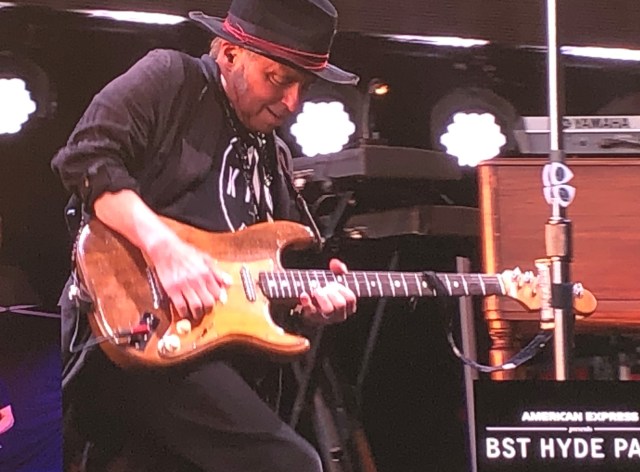
Limehouse Basin opened in 1820, and was known as the Regent’s Canal Dock initially. Two canals are connected with Limehouse Basin. One is the Regent’s Canal, which travels through East London, Islington, King’s Cross, Camden, Regent’s Park and onto Maida Vale, Little Venice and Paddington Basin, where it joins the Paddington Branch of the Grand Union Canal. The second is Limehouse Cut, which joins the River Lea. More of that in the next instalment. Back in the 19th century Limehouse Basin allowed ships that had come down the Thames to transfer their cargoes to smaller boats which could carry their loads along the canals to destinations further afield, notably wood and timber. Limehouse had been a port since medieval times, its name deriving from the lime kilns, or oasts which served the potteries in the area. It was also a shipbuilding centre. Today it is a marina lined, as usual, by apartments and restaurants and bars. There are some great views of Canary Wharf, and an arched bridge carries the Docklands Light Railway over the water.

Limehouse Cut

Regent’s Canal

Down by the river we find Narrow Street, with a Gordon Ramsay restaurant, the Narrow, just by a bridge over the channel connecting the Basin to the river. I and my friends went there in May 2021 after a walk down the River Lea. You were only allowed to eat outside at that point. The food was nice, but a chilly breeze off the Thames had us shivering! Travelling a little further east brings us to the Grapes, another old pub, which is owned by the actor Ian McKellen. Continuing along the Thames Path and over Westferry Circus we find ourselves in Canary Wharf. There are more good views as you approach.

Canary Wharf is a financial centre which rivals the City of London. It has some of the tallest towers in the UK, including One Canada Square, with its distinctive pyramidal top. It was built on the site of the West India Docks, which closed in 1980. The first buildings opened in 1991, including One Canada Square. The area is spectacular if a little soulless as you wander the streets. But there is plenty to entertain you as you get to know the place, including a large roof garden in Crossrail Place. I always enjoy the elevated journey on the Docklands Light Railway here, crossing the docks, looking into the surrounding offices. And since December 2021, there has been an exciting new feature at Wood Wharf – the latest Hawksmoor restaurant, set on a floating pavilion in the dock.

Misty morning, December 2020

Canary Wharf is situated at the northern end of the Isle of Dogs, another peninsula created by the bends in the river. If you walk south, through Millwall, down to the river, you reach Island Gardens where there are some good views of Greenwich, and an entrance to the foot tunnel, which runs under the Thames. It was opened in 1902 and is quite a fun way to get over to Greenwich – though watch out for speeding cyclists. They are meant to push their bikes along the 370 metres, but few do.

Island Gardens tunnel entrance

Tunnel entrance, Greenwich side

And so, we reach our last stop on this part of the journey, Greenwich. In the past a major maritime centre, favoured location for royalty and, of course the home of the Royal Observatory on top of the hill in Greenwich Park. The classic view, either from the Observatory or from the other side of the river is the Old Royal Naval College, with the Queen’s House resplendent in the background, if you are viewing from the riverside. The site of the naval college was initially home to the Palace Placentia, later Greenwich Palace, built by Humphrey Duke of Gloucester in 1443. Humphrey fell out of favour with King Henry VI and died in prison, possibly murdered. The palace was taken over by Margaret of Anjou, Henry’s wife. The palace was rebuilt by Henry VII between 1498 and 1504, and was the principal royal palace for 200 years. Henry VIII and Elizabeth I and her sister Mary were all born there.  The palace was again rebuilt in the early 17th century, and this was when Queen Anne of Denmark, wife of James I commissioned the Queen’s House. This was designed by Inigo Jones and is thought to be the first classical building in England.

Old Royal Naval College; Queen’s House the white building in centre background

In 1660 Charles II decided to rebuild the palace again, but it never came to fruition. In the early 1690s, Greenwich Hospital, a home for retired sailors was constructed. This lasted until 1869 when the buildings were converted for use by the Royal Naval College. The Navy remained until 1998; the buildings were leased by Greenwich University a year later. The Greenwich Foundation took over ownership and in 2002, the whole site was opened to visitors, including the famous Painted Hall. The National Maritime Museum is situated nearby – there is a lot to see in Greenwich!

The Royal Observatory was built in Charles II’s reign, completed in 1676. The architect was Sir Christopher Wren (who also designed the hospital). It is home to the Prime Meridian and thus Greenwich Mean Time. There are also wonderful views of the Old Royal Naval College, the river, Canary Wharf, the Dome and in the far distance, the City of London. Arguably there are no better views in London. I paid a visit in January for the first time in a while. I found the vistas breathtaking.

The Royal Observatory

Queen’s House in foreground, Canary Wharf in background

Down below, by the river, you can pay a visit to the Cutty Sark, originally a tea clipper, later used for the Australian wool trade once the Suez Canal opened in 1869. In time it became training ship, first in Falmouth, Cornwall, then in Greenhithe, further downstream on the Thames, between Dartford and Gravesend. It has been damaged by fire twice this century, but is in good shape at the moment. One of the best pubs in Greenwich is named after the ship – it is a little further downstream, beyond the naval college. A good place to stop for a beer and something to eat, after a river walk or a day trip to Greenwich.

A view from the Cutty Sark pub, November 2017

And there we end this part of the Thames journey. There’s been a lot packed into a short distance. The next episode will stretch out a bit more as we move out of London. It will take us downstream to Erith, in Kent, first stop the Dome.

The Dome from Greenwich Park

Posted in A Thames Journey | Tagged , , , , , , , , , , , , , , , , | 4 Comments

Duke Garwood at the Lexington, Pentonville Road, 26 February 2023

Duke Garwood is a multi-instrumentalist, best known for his languid, bluesy, atmospheric guitar. I first came across him on a Sunday afternoon at Latitude in 2015. Perfect music for the occasion. I was blown away by his guitar playing that day, the richness and warmth of it, the sounds he was conjuring from reverb and tremolo. I was getting hints of Robin Trower over a base of JJ Cale. He was the discovery of the festival that year.

Latitude 2015

Over the years he’s made a few albums, the best of which, for me, are 2015’s Heavy Love and 2017’s Garden of Ashes. The song titles are straight from the early 1970s: Honey in my Ear, Sweet Wine, Snake Man, Heavy Love, Days Gone Old, Blue. Not to mention the earlier classics, Jesus Got a Gun and Mellow Trucker Lady! Surely, you would say, this man is from the deep American south. But no, he hails from Kent. He’s in his early 50s, and in recent times has collaborated with Mark Lanegan on a couple of albums. His latest solo album, Rogues Gospel, was released last year, though I must admit it completely passed me by. I’ve caught up with it now, and it’s broadly more of the same – perhaps a little more instrumentation, a harder blues feel than the sleepy mellowness of, say, Heavy Love.

I saw Duke play at Nottingham Bodega in 2017 – and then, as far as I could tell, nothing. He does communicate on Twitter from time to time, mostly elliptical musings. I saw no evidence of live performances in this country, until I saw something on social media a month or so ago that suggested he was touring. A quick check and I found that he was playing the Lexington on Pentonville Road. Monopoly fans will know that one – it’s up the hill from King’s Cross, on the way to Islington. The Lexington has a good pub downstairs and a nice venue upstairs with the capacity for around 200 people. I’ve seen some great shows there in the past. It’s where I first came across Emily Barker; and I won’t ever forget the brilliant Wilko Johnson gig in 2011. So I got myself a ticket and suggested to my friend Shane that he might like to come along too. A couple of pints and some mellow blues sounded like a good way to end the weekend.

And that’s exactly what we got. Duke was back to a three piece, after having an additional guitarist back in 2017. Checking my 2015 Latitude photos, I think they may well have been the same drummer and bassist. Didn’t catch their names, I’m afraid, but they laid down a nice simple groove, over which Duke wove his musical spells. The finest Louisiana blues, straight from the garden of England! Or maybe the Thames marshlands gave him a taste for the sounds of the Mississippi delta and the Floridan everglades. Whatever, I love the sounds that he draws from his guitar, caressing the strings, fingers sliding up and down the fretboard, a flip of the tremolo arm. And the fuzz, the reverb – sultry, swaying, seductive, soporific. The swamp blues.

They played for an hour and a quarter, and that was just fine. There’s not a huge variation in melody or rhythm – with one exception towards the end of the main set, when Duke picked up the maracas and raised the tempo of his voice while the bassist powered the song along with a relentless, strident rhythm. It was quite rousing! It got the biggest round of applause. But soon we were back to our familiar groove, nodding gently – to the beat and in appreciation of a master of his craft.

Shake those maracas!

A very satisfying evening – a helping of Duke Garwood takes you to a better place!
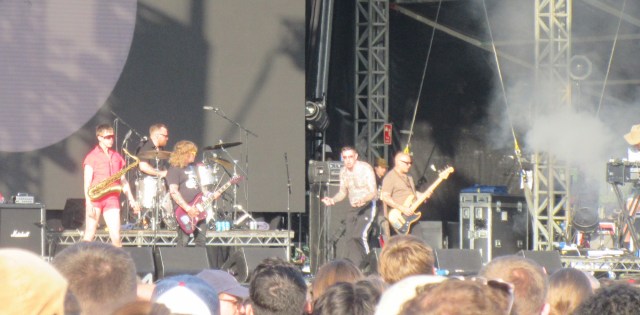
Thanks to Shane for this one

Posted in Music - concerts, lists, reflections | Tagged , , , | Leave a comment

The Murder Capital at the O2 Forum, Kentish Town, 23 February 2023

Second concert of the year, and one I was really looking forward to – the return of the Murder Capital. They had an amazing 2019: a brilliant debut album, When I Have Fears, which I made my No1 of the year, and a string of sold out concerts and triumphant festival appearances, which included the best performance we saw at End of the Road that year. Power, passion, swagger, emotion – the Murder Capital were the new sensation. I saw them again at SWX in Bristol in February, and, if anything, they were even better. Couldn’t wait for what they would do next.

And then the pandemic hit. And they went to ground. Making new music I hoped, but not much sign of it. They weren’t one of the bands that defied lockdown with online performances, new singles, even albums. They re-emerged in July 2022 with a single, Only Good Things. And a few more followed until the second album was finally released in January this year. It’s called Gigi’s Recovery, and reveals itself as a bit of a masterpiece after a few listens. There are no outright rockers as there were on When I Have Fears, but I had a sense that songs like Return my Head and Ethel would be powerful live. In fact, as the album revealed its layers, I felt that it would all be pretty dramatic onstage. There’s a subdued energy about it, some interesting twists and turns, a grandiosity.

And so it proved, because this was a sensational concert. The band look quite different now: more casual, more flamboyant; less of the menace that they had in 2019. But still the swagger. When I say they, I do mean all of them, but mostly I mean singer James McGovern, who struts the stage with a real charisma and connection with the audience. He looks more like a poet than a bouncer these days, but he remains a captivating presence. The set included pretty much all of the new album, interspersed with highlights from the first, and so had some quite long periods, mainly in the middle, where the songs were slow and building to a climax. That’s quite risky in a live show, when a large part of the audience might be there for the rockers, but it worked – or it did for me, and looked like it did for the crowd. And that, in the end, was down to James’s holding their attention. He is an engrossing performer.

The set began in the same way as the new album, with the atmospherics of Existence and Crying, before upping the tempo with Return my Head. Then they unleashed the crowd – and themselves – with two great favourites from When I Have Fears: More is Less and For Everything. This band knows how to rock out! From there we entered a long phase of slow burners, mostly from the new album, though there were also powerful renditions of Green & Blue and Love, Love, Love from the first. Highlights for me included The Stars will Leave Their Stage and the title track Gigi’s Recovery, both of which have so many layers, so many beautiful touches. These are the songs which I most find myself comparing to U2. There are others, like On Twisted Ground from the first album, which didn’t get an airing tonight. The comparison with U2 is intended as a genuine compliment – they are one of my favourite bands of all time. There’s a bit of late Bowie in their music too; and I think James might just be an admirer of Nick Cave. Such antecedents tell you just how good the Murder Capital are – and how good they were tonight.
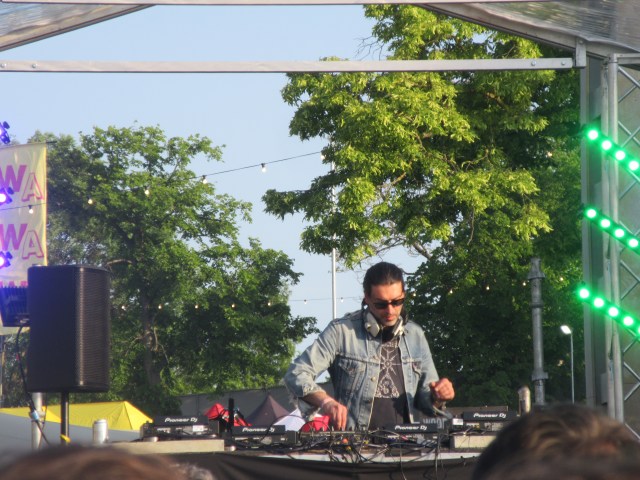
And then we had the last four songs! If anyone was lulled by the slower tunes, then they were jerked to their senses by the denouement. This was when the music got brutal: Feeling Fades, Only Good Things, Don’t Cling to Life, and finally Ethel, which held its own with the rockers from the first album. An exhilarating finish, James spending half his time surfing the crowd. It sent everyone away buzzing.

I thought the band paced the set really well tonight: a taste of rock power early on, a few familiar tunes amid those slow building new songs, and then the blast of rock’n’roll at the end. All the time played with poise and confidence; James a dynamic frontman.

Two brilliant albums, fantastic live: the Murder Capital are one of the best bands around. Can’t wait to see them again at Latitude in July.

James in Johnny Rotten pose!

And Morrissey!

Cathal Roper, guitar and keys; Gabriel Paschal Blake, bass

Diarmuid Brennan, drums

Damien Tuit, lead guitar

Posted in Music - concerts, lists, reflections | Tagged , , | Leave a comment

Jockstrap at the Rescue Rooms, Nottingham, 10 February 2023

On Friday I went up to Nottingham to see Jockstrap at the Rescue Rooms. I found out about the tour a bit late and the London gig had already sold out. I know Nottingham quite well, as my son Kieran went to university there, and have been to the Rescue Rooms once before, to see Honeyblood, back in 2017. I like the venue – it doubles up as a nightclub called Stealth and has a capacity of 450. A good size. Beware the nightclub combination if you go to see a band there though. Normally you’d expect the headliners to come on about 9 o’clock, but in this case Jockstrap were on just after 8.15. Fortunately my hotel was on the same street and I popped by at 7.30 to check on the timings as I couldn’t find them online. Good job I did!

Jockstrap – terrible name, tongue-in-cheek, I’m sure – are a duo: Georgia Ellery on vocals, guitar and violin, and Taylor Skye on keyboards and sound effects, of which there are many. Georgia Ellery is also a violinist with Black Country, New Road, and acted in a very good film called Bait, which is about the culture clash between the second-homers and locals in Cornwall. Both studied at the Guildhall School of Music and Drama, and their musical pedigree is evident in the bewildering array of sounds in their recorded music. They released their first album, I Love You Jennifer B, last year. I really liked it, and made it No 7 in my 2022 albums of the year. Since then I’ve been listening to it even more, and I’m loving it. There’s so much going on, from folky melodies, to cinematic soundtracks, to poppy interludes, to electronic noodling, to thumping dance beats. Quite often in the same song! It repays multiple listens.

With that in mind, I was keen to see the band live again. Previously I’d just seen them at festivals: the first time at Green Man in 2019, and then Green Man again in 2021. On the latter occasion I thought they were a bit self-indulgent; but now I can see that they were experimenting with the music and the beats that would form the basis of the album. I did attempt to see them at End of the Road in 2022, but they were performing in a ridiculously small outdoor space, which didn’t cater for their growing popularity, and I couldn’t even see them. I gave up and went to see something else. This tour provided the chance to put that right.

I caught a bit of the support act PabloPablo – one man and his sound deck – and nursed my beer during the break as I tried to make sure I had a reasonable sightline of where Georgia would be singing from. I did – for a while – then a young man with a good head of hair shifted slowly to his left and partly obscured the view. Such is concert life when you are standing!

They came on amid the glaring lights, assumed their positions and started with the album opener Neon. There was no between-songs patter, just a few smiles and thank you’s. Georgia looked elegant in her long dress; Taylor almost dapper in his shirt and tie – auditioning for Kraftwerk, perhaps? The sound was excellent, the lights inventive, enhancing the show. They played for an hour or so, the set focused on the album, although there one or two older tunes, notably The City towards the end. That song is a real pointer to what would come on I Love You Jennifer B.

Highlights for me, and I think the audience too, judging by the reaction, were my three (current) favourites from the album, which have all been singles. Glasgow, with its engaging melody, Georgia strumming her acoustic guitar, was a real crowd celebration, people singing along. One of their more conventional pop songs – except it has swirls of sixties film music and a few other bells and whistles. She’s not going to Glasgow by the way! Concrete over Water might be their most popular song – it’s the most streamed on Spotify for now – and is a rather lovely ballad at heart, that reveals Georgia’s voice at its best. Its refrain had the crowd in full voice again. And finally, of course the last song of the set, the techno banger that is 50/50. That had the crowd actually dancing – it’s impossible not to. And those bass lines – wow! Even through my recently acquired proper ear plug, you could feel the vibrations drilling into your ear drum. And of course it isn’t a straight techno banger – there are all sorts of weird and wonderful things happening as the song progresses, veering it off course and bringing it back again. Meanwhile Georgia chants something about 50/50. In a way, it took me back to some of Deee-Lite’s finest moments in the early 90s – with extra bass.

And as soon as 50/50 was over, they smiled, said thank you again, and were off. Leaving a well-satisfied audience – there was a buzz about the place.

Who knows what Jockstrap will come up with next. Will they even stick together for long? Whatever Georgia Ellery and Taylor Skye come up with, it is bound to be interesting.

A few more photos – just iPhone quality from near the back this time.

50/50!

Posted in Music - concerts, lists, reflections | Tagged , , , , , | 1 Comment