The exhibition, “Painting the Modern Garden – Monet to Matisse” at the Royal Academy, has just closed. I went a couple of times, and what a wonderful collection! This was art at it’s most appealing: you want stunning scenery, you want flowers, you want vivid colours, you want beautiful people, you’ve got it! You’d like to have that one on your wall? Doesn’t everyone? So art for today’s art-loving masses, me included. A roaring success.
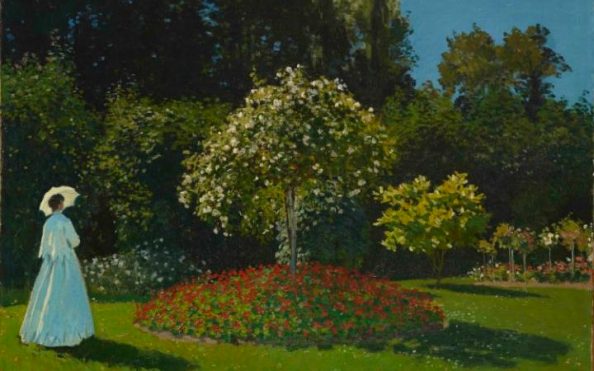
Monet’s “Lady in the Garden”, 1867
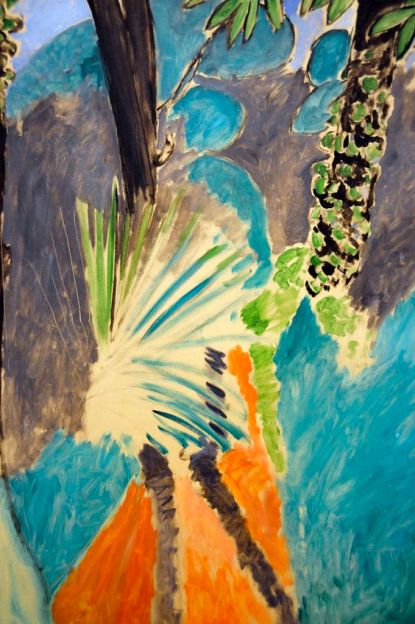
Matisse’s “Palm Leaf, Tangier” 1912
But does that make it bland, safe? Does being easy on the eye disqualify a work of art from being radical, challenging? I would say no. Especially when you put the art on display into historical context. At the heart of the show is Impressionism, with Monet to the fore. Pissarro, Cezanne, Renoir, Degas and others in support, as well as a number of great 20th century artists. And Impressionism has so captured the public taste in recent decades that it seems the safe bet, always. But think how adventurous it was at the time, how it shifted art from mostly recognisable representations of images and scenes (with notable exceptions like Turner in his later years) to representations of the mind’s eye, what was going on in the artist’s head. Picasso, the Cubists, Expressionists and any number of ists then took it all even further. But the Impressionists started it. Think of the brush strokes, the colour combinations, the sheer imagination. Impressionism attracted a lot of opposition from critics when the artists associated with it started their experiments. New ideas and approaches always do. But they won and they are still winning.
What of the exhibition itself? Well, I found it a delight from start to finish. Monet was its anchor. From the early paintings – people in gardens essentially – to the the extraordinary portrayals of his garden in Giverny, with the Japanese footbridge the centrepiece, to, at the end of course, some of the monster canvasses depicting those abstract water lilies. Monumental! I loved the use of light in some of the more conventional garden paintings. “Lady in the Garden” from 1867, was a striking example. The lawn and the lady positively seemed to glow.
As for those Japanese footbridges, some of the renditions went wild with colour. Monet was inspired by Japanese artists like Utugawa Hiroshige, a few of whose prints were shown in the exhibition.
For me, one of the stars of the early part of the exhibition was Pissarro. He’s known best for his “Pointillist” art – using tiny brush strokes, dots, to conjure up the image. But some of his earlier work was more traditional and really brought out the essential Frenchness of the landscape. I liked “Kitchen Gardens at L’Hermitage, Pointoise”. I’d have that on my wall! I loved one of the quotes the RA had found about Pissarro too. It began by mocking him for his deplorable fondness for market gardens before dismissing him as an impressionist market gardener specialising in cabbages. Only a French critic…
Pissarro was unrepentant. He wrote to Monet, I love compost like one loves a woman…
The middle phase of the exhibition brought some relatively unfamiliar artists to my attention. Notably three Spanish artists, Joaquin Sorolla, Joaquin Miry Trinxet and Santiago Rusinol. The colours were vivid, exuberant, reflecting their Mediterranean roots. Rich pinks, ochres, oranges, greens. Life itself.
I loved Max Liebermann’s updated Impressionist take on scenes from the shores of Lake Wannsee, just outside Berlin, too. And a one off from a British artist, Alfred Parsons, who depicted a garden, entitled “Orange Lilies”, in Broadway, Worcestershire, a place I know and love from having visited it on numerous occasions for get-togethers with friends over the years. Could that garden, painted in 1911, have been where we stayed?
The latter part of the exhibition gave us artists like Matisse, Kadinsky and Munch diverting from their usual preoccupations to celebrate the glories of the garden. Again with exuberant flourishes. No need to pretend – just celebrate colour and beauty… nature. I loved the way, though, that Munch managed to remain discombobulating. Or should I say scary?
There was a room of photos of many of the great artists that featured in the exhibition, just before Monet’s waterlily denouement. And did they look like artists? Oh yes!
There’s a wonderful quote from Monet too, which sums it all up really. During the First World War, that horrific slaughter which came close to where he lived and worked – and his beloved garden. It’s a good way to end this piece.
As for me, I’m staying here all the same, and if those savages must kill me, it will be in the middle of my canvasses, in front of all my life’s work.
He and his art survived. And we still wonder at the splendour of it.
Art is eternal.
https://www.royalacademy.org.uk/exhibition/painting-modern-garden-monet-matisse