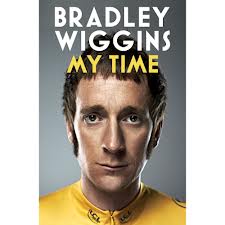
Sportsthoughts (62) – “My Time” by Bradley Wiggins

DownloadedFile

I’ve just finished reading Bradley Wiggins’ autobiography, “My Time”, featuring his amazing 2012, when he won the Tour de France and the Olympic time trial gold. And three other top road races: Paris-Nice, the Tour de Romandie in Switzerland and the Dauphine-Libere in France. An extraordinary series of achievements, like nothing any British road cyclist has ever achieved before.

It’s an enjoyable read – it’s mostly about success, after all. Not a work of art, but for anyone who enjoys cycling, and maybe others too, it’s an inspiring story. If you’ve been reading my blogs, you’ll know how much I’ve enjoyed Bradley’s feats over the past year, so I’ll admit to reading the book with a very positive mindset, but hey what’s wrong with that?

Why is it inspiring? Well, partly it’s just sharing the triumphs, enjoying the personal insights; but it’s also the appreciation of what went into those triumphs. For me there are three things that Bradley highlights which are lessons for all of us if we want success, especially when we are part of a team.

1. Preparation

The book is at its most fascinating as Bradley describes his training regime for 2012. The preparation for the 2012 Tour started almost as soon soon as the 2011 Tour ended. Especially for Wiggo, as he was forced out of the 2011 after he was caught in one of the big crashes and broke his collarbone.  He was back for the Spanish tour, La Vuelta, where the Sky team did pretty well, but didn’t win it. Lessons were learnt from that.

One of the most striking things was the training he did at home over the winter of 2011-12. In his shed at the bottom of the garden, on what was probably the ultimate exercise bike, hooked up to the computers at HQ at the Manchester velodrome. Heaters turning the temperature up to 35 degrees celsius. Instructions pumped down the line about the intensity, the power, everything. The impression is that this was a new approach to cycling, where in the past a lot of the hard training had been done in races themselves, in the early part of the season.

Then the training camps in the mountains of Tenerife and Mallorca. Really testing the athletes – the team, not just Bradley – working on the power, the ability to up the tempo at crucial moments.  I love all the jargon: torque, cadence, wattage, TSS (training stress scores). I’ve been imagining it as I cycle up a gentle hill in Ealing – not quite the Alps – what’s my torque? Have a got the right cadence here? Ah, great, it just brings home what a feat of endurance any competitive cycling is, never mind the pinnacle of the sport.

2. Teamwork

Maybe there was a time when a swashbuckling individual would win the Tour through sheer brilliance. Eddie Merckx perhaps. But no longer. It’s all about putting the best cyclists in a place where they can win, be it the sprints or the overall classification. Bradley Wiggins won the Tour de France because Sky knew he had the capability to do what was necessary. The role of all the other team members was to make sure he was in the position to do it. The book describes how that happened, but also how, from time to time, it almost went awry. The classic moment, which was clear to see on the TV coverage at the time, was when Chris Froome launched an attack on the breakaway group in one one of the Alpine stages. He said it was to take time out of the Italian, Nibali, who was his rival for second place. But it looked to all of us like a grab for first place, and within the Sky confines it was a clear breach of instructions. He was reined back by the team management, but it led to questions – briefly – about who was really the best. Inexcusable in a team sport where roles are so clearly defined. It’s the only place in the book where Bradley has a go at a team mate. Generally he is full of praise, especially for Mark Cavendish, who put aside green jersey aspirations to help the team.

The message – you only win things when you are genuinely a team. Applies in any workplace as much as top level sport.

3. Sacrifice

To achieve something like victory in the Tour de France, the preparation, the focus, is phenomenal. Inevitably, that means that some of those nearest and dearest to you are neglected. Bradley clearly feels this very strongly. It takes great understanding and support from your family. Younger children especially won’t understand why you aren’t there for key moments in their life. It’s part of the pact for success – you can’t have everything. We all have to make choices. People at the very top of their game have to be selfish. They may regret it. They are human. Bradley addresses this with great honesty.

Those three themes tell us what it takes to win the Tour de France. There are some lovely, moving moments in the book, when it is coming together. Again, there are three which really hit home for me, brought a gulp or shiver to the spine. Or a hint of a tear, until I remembered I was on the Piccadilly Line, heading home!

The first was when Bradley won his first yellow jersey, after the first major climb, on Stage 7, to La Planche des Belles Filles in the Vosges, near Nancy. He describes movingly how much that meant to him, to join the pantheon of yellow jersey wearers in the world’s greatest race. He knew his history, knew whom he was joining. It was like nothing else would matter – at least he had that now. No-one could take it away from him.

images

First ever yellow!

The second was in the second time trial, a race to Chartres. The last day before the run into Paris. Already two minutes ahead of the field, so no question of having to take time out of anyone, like Cadel Evans. But still there to be won. Feeling at the peak of his form, all the training, all the preparation, coming to fruition. Knowing that if he just did what he knew he could do, he would be the Tour de France winner.  He did that and more. He took first place in the time trial, taking more time out of all his rivals. As he rode the race, he was in his own victorious bubble, guided along by Sean Yates, his tour director, on the radio. Everything went to plan. The culmination of all that preparation, teamwork, sacrifice. Cloud Nine.
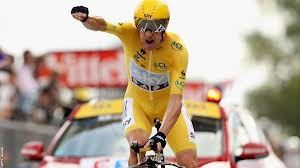
DownloadedFile

I’ve won the Tour de France!

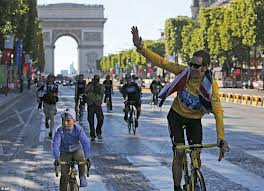
The third was just the way he sought out his family – wife Cath and children, Isabella and Ben, after Cav’s victory on the Champs Elysees. (Where Bradley played a major part in riding out for Cav – no simple victory procession – this was a team, a return of favours.) He did the same when he won the Olympic time trial. Both times he didn’t seem to know where they were. In the midst of victory, finding them was the most important thing. Just a reminder, and a moving one: he’s just an ordinary man, with ordinary feelings. But with an extraordinary talent.

DownloadedFile

Leading out Mark Cavendish on the Champs Elysees
DownloadedFile

Victory parade with son Ben

Wonderful, feelgood stuff. But there are dark moments. Like in 2010, when things went wrong on the bike after a fourth place in the Tour de France in 2009, and he suffered the loss of his grandfather, George, who had been very much a father figure in his life. Or, of course, the drugs insinuations. How could he and Sky get so good so quickly? This in a sport that has been riven by cases of doping and just recently ripped apart again by Lance Armstrong’s confessions. To any doubters I’d just say read the book. Read the passionate denunciation of drugs, his explanation of why he could never contemplate taking them. And the the whole description of how the Sky team brought a new level of preparation and planning to road racing. It may be less glamorous than the idea of individuals relying on pure talent, but it is the professional way. Advancement through small margins. Attention to every detail. Science as well as inspiration. That’s how Bradley Wiggins won the Tour de France and the Olympic Gold.

But there is inspiration too. Proof that if you try hard enough, care enough, are willing to put in the hard yards, you can achieve your objectives. Your dreams.

A lesson for us all.

(Photos from Google Images)

Posted in Art, books, theatre, cinema, Sportsthoughts | Tagged , , , , , , , | 9 Comments

Sportsthoughts (61) – Six Nations 2013 predictions

Saturday 2 February marks the beginning of this year’s Six Nations rugby tournament. Always one of the highlights of the sporting calendar and a great pick-me-up in the gloom of winter. Last year my Sportsthoughts 10 set out why I love the tournament and made some predictions. Needless to say, they were all wrong. Sportsthoughts 17 made my excuses!

Last year I thought Ireland were just too strong for everyone. They came third. The strength of their provinces – Leinster, Munster, Ulster – didn’t feed through to the national team.  Wales, who I had down to come fourth, won the Grand Slam! England did marginally better than expected: 2nd rather than 3rd. And France were a poor fourth. Italy and Scotland occupied the bottom two slots as usual, but Italy 5th and Scotland 6th. I’d predicted the other way round.

I’ll give it a go again this year nonetheless. So here’s what not to put your money on!

1. England

2. France

3. Ireland

4. Wales

5. Scotland

6. Italy

England first because we just can’t ignore that victory over New Zealand, and the steady improvement before it. A young team still, which could malfunction, but I’m betting that they have got it together now and are the team to beat. I’m going for a Grand Slam.

So Jim Telfer, ex-Scotland player and rugby coach says, ahead of the England-Scotland game this Saturday, that England are “arrogant”. Widely reported in the media, as intended by Telfer, I’m sure. But hardly original. The Scots have been moaning about English arrogance since time began. Chip on the shoulder stuff. Let’s see how the game goes.

The French could easily win the tournament. If the Heineken Cup is a pointer, then they will triumph. Their teams in the quarter finals look strongest. But all of them have a lot of foreign players in key positions. So as usual the question is, which France will turn up? I think they will beat all except England.

Ireland are rebuilding, as some of their stars reach the end of the road. Their back line is still exciting and dangerous and Brian O’Driscoll is back for maybe one last hurrah. I’m not sure their forwards are quite right yet, but, hey I could be wrong. But probably not. I’m betting the French and English forwards will be too much for them this time around.

Wales have been ravaged by injuries recently and their coach, Warren Gatland, is absent, preparing for the Lions’ tour of Australia. But it looks like quite a few of the injured players are coming back just in time, so they could revive. Their teams in the Heineken Cup have been disappointing. So it’s hard to predict much success for them, but they will always be capable of a surprise. No Grand Slam this year, but this 4th place prediction could easily be wrong. There is a lot of talent in the Welsh team.

Scotland and Italy are interchangeable. They simply don’t have the squads to compete over the whole tournament. Scotland will always raise their game against England, driven by historical hatred, but there are four other games when something else than bitterness is needed. Wooden spoon contenders with Italy.

I’m not totally convinced by England. Not enough Quins boys in there yet! If France play to their potential they could be immense. I think this year it will come down to these two, but it is all fine margins. Watch out for the winner of Wales v Ireland getting on a roll, and turning everything on its head.

So all I know is that it is going to be a brilliant, unpredictable tournament as usual. A winter warmer.

Swing low, sweet chariot!

Posted in Sportsthoughts | Tagged , , | 4 Comments

Sportsthoughts (60) – So Close! Brentford 2 Chelsea 2

The FA Cup. Not what it used to be – time was when it felt as important as the League and the winners played in their own competition in Europe – but still capable of firing the imagination. Eventually it is usually won by one of the big sides, and in recent years there haven’t been too many upsets. But this season something seems to have happened. The minnows have bitten back.

The League Cup – currently labouring under the title of the Capital One Cup – set the tone, with Bradford, from League Two (ie, the fourth division) reaching the final, beating Wigan, Arsenal and Aston Villa (over two legs) on the way.

And this weekend there has been a whole load of “giant killing” acts. Millwall beat Aston Villa on Friday (not very giant killing given Villa’s previous flop). On Waturday, non-league Luton toppled Norwich and League One Milton Keynes Dons stuffed QPR. Today League One Oldham beat Liverpool 3-2 and Championship Leeds (once mighty Leeds but no longer) ambushed Spurs 2-1. And none of them looked like flukes. The top teams get complacent, put out semi-reserve teams, and the lower league teams may be beginning to get better, as training and technique improves at all levels.

Which brings us on to the West London derby that hadn’t happened since 1950, Brentford v Chelsea. League One promotion hopefuls against the Premier League arrogant aristocrats.

Brentford are my local team, 20 minutes walk down the Windmill Road. Just over the A4. Over the years I followed them a bit, but despaired at the awful football they played. They had a really good spell seven years ago, when they were poised for promotion and beat Premier League Sunderland in the FA Cup in January 2006. Things were looking good, but the management immediately sold their best striker, DJ Campbell, for a paltry half million to Birmingham. The goals dried up, promotion was missed and they slid back into obscurity. I stopped going a lot, as I got into the Quins rugby as a season ticket holder four or five years ago. The Bees stopped buzzing for me.

So I felt like a bit of an interloper when my friend Smithy offered me a ticket to today’s game. The big one. But I couldn’t resist the chance to see the Bees pit their wits against the Chelski.

The game was on at the absurdly early time of 12 noon. On a Sunday! A tweet from the Pope (yes I follow him  – or his press office) reminded me it was a time for the family and for worship. Er well, Smithy and I met for a fry up at Cafe Nell on Northfields Avenue at 10 am and then walked down to the Lord Nelson pub near the A4 for a couple of pints of London Pride before the game. Before 11.30! The things you do for football…

There was a cracking atmosphere inside the ground. A tremendous sense of anticipation. The Chelsea fans cuttingly sang “You’re only here for the Chelsea” (which was kind of true in my case) but the Brentford boys riposted with “Champions of Europe, you’re having a laugh”. Which, as the first half progressed, was very telling. And they had great fun booing the pantomime villains, John Terry and Ashley Cole.

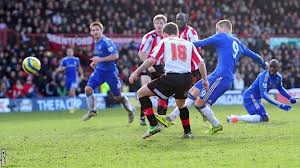
Brentford started tentatively, but as they began to realise that some of the Chelsea players weren’t really up for it – step forward Marko Marin and Oscar – they grew in confidence, dominated midfield and deservedly took the lead, through Marcello Trotta. The fans went crazy. 1-0 to the Super Bees!

images

Chelsea came out in the second half with a bit more purpose, helped by the fact that Juan Mata was on. He became the fulcrum of the team, gave it shape and confidence. It was no surprise when Chelsea equalised. Oscar, liberated by Mata’s arrival, with a classy outside of the boot finish.

images

It didn’t look too good for the Bees, but they regrouped and pressed forward. A lovely pass by striker Clayton Donaldson put subsitute Tom Adeyimi through and he was brought down in the penalty area. Young midfielder Harry Forrester put the penalty away. 2-1!

images

Inevitably Brentford sat a bit too deep after that and Chelsea dominated. In the end they got a deserved equaliser, a lovely curled shot from Fernando Torres, who’d had a frustrating game.

DownloadedFile

With a few minutes to go you feared the worst, but Brentford closed the game out for a replay at Stamford Bridge.

That will be great for Brentford financially, and I hope I’ll be able to go to the replay. I was impressed by some of their play today – more sophisticated than what I witnessed when I used to go to see them regularly. There were some promising players in the team. Harry Forrester and captain Jonathan Douglas were impressive in midfield. The young left back, Shaleum Logan, showed good skills and the sign of class – time on the ball. And I like the the way Clayton Donaldson put himself about, especially when he went to sole striker in a 4-5-1 in the last twenty minutes.

Chances are that Chelsea will polish off the tie fairly easily in the replay. But you never know. Wouldn’t it be great if the Bees humiliated John Terry and his complacent gang?  Not that they’d care all that much, as they have bigger fish to fry in the Premier League. But manager, Rafa Benitez might, as the hard core fans are still against him. Contrast with the Bees manager, the German Uwe Rossler. Top player in his time and looking pretty slick as a manager too.

I don’t really go for the “magic of the Cup” cliche that all the commentators trot out. But it is a time for fans of the smaller clubs to dream, and Brentford’s performance today showed that those dreams can have meaning.

Come on you Super Bees!

(Photos courtesy of Google Images. Took a few shots on my iPhone, but managed to delete them updating my iPhone software tonight. Grrr….)

Posted in Sportsthoughts | Tagged , , , , , , | 3 Comments

Have You Heard (and seen)? – (32) Billie Holiday singing “Fine and Mellow”

I’m on to a chapter about jazz in my book at the moment and earlier this evening I was just reminding myself about Billie Holiday. What a fantastic singer she was. She had the most turbulent life – absolutely awful as a child especially. That all came out in one of the most amazing, original bluesy voices ever. And the best thing of hers that I ever heard was a song called “Fine and Mellow”. I first came across it in a documentary on the TV –  probably BBC2 and probably the late eighties. The memory about the timing is hazy, but not the performance, which was extraordinary.

Billie sings this woozy, wistful blues about a man who’s done her wrong, but who she can’t resist, and then there is the most amazing array of the greatest saxophonists and other brass players taking their turns to embellish the song, paying tribute to Lady Day. Lester Young, Ben Webster, Coleman Hawkins, Gerry Mulligan, the list goes on. It’s a recording of a performance on an American TV show in 1957. It must have been mesmeric to have been there witnessing this. Everyone is in the zone. I’ve rarely seen a performance in which there is clearly so much love, so much mutual respect. Subtly expressed, but deep. I especially note Gerry Mulligan, the only white man playing a solo: in 1957 when these things in America might still have mattered. He just plays like he is the luckiest man on earth to be there.

I think he was.

So, thanks to the ever-brilliant YouTube, here’s the video in question. It’s nine minutes long, including the gauche introduction,  but every second is worth it. I promise you!

Posted in Music - Have You Heard? | Tagged , , , , , , , , | 2 Comments

Sportsthoughts (59) – Oh No! Arsenal 5 West Ham 1

Fortunately I went out last night, so I didn’t watch or listen to the drubbing that West Ham got at the Emirates. It mostly happened in a ten minute spell just after half time, when Arsenal rapidly scored four goals. Things got worse later on when young Dan Potts went off with a serious head injury. Hope he’ll be OK.

West Ham v Arsenal is always a bit of an event in our house. My son is an Arsenal supporter. So when they thrash us, as they usually do, the pain is tempered by the fact that Kieran will be happy.  Likewise, if we win, I just can’t gloat. It causes too much upset. And but for those two games in the season, I’m a bit of a Gooner myself, really. Strongly my second team. And so they should be. My Dad supports Arsenal, as well as my son, brother-in-law and father-in-law. I’m the renegade. The result of the 1966 World Cup final, when I decided that Geoff Hurst, hat-trick hero in the 4-2 defeat of West Germany, was my favourite player. He like Bobby Moore and Martin Peters, was a West Ham man. It had to be the Hammers for me.  I was seven at the time. I’ve paid for that decision ever since!

Anyway, I expected something like this 5-1 defeat. West Ham can be quite obliging to teams in a bit of a rut. Always a chance to recover your form. Arsenal, of course, aren’t doing that badly, but to listen to their moaning fans you’d think it was the end of the world. And there is something very brittle about the team at the moment.  They are capable of great things – witness that ten  minutes last night – but there is something weak at the core of the team, in the spine. A lack of leadership, of passion. And so they’ve lost games they should have won and are staring at a first season in aeons when they don’t make the top four and Champions League qualification. If that happens, could it be the end of Arsene Wenger’s reign?

As for West Ham, I’m getting a little worried. The natural state of the football fan is pessimism, and I’m beginning to look at the bottom of the table rather than the top ten. The relegation zone. We are still eight points above the 18th placed team, Reading. Only 13 more points to reach the magic 40, which usually means safety. Objectively, we should be OK, but there’s a nagging doubt. We have history. Implosion is always a possibility.

I’m sure Big Sam has it sussed. And my suspicion is that he even wrote last night’s game off, with a view to winning the next one, away to Fulham. Why else did Joe Cole and Mo Diame both start on the bench? Why didn’t Joey even come on?

I don’t like all this pragmatism. Might keep us up in the end, but it’s not the West Ham way. Just as booting it long to Carlton Cole all the time isn’t either. It’s an ambiguous time for West Ham fans at the moment. We’re delighted to be back in the Premier League, but the Allardyce approach to the game, admirable though it is in its attention to detail, and its defensive solidity in most games, still grates. It’s hard to love. There are no pretty bubbles in the air.

Fingers crossed, we’ll be alright.

In the meantime, no wonder my focus is on Harlequins. The best English rugby team playing the best rugby. A new experience for me, supporting the best.  #COYQ!  

(Well, and #COYI too – I will always love the happy Hammers, the Irons).

Posted in Sportsthoughts | Tagged , , , , , | 4 Comments

Sportsthoughts (58) – the Heineken gets heavy!

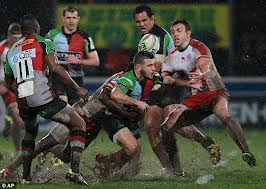
So, Quins into the quarter finals of the Heineken Cup, as top seeds, after the last round of matches this weekend. They slugged it out with Biarritz on a swamp of a pitch in south west France, Friday night, and came away with a 16-9 victory. 100% record, but not without a few scares, mainly against Connacht, the up and coming province in Irish Rugby. A home tie in the quarters guaranteed against one of the two best second-placed teams. Easy?

images

Before it got REALLY muddy! Photo from Google Images/ Daily Mail

Er, no. the privilege of playing Quins came down to a battle between the mighty Munster and the even mightier Leinster, between them winners of the tournament five times in the last seven years.  Both going through something of a transition, as some of their great players retire or near the end of their careers, but both still formidable. Leinster needed a bonus point away to Exeter on Saturday, which they duly managed. That meant Munster needed the same on Sunday against Racing Metro, a top French team, but with no interest left in the competition. Munster did the business, which meant they got the eighth QF slot by dint of scoring one more try than Leinster over six games. Blimey, I bet there were some celebrations in Limerick! And bemusement in Dublin. Leinster not qualifying for the quarter finals. Unheard of. I think they can put it down to the (bad) luck of the group draw, ending up with Clermont Ferrand, the team of the moment, stuffed with French and other internationals, and favourites to win this season.

There was a real battle, too,  in the snow yesterday between two giants of the game, Leicester and Toulouse. Winner takes all. You wondered why the authorities didn’t have a fluorescent ball for a game when the ball spent a lot of time being kicked for territory on a snowy white field. It was a grim struggle. Toulouse had the possession, but kicked their penalties so abysmally that Leicester snuck through 9-5. Their reward, an away tie at Toulon, another powerful French team, featuring our greatest rugby icon,  Jonny Wilkinson, at fly half. Rejuvenated, refreshed, on the Mediterranean coast.  Who isn’t?

DownloadedFile

Ou est le ballon? Photo from Google Images/ Daily Mail

So, some heavy duty ties in the quarters, to be played in April, after the Six Nations internationals take centre stage over the next couple of months. Toulon v Leicester, Saracens v Ulster, Clermont v Montpellier and Quins v Munster. Last time Quins played Munster was away in the semi finals of the Amlin Cup, the secondary European tournament, the season before last.  It was away, in the fortress that is Thomond Park, Limerick. Our expectations weren’t that high, but the boys played one of their greatest games and came through.  It was the turning point, for a team which still hadn’t totally conquered the self doubt when it came to the crunch games. They went on to win the final in Cardiff against Stade Francais and haven’t really looked back. Getting better and better.

Shouldn’t tempt fate. Munster are an experienced team who know how to win these knock out games.  It will be very tough. And if we win, it will get tougher still: away to Clermont or Montpellier. Which probably means Clermont who NEVER lose at home.

But there’s a first time for everything. If Quins can get past Munster – and what an atmosphere that will be at the Stoop – they will believe they can do it. It will be an epic clash. The best of France v England. Bring it on!

Posted in Sportsthoughts | Tagged , , , , , , , , , | 6 Comments

It’s snowing!

One of the features of global warming is that it’s started to snow more in the winter again, here in the UK. Not serious snow like you get in Canada or Norway, but enough to cause a fair bit of disruption and lots of fun for children and adults alike. Today it kept on snowing through the day and round where I live there weren’t too many people venturing out. Maybe tomorrow.

The kids are all waiting for that email from the school saying it’s been closed on Monday. Not sure it will happen: public transport’s been holding up quite well so far. We’ll see.

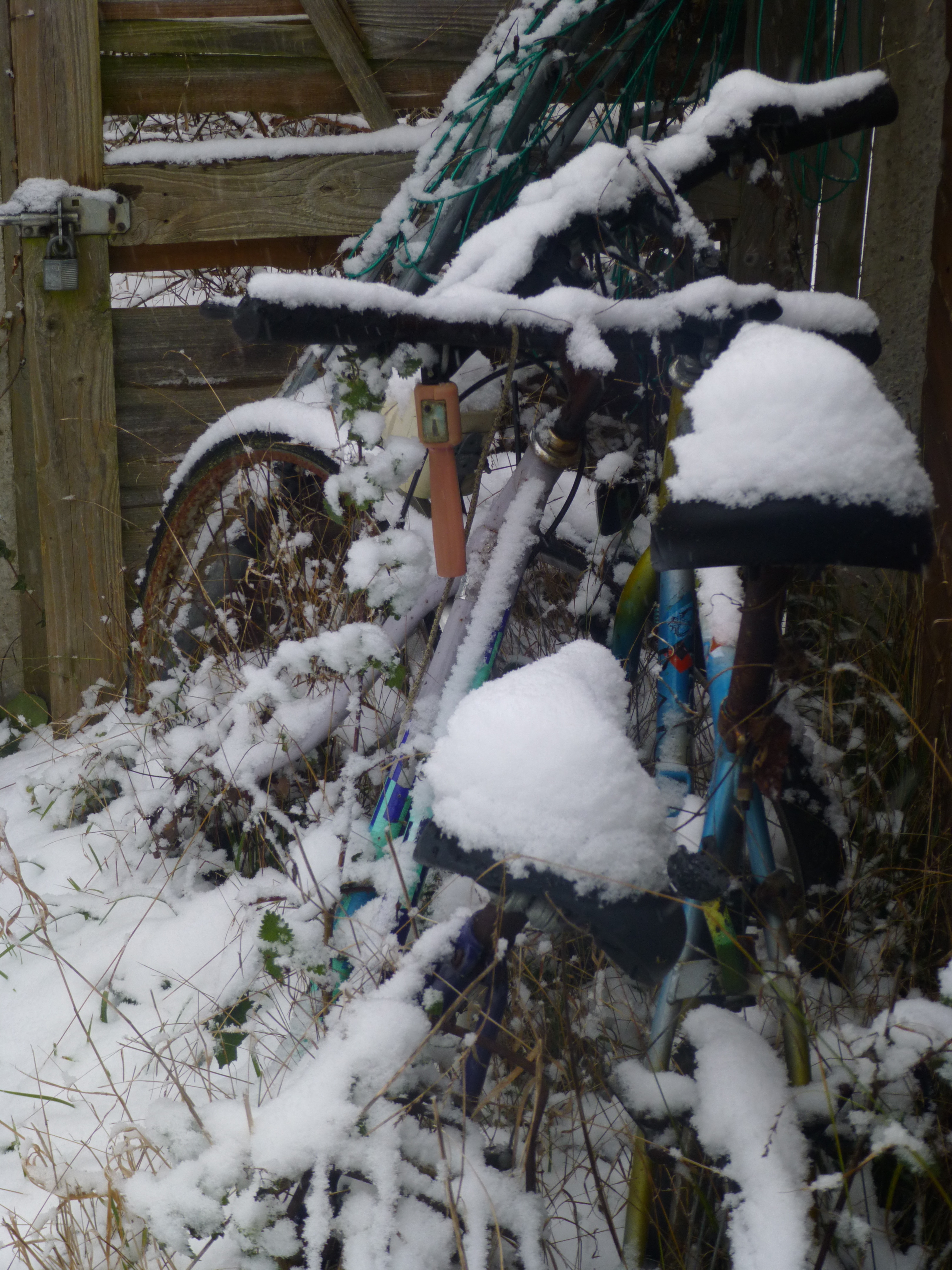
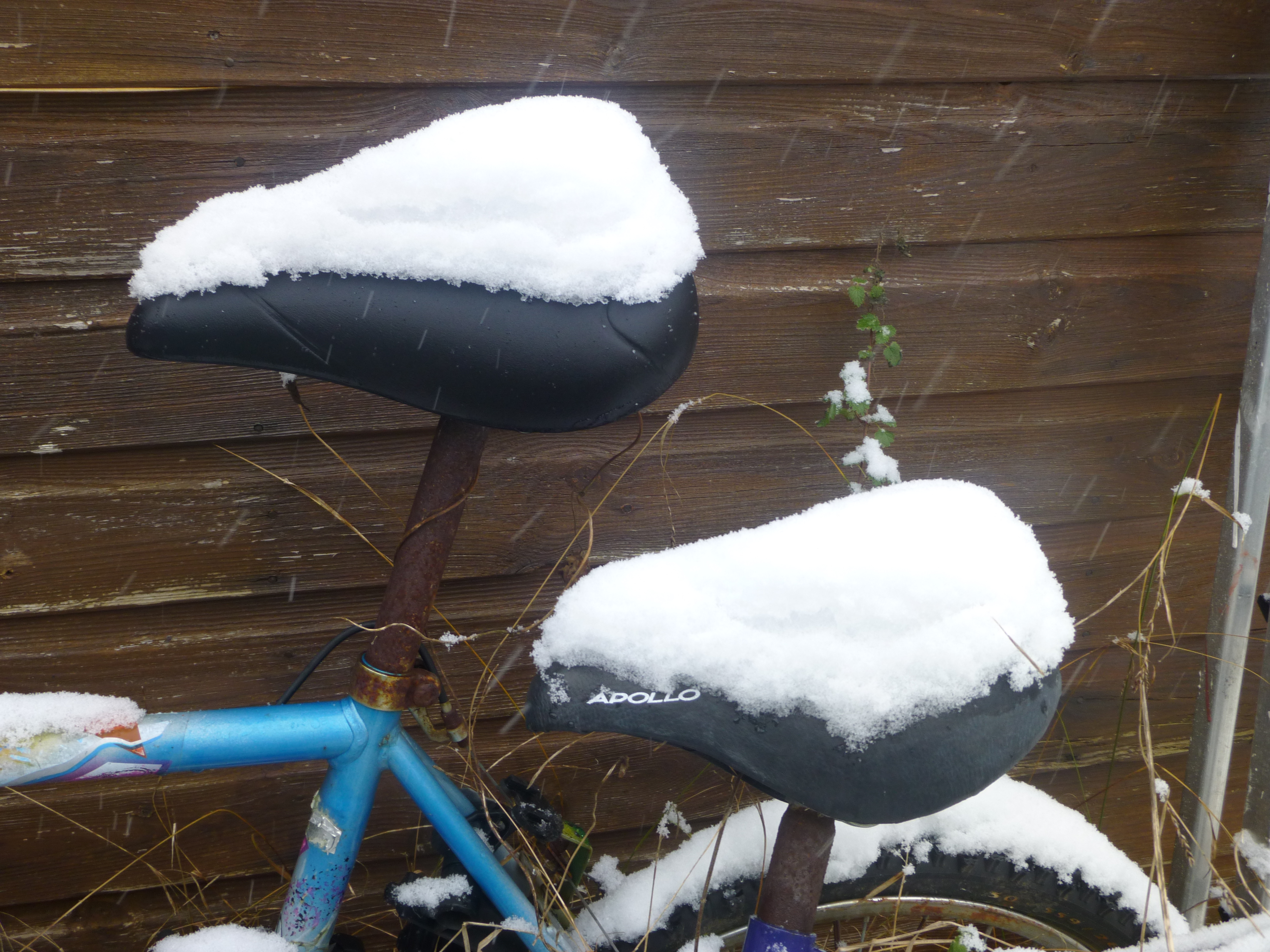
Anyway, I love going out in the snow to take photos. Everything changes its appearance. New shapes and perspectives emerge. It’s a thing of beauty and wonder really, especially when you go into close up. So here are a few shots I took this afternoon, before I settled down for some mass sports viewing!

If you’ve been reading my blog for a while, you’ll know I did one called An (un)English Garden last year. About how all the mess can look quite interesting. Good excuse for leaving it that way. Here are a few shots of the same mess, enhanced by the snow! Double click to get full size.

The summer selection.

P1010796P1010805

P1010804P1010810

The old trampoline is going soon… and the burst balls.

P1010803P1010806

Sums up Arsenal at the moment… somewhat forlorn. Hiding.

P1010814

Bush, getting closer…

P1010799P1010800

P1010801

Still haven’t taken these old bikes to the dump!

P1010812P1010817

Bramble and ivy.

P1010826P1010827

Moving into the street, this one should be in Cannes…

P1010837

The park.

P1010841P1010844

P1010845P1010847

Fallen…

P1010851

Path.

P1010854P1010855

P1010857

Flying high.

P1010859

Patriotic allotments.

P1010860P1010862

The Tube depot – always looks good in the snow. As long as they keep running!

P1010869

P1010865P1010872

P1010873P1010874

Boston Manor station.

P1010868

Greys and browns and whites dominate. Soft, soothing colours and light. But different patterns, unusual profiles. Snow transforms the sky and the landscape.

If you’d like to see a few more of these photos click here.

Posted in London, Photos, Random stuff | Tagged , , , , , , , , , | 6 Comments

“How Music Works” by David Byrne

DownloadedFileimages

Just spent a lazy Saturday morning finishing a great book by David Byrne, called “How Music Works”. For any of you who aren’t familiar with DB, he was the frontman with the Talking Heads in the seventies and eighties and has made a lot of interesting music since, often collaborations with artists from all over the world.

The Talking Heads are one of my favourite bands, and to help you through this blog here’s one of my favourite tracks, “Cross-eyed and Painless” from their fourth album, “Remain in Light”.

It’s a fascinating book which begins with DB’s observations about how environment shapes music and has done so ever since music began, which is basically ever since life began. It seems obvious when you read it, but then you think, hmmm, I’d not thought of it like that before. There’s some interesting stuff on how technological advances, likewise, have changed the way music is made and what it is designed for. There’s a great example of how certain types of rap music today have to be able to boom out of the car speakers. So the beats and sounds are tailored appropriately. Made to measure!

And I hadn’t realised that on the early phonographs you could record your own music as well as play the records. Then the manufacturers took that away because they wanted consumers, not producers.  It’s come full circle of course.

There are some insightful chapters on DB’s own musical development, from the time he made discordant soundscapes in his bedroom. As a Talking Heads fan it’s really interesting to read about the band’s evolution, especially how, in the period I like most – “Fear of Music”, “Remain In Light”, “Speaking in Tongues” – they became more experimental with the sounds (Eno lurking in there), took on more players, especially live, but remained grounded in the groove. I love the way DB describes this, how the beat doesn’t have to be perfect, in fact won’t be in the most memorable performances, even though digitisation forces it that way. Being tight means being together. Losing yourself in that togetherness. He describes how as the band got bigger, he, as lead singer and guitarist, could lose himself more in the music, experiencing “a kind of ecstatic release”. It’s really quite inspirational reading.

There are some fascinating reflections on how the business of making and selling music has evolved, again driven in many ways by the technology. The relative economics of recording and of live performance is constantly shifting. We are in an era now where, as the cost of recording drops and people expect lower prices – or no price at all – for their recorded music, live shows assume greater importance as money generators. But how many artists will be able to make big money from that? It all means that the relationship between artist and record company and retailer is all over the place (though one constant is that the retailer always gets a massive cut, iTunes as much as Tower/HMV before it). DB outlines six different models that an artist might follow these days to get his or her music out there to the public, and survive financially.  Again, really interesting stuff.

At the heart of the book is a strong belief in the importance of playing music. Not just listening, consuming, being told what is high art and what isn’t. There’s a lovely chapter about how to create a music scene locally, which draws heavily on DB’s experience of CBGBs, in New York’s Bowery in the seventies. Memories! But he is at his most inspiring when he talks about the transformative power of playing music, expressing one’s feelings through music. The importance of collaboration, the creation of communities, the channelling of anger, frustration, that might otherwise lead to despair and violence. He cites research that shows how creating music – doesn’t have to be brilliant, it’s the process that matters – stimulates certain parts of the brain and can help develop creative problem-solving skills. Crucial life skills. There’s a manifesto here. A study at Vanderbilt University in the US apparently showed that:

“…. arts majors developed more creative problem-solving skills than students from almost any other area of study. Risk-taking, dealing with ambiguities, discovering patterns, and the use of analogy and and metaphor, are skills that are not just of practical use for artists and musicians. Creative problem-solving… is an essential survival skill. If one believes, as I do, that creative problem-solving can be learned, and is something that can be applied across all disciplines, then we are chopping our children’s legs off if we slash the budgets for classes in the arts and humanities. There’s no way these kids will be able to compete in the world in which they are growing up.”

I think David Byrne’s right.  We need much more than the educational basics, important though they are.  We need the arts both for people as individuals, but collectively too. How are we going to break out of recession long term, continue to innovate, without encouraging creativity, questioning, collaboration, a bit of risk-taking?

Then DB goes all cosmic on us at the end of the book, but in a good way! How fundamental is music, its structures, to the world? There are analogies with the periodic scale of elements, there are relationships between music and maths, there is sound and music all around us in the world. Ancient philosophers like Pythagoras thought that music was a divine creation that shared properties with the arrangement of the solar system!

There’s a contrast DB makes, between visual and acoustic culture, which I like. (It draws on the work of Marshall McLuhan, a Canadian philosopher specialising in communication). Visual culture has a perspective, a vanishing point. Acoustic culture is multi-layered, all round you with no centre or focal point. “In an acoustic universe one senses essence, in a visual universe one sees categories and hierarchies”. It takes me back to what DB was saying about the groove. Not a perfect beat, but a feel. The thesis is that increasingly we have become a visual culture and maybe we need a bit more of the acoustic. He quotes a wonderful story about a nine year old boy in New York who was born without sight and how he relates to the world musically. A fax machine whirrs in the key of A, a copier in B flat. When asked to describe New York he says:

“New York is a circle of sounds… there is music everywhere. Everybody has a smile on their face. It’s musical, it’s dark and so beautiful.”

How brilliant is that?

“How Music Works” is a book that reminds me how much and why I love music.  It makes me want to understand more about the theories and structures, as well as confirming in so many ways why it is a passion for me. It gives me inspiration to continue writing my book on my musical journey and to share my thoughts with you about music on this blog. And it shames me for not having made my own music yet, while reassuring me that just sitting there playing acoustic guitar, improvising, is a good thing in its own right.

And of course it reminds me what a great man David Byrne is, and what a brilliant band Talking Heads were. The music lives on…

DownloadedFile

Posted in Art, books, theatre, cinema, Music - concerts, lists, reflections | Tagged , , , , , | 6 Comments

The demise of HMV – and the end of an era

HMV, the flagship music store in the UK, has gone into administration. Perhaps a couple of the London West End stores will survive through the tourist trade, but I’m sure otherwise it is the end.

HMV isn’t the first: we’ve lost Virgin, Tower, Borders. All victims of the competition from on-line purchasing. Or downloading without even buying. A generational shift made possible by the new technology.

I’m not criticising. I’ve gone with the flow. I buy all my music from iTunes now. Everything is on the computer and the iPod. 25,000 tunes on a device that fits into your jacket pocket. How could you resist?

But I look back at the days of browsing in the record stores with affection. And none was better than HMV. In the 1980s, when I started work and finally had some money, I spent hours in HMV, Virgin, Tower and some of the specialist record shops in central London like Selectadisc (now Sister Ray) and Ray’s Jazz Shop – browsing, discovering. That carried on into the nineties and the early 21st century. I might have been pointed in the direction of something by a review in the NME, or Time Out or The Face or Q magazine or the Word or the Guardian, but once I got into the shop, I’d always be attracted to something else. From vinyl to CDs, I’d very rarely walk out of a record store with just one item. A while back I remember there was a media stereotype called the “fifty quid bloke”. He’d go into a store with one CD purchase in mind, but would rarely leave without spending that half century.  For a while he was held up as the salvation of the record and book stores, but he succumbed to the temptation of Amazon and iTunes, like everyone else.

He was me – in fact £50 was an understatement. I often struggled to get out with much less than £100 of musical booty.

So it’s my fault. I deserted the stores I loved. Delivered the killer blow.

But I do remember the days of browsing. So much better than skimming round iTunes, or Amazon, or Spotify. Brilliant though they are. More random – you didn’t really have to know what you wanted. You just browsed.

It’s how I developed my taste in jazz, world music, reggae, dance, even indie. I had plenty of recommendations from the papers, but I just saw stuff that looked interesting, maybe heard it on the PA, and took a punt.  Most times it paid off. They were my most adventurous musical times.

Sugar Minott, the Bhundu Boys, Ornette Coleman, John Coltrane, Van Morrison, Ali Farka Toure, Fugazi, so many compilations like The Rebirth of Cool, Acid Jazz, Wired, Artcore, Jungle Jazz, Reggae Hits, The Real Birth of Fusion. All discovered, or fully realised, through browsing,

So I feel sad to hear of the demise of HMV today, because it gave me so much over the past decades (in return for large amounts of my money, but that was OK!). I guess people find out about the best music through other means these days. Social networking above all.

But there was nothing like stumbling upon a really good album or twelve inch single because the cover looked good, or the blurb on the cover seemed interesting. Or because The Face thought it was good, but you weren’t sure until you saw the album on the racks. Or at least sure enough to give it a go, take a risk – rather than now when you check it on Spotify first.

I’m not saying things were better in the past, because having resources like Spotify now to find out about music is absolutely brilliant. But I do feel a great affection for those days when I’d while away the hours flicking through the racks of vinyl or CDs in all those great West End music stores, big and small.

And I’m very sorry to see the demise of HMV, even though I’ve played my part in its downfall.

Thanks HMV, and Virgin, Tower and all the others, for the memories…. and above all, the discoveries.

Without you I wouldn’t have the music that has been such such an important part of my life.

This is a nice selection of photos from when HMV really mattered!

http://www.guardian.co.uk/business/gallery/2013/jan/15/hmv-oxford-street-store-gallery?CMP=twt_gu

Posted in Music - concerts, lists, reflections | Tagged , , | 5 Comments

Have You Heard? – (31) “Where Are We Now?” by David Bowie

DownloadedFile

Earlier this week, as I was working my way through a few hours’ worth of tweets, I saw something unexpected and exciting: a new single from David Bowie! It was completely out of the blue as far as I was concerned, and it seemed that way with quite a few of the commentators too.

The song is “Where Are We Now” and it’s the prelude to a new album, due out in March, called “The Next Day”.

There was quite a media storm about it, which shows that Bowie’s musical legacy will always make any new music a real event. At the same time it means that expectations are always high; and the last few Bowie albums haven’t really met those expectations.  He hasn’t released anything for about ten years as far as I’m aware. He had a serious heart attack in 2004 and appears to have spent the last decade based in New York doing creative things, bonding with his family, but not putting any new music out. Fair enough, he’s done his bit for pop and rock music.  One of the greatest. I chose a Bowie top ten on this blog a while back, which you can see here. Every track is immense. From the early seventies to “Let’s Dance” in 1983, he had a run of albums which is unsurpassed.

So no pressure then!

And now we have “Where Are We Now?”. Is it any good?

Hmmm, well, first impressions weren’t that amazing. Those first impressions were tied in with the video, which is just a bit… depressing. The positive take would be wistful, or elegaic, but I found it rather grim.  Those faces trapped in the mirrors, the lyrics moving across the scenes from Berlin. The former just deflating, the latter showing how throwaway the lyrics are.  They couldn’t have taken long to write.  No, I couldn’t get excited about the song once I’d heard – and seen – it.

But. But because it’s Bowie, I had to give it more chances.  So I downloaded the track from iTunes. And listened to it without the visual aids. Reverted to my normal habit of not really paying much attention to lyrics, other than striking snippets, but taking in the sound, the rhythm, the ambience. And, you know, I’m getting to like it.  It is wistful and elegaic. It’s the sound of a man looking back, maybe with pride, maybe with regrets. Probably both. There’s a lovely piano. It’s quite moving. As a piece in the album it could be really quite essential. Maybe a reflective interlude amid some more upbeat pieces. Maybe – we don’t know yet.

So it’s OK then! Don’t think I can go above 6/10 yet, but I think it might grow.

Try the video on YouTube and you’ll see what I mean about it being a bit depressing. Or maybe you won’t. Maybe you’ll say, this is brilliant. Maybe…

I will always love Bowie. I will always listen to whatever music he brings out. I will always give it the benefit of the doubt.  So I’m looking forward to “The Next Day”.

But realistic about how good it will be.

In the meantime I think I’ll stick on “Station to Station”!

Posted in Music - Have You Heard? | Tagged , , | 9 Comments