Sportsthoughts (149) – Quins’ last game of the Premiership season

The sun shone, the temperature was into the mid-twenties, last game of the regular season. Quins v Exeter. Exeter second in the table, hoping to cement their place in the play-offs with a home semi-final. Quins needing to win to secure a top six spot and a place in the European Championship next season. So all to play for.

I felt quite optimistic. Quins were unlucky not to beat Exeter in the away game earlier in the season. They scored 4 tries to 2, and lost on penalties and conversions by one point. Exeter didn’t lose as many players during the Six Nations, which helped them to consolidate their top four place, so I felt we were evenly matched. When the sun is out, and the pitch is firm, Quins usually shine.

Er, not yesterday. Exeter won 62-24. 10 tries to 3. It was only 10-17 at half time, but Quins just collapsed in the second half. Stopped defending with any intensity, and that means ruin. It may have been their worst home defeat ever. And in coach Conor O’Shea’s last ever league game.

We’ve got the the European Challenge Cup final on Friday in Lyon, France. Against Montpellier.  The winner gets a place in the Championship next season. I suspect Quins’ minds were half on this game yesterday. Well, now, it’s even more important. I will be there!

Still, yesterday, as the sun was shining, I took my camera down to the ground. I missed the start because of bus problems, but got a good selection of photos. Here are a few. Rather biased – you’d think from this selection that we were on top. More than anything, they show that when you take a moment in time, rugby looks pretty chaotic. People are still fighting the old battles when ball has moved on, still collapsed in heaps, all over the place. But there is structure, and the teams that keep their structure win.

Which was not Quins yesterday!

IMG_0716_2

Ruck

IMG_0718

Our favourite ref, Wayne Barnes, still has has his eye on the maul as Danny Care sprints off with the ball!

IMG_0727

A confrontational dance, but where’s the ball?

IMG_0728

Jack Nowell (blue cap and England star) is not happy about something!

IMG_0734

Danny sets Mike Brown off on a run.

IMG_0735

Even in a poor performance, Chris Robshaw never stopped.

IMG_0736

Winston Stanley about to be brought down.

IMG_0739

Marlon Yarde picks up speed.

IMG_0740

Nick Evans does his dance.

IMG_0756

The wing can be a lonely place.

IMG_0758

Mike Brown on a trademark run.

IMG_0762_2

A colourful scene at the lineout. Jack Clifford snaffles the ball.

IMG_0769

I think, as Ross Chisholm missed the ball, Jack Nowell got one of his three tries here.

IMG_0772

Danny gets a move away. On the day it probably didn’t get far.

So it was a pretty disastrous end to the season. But we we still have the European final in Lyon this Friday. Jon G and I will be there, and enjoying a weekend in Lyon which also takes in the Championship Final, Saracens v Racing 92 of Paris. Two England v France tussles. Should be awesome!

Posted in Sportsthoughts | Tagged , , , , , | Leave a comment

Sportsthoughts (148) – The Leicester City phenomenon

Congratulations to Leicester City, winners of the 2015-16 Premier League. Who’d have thought I’d be writing that when I made my predictions for the season back in August last year? I was expecting them to go down, as were many others, after their dismal 2014-15, in which they narrowly avoided relegation. Apparently they were 5,000-1 against winning the Premier League this season. This was why I was so incensed when West Ham lost their first home game of the season… to Leicester. Little did I know it would be a fate shared by many other teams.

So what on earth happened? How did one of the worst teams in the Premier League become one of the best? And with pretty much the same squad. Some point to the run of form at the end of the 2014-15, which saved them from relegation. They simply continued it. Well, it’s true that they did. But that’s never happened before and the manager, Nigel Pearson, was sacked at the end of the season. So there was no continuity in that respect.

What about money? The two teams which broke the Man Utd-Arsenal duopoly of the late 1990s and early 2000s were Chelsea and Man City. They both did it with the assistance of hugely wealthy owners who piled in breathtaking amounts of money to buy world class players. It worked – though others have tried, with only a little less money, and failed. But Leicester have not spent crazily. They have generous Thai owners, and every Premier League team now gets a huge injection of TV money every season now. But they still have one of the cheapest squads, taking £72m to assemble (according to September 2015 figures). The most expensive is Man City, at £560m.

I’m going for the following:

  • Leadership
  • Simplicity
  • Speed
  • Desire

Which resulted in a growing confidence and belief which sustained the team through the season.

And maybe some complacency on the part of some of their big rivals, who underachieved this season. I’ll come back to that, but let’s concentrate on the positives first

So first, leadership: manager, captain, everyone.

In the summer Leicester brought in Claudio Ranieri as manager, from Italy. Oh, how we sniggered! Ranieri had form. He’d been Chelsea manager between 2000 and 2004. And in fact, he’d done pretty well. In his third season Chelsea qualified for the Champions League. Then multi-billionaire Roman Abramovich came in and Ranieri started to flash the cash. Chelsea came second to the Arsenal Invincibles and reached the semi-final of the Champions League before blowing it against Monaco. Ranieri acquired a reputation in England as “The Tinkerman”, always rotating his team and changing formations and players in bizarre ways during matches. He was replaced by Jose Mourinho and history did not treat him well.

So, ignoring his experience in Italy with the likes of Juventus, Roma, Fiorentina and Napoli, in Spain with Valencia and in France with Monaco, we assumed he and Leicester together were a recipe for disaster. An entertaining disaster perhaps.

How wrong we were! Claudio Ranieri has shown himself this season to be an astute coach, a motivator, likeable and courteous, always respectful of the opposition. His quirky phraseology has provided us with humorous moments, but we have increasingly laughed with him rather than at him. He is an admirable man, and his players have responded. Leicester have been a truly united team. Without a united team it doesn’t matter how good your players are. You won’t win the League.

He isn’t the only leader. His captain, centre back Wes Morgan, previously a stalwart with Championship Nottingham Forest (sorry Dood, I’ll rectify that later!) has risen to the occasion, commanding his defence, in partnership with German Robert Huth, another who has been round the block a bit. These two are classic old-fashioned centre backs. Not fast, not pretty – just solid, effective players. Immoveable and unwavering. They are truly at the heart of Leicester’s success.

And there are leaders everywhere in this Leicester team. Obviously early success bred confidence and togetherness; but, still, you get a sense that this team would do anything for each other. Each player knows his role and sticks to it. No-one gives up. They have only lost three times all season (twice to Arsenal).

Indomitable.

Then simplicity and speed.

You know, football is a simple game. Or should be. Some managers make it very complicated, but I have always thought there are a few simple principles which will allow you to perform at a high level:

1 – Pass the ball to players on the same team.

2 – If you lose the ball make sure the team regroups, to keep the defensive structure.

3 – If you have the ball, make sure the player in possession has at least two players in support. Play those triangles. This aids principle 1.

4 – Use the whole pitch. Go wide when attacking. Stretch the opposition. Holes will appear in their defence.

5 – Keep the ball going forward at pace with those triangles.

6 – Each line of players – defence, midfield, attack – should imagine themselves on a pivot. If you are going forward on the right, make sure someone is tucking in on the left in case you lose possession.

7 – If you have a skilful player, give him some latitude to do the unexpected. If it doesn’t come off, applaud the attempt rather than decrying the mistake. Football is meant to be entertaining.

8 – If someone is in a better position than you to score give them the ball!

9 – Give the goalkeeper options for a short pass out. Big hoofs upfield usually result in lost possession, especially if your forwards are 5 feet 8!

10 – Midfielder and forwards must always track back. Don’t leave your defenders exposed, especially to pace.

I reckon Leicester have pretty much played to these principles this season. They have played in a classic English 4-4-2 formation in which every player is absolutely clear about what he has to do. There are subtle variations of tactics, but this has been the basic formula. Leicester are a lethal counter-attacking team. If they surrender the ball, they regroup quickly, allow teams to come on to them. And then, if they get the ball, bang! They are not averse to the long ball, especially to Vardy up front, who has been electric. But they can play it out of defence at speed too, with Kante at the centre of so much.

And then there is Mahrez. The players’ player of the year. Unbelievably skilful and fast. Wiry and strong. Stationed out on the right, but with licence to roam. See principle 7! A joy to watch and Leicester’s key man – even more so than Vardy, Kante and those centre backs.

A multinational team, like all Premier League teams these days, but one which plays a classic but intelligently executed English game. Roy Hodgson and England in the Euros, take note!

Finally, desire.

The leadership, the simplicity, the complementary talents with everyone knowing their roles, have combined with a desire, an unwillingness ever to give up. At home to West Ham recently they snatched a late equaliser. Poor refereeing decision for the penalty, but they were still going, still probing, heads never going down. Last Sunday, they drew again away to Man Utd. Utd gave them a bit of a going over early on, and scored a good goal. But soon Leicester were back, Wes Morgan – who else? – outmuscling Rojo at a corner, to head the equaliser. With 30% possession, Leicester could easily have won the game. Disciplined, fast, focused. Full of desire.

Now, there will be naysayers.

They will argue that Leicester have only won because the “Big Four” (or five, if you count Liverpool) have all misfired. Chelsea imploded under Mourinho, in the most remarkable and sudden decline we have seen in recent times. Will the true reasons eventually come out? They were most certainly not united. Man City have seemed distracted: doing well in the Champions League, and with everyone waiting for the arrival of Pep Guardiola as manager next season. And their leader, Vincent Kompany, has been injured for much of the time. Man Utd, under Van Gaal, are still finding their way. Stuttering, defensive until recently, when youth has been give its head. Will LVG survive to see the benefits? Maybe not. And then there is Arsenal – who have been Arsenal. ‘Nuff said.

All this is true; but you beat what is in front of you. And Leicester have done that. They are not the only ones though. Spurs, after all, look set to come second. A big club by tradition, but not top four very often in recent times. A young, exciting team, which will provide the core of the England team at the Euros. And I must mention the happy Hammers. We are sixth, after all. Playing some excellent football, with Payet the hero and Mark Noble a magnificent captain. Slaven Bilic, manager has helped the team, the club, rediscover its true self. Perfectly timed for the move to the Olympic Stadium. The future is bright. Southampton have been admirable too. Raided each summer for their best players, but regenerating each time, with new managers and players. Clearly a well-run club.

Everywhere else, there is strong competition. Few games (unless they are against Aston Villa) are easy. Things are clearly evening up as a result of that TV money. So maybe the Big Four oligopoly will not be restored. It will evolve, admit new members, expel others, readmit them (anyone fancy Liverpool next season?). Margins are getting finer and finer. So maybe it isn’t that the top teams got much worse this season – except for Chelsea – but that the next tranche are getting better and better. Even almost-relegated teams from the previous season!

So are Leicester the most remarkable ever top league winners?

In this self-obsessed football world in which history began with the creation of the Premier League in 1992-93, definitely. But there are precedents. In 1962, Ipswich came up from the Second Division and won the First at first attempt. Manager Alf Ramsey went on to manage England and take them to World Cup victory in 1966. And then there is Nottingham Forest. In the 1977-78 season, just up from the Second Division, they won the First at the first attempt… and then won two successive European Cups. Management team Brian Clough and Peter Taylor, who had also won titles in the early 70s with Derby County, another unfashionable club. Forest’s achievement remains the benchmark. Leicester have achieved only the first of the three, and even that was a bit different, as they were already in the top division – just close to relegation.

Can Leicester win the Champions League?

It seems unlikely. Can they bring that simple English game to Europe and defeat the establishment – Barcelona, Real Madrid, Bayern Munich and others, including some of the English giants? Can Claudio Ranieri persuade all his players to stay and add further quality? Can they keep that team spirit and focus on two very different fronts – Premier League and Europe? It seems like a huge ask.

But after winning the Premier League, as 5000 -1 outsiders, can you rule Leicester City out?

Posted in Sportsthoughts | Tagged , , , , | 9 Comments

Sportsthoughts (147) – Meeting two West Ham and England heroes

A week or so ago, I went with a few friends to a charity dinner, to celebrate the impending 50th anniversary of England’s one and only World Cup final triumph. Blimey, fifty years since we have won anything! Before the Euro 96 finals, which England hosted, the comedy duo David Baddiel and Frank Skinner, with the indie band, the Lightning Seeds, released a tune called “Three Lions”. It became the anthem of the summer:

Three lions on the shirt,                                                                                                              

Jules Rimet’s still gleaming,                                                                                                          

Thirty years of hurt,                                                                                                                      

Never stopped me dreaming…

Thirty years of hurt… it’s now fifty!

The charity that hosted the events was Sparks, who fund research into diseases and disabilities affecting young people, including the effects of premature birth. We heard some moving tales of the impact of premature births, which put the football hurt into perspective, for sure. There was also a silent and an open auction for a range of objects and holidays. The prices were a bit frightening – there were a fair few City types at the event – so I didn’t get a chance to get involved in that side of things. There was a chance to donate though, which we all did.

But the reason we were there was the main speakers. Two of my great footballing heroes from my younger days. Geoff Hurst, who scored the hat trick that won England the World Cup in 1966, and Trevor Brooking, perhaps the finest midfielder ever to wear a West ham shirt. He graced the team in the 70s and the 80s, the latter decade being when I used to go to all of West Ham’s home games, having just come down to London from university.

geoffhurst_1072676a

Geoff Hurst’s third goal in the 1966 World cup final.

Trevor Brooking - West Ham Pic : Action Images West Ham United

Trevor Brooking – West Ham
Pic : Action Images

Geoff Hurst is the reason I support West Ham. And I was delighted to have the opportunity to tell him that during questions. At the age of seven in 1966, I hadn’t yet become a massive football fan. My dad was Arsenal. He was in the Royal Air Force and was away a fair bit on tours of duty. So I developed a bit of independence. It was the World Cup that awakened my interest in football, but even then I remember going out with friends during the final. We came back for extra time, I think.

England beat West Germany 4-2, and Geoff Hurst scored three. The other was scored by another West Ham player, Martin Peters. The captain was Bobby Moore… of West Ham. I don’t remember making a conscious decision, but that must have been the moment that my allegiance with West Ham began. And Geoff was my hero. I remember this because my next memory is of when we lived in Cyprus, between 1967 and 70. We’d listen to the BBC on the radio for the football results, and I remember exulting when Geoff Hurst scored six goals in an 8-0 victory against Sunderland in 1968. I was a Hammer, and have never wavered since.

I got my karma when my son, Kieran, rejected West Ham for Arsenal – at the age of seven! And Arsenal are very much my second team. But when the two play each other, my emotions tell me I am an Irons fan through and through.

Trevor Brooking is my favourite West Ham player of all time. A brilliant, apparently effortless midfielder, he was at his peak in the early eighties, when he combined with the left winger, Alan Devonshire – Devo – to produce the most exciting football I have seen at the Boleyn. He played for England 47 times and it should have been more. Ironically, it was an ex-West Ham manager, Ron Greenwood, who made him second choice on the left of England’s midfield to Liverpool’s Ray Kennedy on the basis that he wanted to construct England’s core from the Liverpool team which dominated English and European football in the late 70s and early 80s. Fair enough, but to sacrifice Trev…

Trevor didn’t score a lot of headers, but there were two memorable ones. The main one was when he scored the only goal in the 1980 FA Cup final – against Arsenal. West Ham were in the Second Division (now the Championship) that year, having been relegated the year before. They got back the year after the Cup final victory, as runaway champions. They also played brilliantly in the European Cup Winners cup that season, reaching the quarter finals. At that point they faced the mighty Dynamo Kiev, who had half of the Soviet Union team in those days. At the Boleyn, Kiev won 4-1, with one of the best displays of football I have ever seen. But in the away leg we beat them 1-0. Pride restored.

The other header was in one of the first games of football I ever went to. It was at Ipswich’s Portman Road in 1971. An England Under-23 game against Switzerland. 1-1 draw. (I must say I placed it as about 1973 and against Bulgaria until I checked). Trevor was just starting to break through and scored with an awesome diving header. A collector’s item!

Geoff is in his 70s now and Trevor in his 60s. They both looked incredibly fit and well at the dinner. Before and after dinner they were on the soft drinks. An example to all of us!

IMG_3640

Geoff on the right with a mic and snazzy shoes, Trevor next along.

Geoff dominated questions – not surprising given that the occasion being celebrated was the ’66 World Cup victory. I asked him a question about what Mark Noble, West Ham’s current captain and midfield anchorman, had to do to get in the England squad. He is the most capped player at England U-21 level and has been in outstanding form this season. Geoff gave a long and reasoned answer, which essentially said that there was huge competition, especially with the young Spurs players like Dele Alli and Eric Dier coming through, and he may not be quite good enough. I’m not sure I agree, but it probably indicates what the football establishment thinks. Another West Ham stalwart in the past, Billy Bonds, suffered a similar fate. Never picked for England, when so many inferior players – flavours of the month – were.

I also got to speak to Trevor after the Q&A. Asked him about that partnership with Devo – they are still in touch. What a privilege to be able to speak to two of my all-time footballing heroes in the same evening. The player who made me support West Ham, and the player who embodied the values of the club, the preferred style of football – the West Ham way that poor ol’ Sam Allardyce never understood – like no other.

West Ham have had a fantastic season. They lie sixth today, one point behind Man Utd, who they still have to play. Man City faltered today, so if West Ham can win their last three games, it is not out of the question that they could sneak into the Champions League next season. A long shot, but still possible…

Things are looking up. We move into the Olympic Stadium next season. Slaven Bilic has been superb as manager this season. West Ham have rediscovered themselves – the West Ham of Geoff Hurst and Trevor Brooking is restored.

Come on you Irons!

#COYI


Posted in Sportsthoughts | Tagged , , , , , , | 6 Comments

lovelondonscenes 112 – Tramshed, Shoreditch

Hey, it’s like London buses. Don’t get one lovelondonscenes for ages then there are two together. Been a bit busy on the day job recently.

We went to the Tramshed restaurant in Shoreditch with old friends last weekend. It’s an amazing space – really is an old tram depot. There is a Damian Hirst cow suspended from the ceiling. And the steaks are awesome. Not cheap, but a great experience – and excellent service too.

IMG_3649

Posted in Photos - lovelondonscenes | Tagged , , | 6 Comments

Lovelondonscenes 111 – View from Ravenscourt Park tube

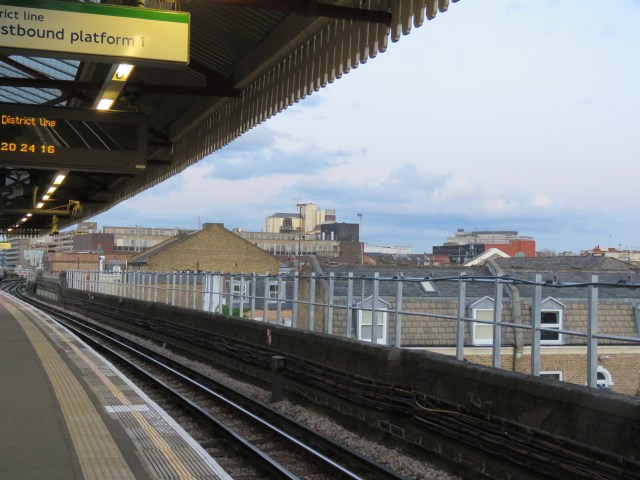
We were sitting waiting for a District Line train this evening and I had my camera with me. That’s all. The Church spire must be St Peter’s down by the A4 in Hammersmith. I say must because I would have thought we were looking directly south, but it must have been south west.

IMG_0673

IMG_0677

Posted in Photos - lovelondonscenes | Tagged , , | 2 Comments

Have You Heard? – (73) Dexy’s Midnight Runners

MI0002081308220px-Dexys_Midnight_Runners_Too-Rye-Ay

As I went through my book “I Was There – A Musical Journey” for, I think, the fifth time, having edited out all the quotes, I was mostly checking for typos and infelicitous grammar. But, as I read the bit about my 50th birthday, waxing lyrical about Dexy’s Midnight Runners’ contribution to the affair, with “Come on Eileen”, I thought, where did  I write about them? And I realised I’d forgotten. Even though they were in the plan.

So Dexy’s, apart from a party reference, aren’t in the book I printed. Clearly that must changed for the final version! So, tonight, I wrote a piece. I so enjoyed writing it, and listening to the crucial music as I did so, that I thought it was something to share. So here is the late – and last – entry into the book…

A last kind of grandiose was mixed up with sixties soul and then a bit of that celtic variety. A band that started off with quite a strong association with Two Tone, even though they didn’t have a reggae or ska sound. But they were from Birmingham and combined the anger at the way things were with a danceability, albeit of a different kind. The band were Dexy’s Midnight Runners and their singer and main man was Kevin Rowland, whose somewhat strangled tones weren’t so different to The Associates’ Billy Mackenzie. Slightly deeper, I guess.

Dexy’s – a reference to a drug which kept you going at those Northern Soul all-nighters, apparently – had two No 1 singles in their early days, both of which were absolute anthems. From their first album in 1980, “Searching for the Young Soul Rebels”, there was “Geno”, a tribute to the 60s and 70s soulman Geno Washington. From the moment it came out, the swaying horns and the chorus caught on big time. A staple for any student disco! From the second album, “Too-Rye-Ay” in 1982, it was “Come on Eileen” that captured hearts – and feet. Dexy’s had, on “Too-Rye-Ay”, introduced a raggle taggle beat, with violins supplementing the brass, and it was simply irresistible. “Come on Eileen” was a song made for celebrations – weddings included. It featured in mine and was right there again when I celebrated my 50th birthday. Read on!

“Searching for the Young Soul Rebels” married a celebration of the sixties soul sound, especially the sound that made it into Northern Soul, with some trenchant observations on life in the early 80s. Not many of Dexy’s songs were fast enough to qualify for the genre of Northern Soul themselves, but “Seven Days Too Long” came pretty close. And maybe the long-winded “Thankfully not Living in Yorkshire it doesn’t Apply”. What didn’t apply, I have no idea. The stand-out songs, other than Geno though, were “Tell Me When My Light Turns Green” and “There, There my Dear”. Both made you want to punch the air when the horns soared in unison. And Kevin’s rolled Rs in “There, There my dear” must have been a tribute to Jackie Wilson in “Reet Petite”. Rousing stuff.

In the “Soul Rebels” period the band were decked out in workmen’s donkey jackets and woolly hats. People’s music. For “Too-Rye-Ay”, just in case we didn’t realise, they’d gone Irish, donned the dungarees. They liked their statements, did Dexy’s – or should I say Kevin Rowland? There was turbulence and upheaval in the band. The only person who stuck it out with Kevin was trombone man, “Big” Jim Paterson. Judging by the name, Kevin didn’t dare chuck him out!

So, dungarees and all, Dexy’s made an album with even more anthems than “Searching for the Young Soul Rebels”. “The Celtic Soul Brothers” opened up “Too-Rye-Ay” with the violins in full flow, a real Irish-inflected dance piece. And did they get away with it? Yes! That was followed by “Let’s Make it Precious”, which took the “Soul Rebel ” formula and made it even better. Throughout the rest of the album, there was a wonderful coming together of the Irish and sixties soul influences. “Old”, “Plan B”, “Until I Believe in my Soul” – these were some of my favourite songs of 1982. Inspiring and anthemic. For that brief moment, Kevin and Dexy’s got it absolutely right. Topped off with “Come on Eileen”, the celebration of celebrations.

And then it all went wrong. Kevin Rowland was a singular character. He didn’t take any crap – and he didn’t like the newspapers. But you know, you have to work with them, if you want a good press. He took them on. Started publishing adverts – in the same press he hated – putting his side of the story. They were entertaining, but all over the place. They didn’t enhance Dexy’s credibility.

It got worse after that. By 1985, Dexy’s were wearing suits for “Don’t Stand Me Down”, and there wasn’t a lot of interest. Kevin went solo, and his nadir was an album called “My Beauty” in 1999 when he put on a dress, hitched it down, showed his suspenders and just looked ridiculous. Maybe Bowie and Marc Bolan – even Prince – could do that sort of thing. Kevin Rowland couldn’t. Loyalists stuck by him; everyone else said thanks very much and moved on. You need to be understanding of what the artists might be going through, but even so…

I wasn’t a loyalist, but I loved those first two albums, and will always regard Dexy’s Midnight Runners as one of the great bands of the early 80s.

If you aren’t familiar with Dexy’s give those first two albums a whirl. They are most definitely worth it!

Posted in Music - Have You Heard? | Tagged , | Leave a comment

Prince, 1958-2016

It’s a shock writing that title. Another great artist struck down. 2016 is proving to be a momentous year for the loss of some of our musical icons. Lemmy, Bowie, and now Prince. And Prince’s departing  sudden, out of the blue. He was still going so strong, playing endless concerts, entertaining us as brilliantly as he ever did. I and a few friends got to see him at an impromptu gig at the Roundhouse in 2014.  With Third Eye Girl. He, they were awesome. The old songs as brilliant as ever, given new, rockier treatment. I wrote a review at the time, which is here.

Prince combined genres like few other were capable of. Rock, funk, soul, dance, and downright weirdness. He was the complete artist. His heyday was the eighties, when he had a string of astonishing albums, rooted in funk, soul and rock’n’roll but path-breaking too. He was up against Michael Jackson, who influenced pop in that era like no other, but Prince’s recorded legacy is stronger, in my view. Like Bowie in the seventies, he just couldn’t stop making incredible, surprising, symbolic music: albums like “1999”, “Purple Rain”, “Parade”, “Sign o’ the Times”, “Lovesexy” to the fore. He was Hendrix, James Brown, Stevie Wonder rolled into one, but none of them. He was Prince.

From the nineties onwards he began to tread water musically. There were great tracks still, like the funky rap, “Gett Off”, but he lost his way a bit, getting embroiled in disputes with record companies, changing identity, embracing and then rejecting the internet. I eventually gave up on him – having bought 17 Prince albums! – but never lost interest in the music. And he continued to thrive, live. He put on a show. I saw him twice in the eighties, both times at Wembley Arena. The first time, in 1986, it was in the round. he emerged from under the stage in a red Corvette, he played basketball, Sheila E played the drums… and he played “Purple Rain” with a transparent guitar that was shaped like a swan. “Purple Rain”, always the highlight. The slow build up, the atmosphere and then the guitar, the astonishing guitar. Spirit of Hendrix, the virtuosity of any of the greats. Prince could do anything. In 2014, that guitar still sent a shiver down the spine, still created a sense of wonder. Pure genius.

And now we won’t see him play live again. But we have the memories, brilliant memories. In 2012, I wrote a blog about my Top Ten Prince songs. I repeat it here, because what we need to do today, and in future,  is to celebrate these great songs – party like it’s 1999!

  1. Purple Rain
  2. Sign 0′ the Times
  3. 1999
  4. Little Red Corvette
  5. When Doves Cry
  6. Kiss
  7. Let’s go Crazy
  8. Gett Off
  9. Alphabet Street
  10. The Cross

Near misses: Life Could be so Nice, I Wonder U, Girls and Boys, If I Was Your Girlfriend, U Got the Look, Take me with U, I Would Die For U, Raspberry Beret, Pop Life, Around the World in a Day, DMSR, Cream, Lemon Crush, Sexy MF, The Morning Papers, Jam of the Year.

So that’s a Top 26 then! Always the Jam of the Year…


Posted in Music - concerts, lists, reflections | Tagged , , | 8 Comments

“Painting the Modern Garden – Monet to Matisse”, at the Royal Academy

The exhibition, “Painting the Modern Garden – Monet to Matisse” at the Royal Academy, has just closed. I went a couple of times, and what a wonderful collection! This was art at it’s most appealing: you want stunning scenery, you want flowers, you want vivid colours, you want beautiful people, you’ve got it! You’d like to have that one on your wall? Doesn’t everyone? So art for today’s art-loving masses, me included. A roaring success.

painting-modern-garden-new-lead-large_trans++7arnwk4aCQlFbdfceVh_Wo7tw0H4YY6R2zlSOf3bCMg

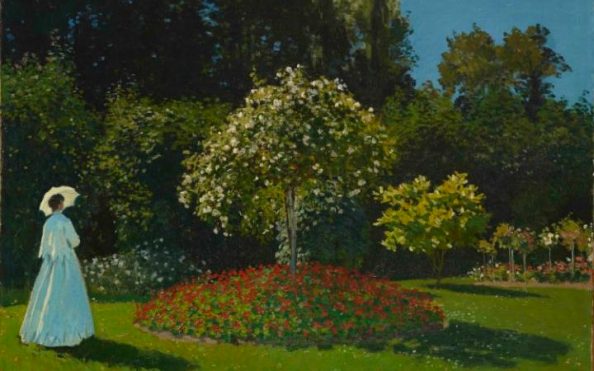
Monet’s “Lady in the Garden”, 1867

f9aee3eccff4f9549cd3c1ef9e0cf53d

Matisse’s “Palm Leaf, Tangier” 1912

But does that make it bland, safe? Does being easy on the eye disqualify a work of art from being radical, challenging? I would say no. Especially when you put the art on display into historical context. At the heart of the show is Impressionism, with Monet to the fore. Pissarro, Cezanne, Renoir, Degas and others in support, as well as a number of great 20th century artists. And Impressionism has so captured the public taste in recent decades that it seems the safe bet, always. But think how adventurous it was at the time, how it shifted art from mostly recognisable representations of images and scenes (with notable exceptions like Turner in his later years) to representations of the mind’s eye, what was going on in the artist’s head. Picasso, the Cubists, Expressionists and any number of ists then took it all even further. But the Impressionists started it. Think of the brush strokes, the colour combinations, the sheer imagination. Impressionism attracted a lot of opposition from critics when the artists associated with it started their experiments. New ideas and approaches always do. But they won and they are still winning.

What of the exhibition itself? Well, I found it a delight from start to finish. Monet was its anchor. From the early paintings – people in gardens essentially – to the the extraordinary portrayals of his garden in Giverny, with the Japanese footbridge the centrepiece, to, at the end of course, some of the monster canvasses depicting those abstract water lilies. Monumental! I loved the use of light in some of the more conventional garden paintings. “Lady in the Garden” from 1867, was a striking example. The lawn and the lady positively seemed to glow.

As for those Japanese footbridges, some of the renditions went wild with colour. Monet was inspired by Japanese artists like Utugawa Hiroshige, a few of whose prints were shown in the exhibition.

For me, one of the stars of the early part of the exhibition was Pissarro. He’s known best for his “Pointillist” art – using tiny brush strokes, dots, to conjure up the image. But some of his earlier work was more traditional and really brought out the essential Frenchness of the landscape. I liked “Kitchen Gardens at L’Hermitage, Pointoise”. I’d have that on my wall! I loved one of the quotes the RA had found about Pissarro too. It began by mocking him for his deplorable fondness for market gardens before dismissing him as an impressionist market gardener specialising in cabbages. Only a French critic…

Pissarro was unrepentant. He wrote to Monet, I love compost like one loves a woman…

The middle phase of the exhibition brought some relatively unfamiliar artists to my attention. Notably three Spanish artists, Joaquin Sorolla, Joaquin Miry Trinxet and Santiago Rusinol. The colours were vivid, exuberant, reflecting their Mediterranean roots. Rich pinks, ochres, oranges, greens. Life itself.

I loved Max Liebermann’s updated Impressionist take on scenes from the shores of Lake Wannsee, just outside Berlin, too. And a one off from a British artist, Alfred Parsons, who depicted a garden, entitled “Orange Lilies”, in Broadway, Worcestershire, a place I know and love from having visited it on numerous occasions for get-togethers with friends over the years. Could that garden, painted in 1911, have been where we stayed?

The latter part of the exhibition gave us artists like Matisse, Kadinsky and Munch diverting from their usual preoccupations to celebrate the glories of the garden. Again with exuberant flourishes. No need to pretend – just celebrate colour and beauty… nature. I loved the way, though, that Munch managed to remain discombobulating.  Or should I say scary?

There was a room of photos of many of the great artists that featured in the exhibition, just before Monet’s waterlily denouement. And did they look like artists? Oh yes!

There’s a wonderful quote from Monet too, which sums it all up really. During the First World War, that horrific slaughter which came close to where he lived and worked – and his beloved garden. It’s a good way to end this piece.

As for me, I’m staying here all the same, and if those savages must kill me, it will be in the middle of my canvasses, in front of all my life’s work.

He and his art survived. And we still wonder at the splendour of it.

Art is eternal.

https://www.royalacademy.org.uk/exhibition/painting-modern-garden-monet-matisse


Posted in Art, books, theatre, cinema, London | Tagged , , | 10 Comments

“The Chimes” by Anna Smaill


23523012

I’ve just finished reading a rather intriguing and gripping novel called “The Chimes” by Anna Smaill, a New Zealand author. It was long listed for last year’s Booker prize, but I only came across it when I googled “dystopian future” novels, to get me in the mood for a novel I’m planning to write myself. Dystopian it certainly is, but with a difference.

For the most part, the novel is set in a London which has been shattered by something which is known as the Allbreaking. The scenes are of a city which has returned to Dickensian, or even mediaeval, times. With added ruins. The people are controlled by a mysterious force which manifests itself as Onestory and Chimes. Each day these are broadcast to all – through music. Music is now the common language, particularly in public. Chimes is so intense, beautiful, that it captures people’s senses and destroys their memories. The only true memory is Onestory, a tale of how and why The Order, the rulers, came to power.

Naturally, the novel tells a story of how The Order and its control through music is challenged. The two central characters, a young lad called Simon, and a not much older man called Lucien, who leads a group of Pactrunners down by the Thames at the Isle of Dogs, or Dog Isle, as it is called in the book. They forage in the river mud, mostly in the network of tunnels underground, for scraps of a pale metal called The Lady. Its importance and provenance is unclear early on, but all is revealed…

Simon has come down to London from Essex, at the behest of his recently deceased mother, to meet a friend of hers, who can help him. The friend doesn’t want to know. Simon wanders through London, drawn to the Thames by a mysterious silence. One of the book’s paradoxes – silence seems to speak to those who can hear. Down by the shore he is ambushed by the aforementioned group of Pactrunners who are called Five Rover, and led by Lucien, who is blind, but blessed with extraordinary hearing and musical ability. Simon is taken in by them (as is a girl called Clare, who has been pretty messed up) and mentored by Lucien, who helps him to recapture his memories. Normally memories can only be objectmemories, retrieved from scraps and momentoes that people carry around with them. Their bodymemories help them survive, do a job, converse, but not much else. Each day, in Onestory, they are reminded how they have been saved from destruction by The Order. There is only one version of the truth…

Or is there? The story unfolds. Lucien’s role becomes more complex. Simon discovers more about himself. I’ll say no more!

The action eventually moves to Oxford, home of The Order, the Citadel, the Chimes. The plot, which starts slowly, weaving repeat patterns of language, metaphor, music, daily existence, allowing Simon gradually to make sense of things, accelerates. I found it hard to put down towards the end, and couldn’t really predict how things were going to end. As it should be!

The use of language was interesting. There were echoes of “A Clockwork Orange” in Simon’s alternative vocabulary, with musical terms used as replacements for some our everyday words. It was easy enough to figure out, and added to the fascination, for me. Might annoy some people, I guess.

The role of music was the book’s ultimate theme. Music as belief, religion, ideology, with the same impact as any other ideology when it comes to power. Intolerant of challenge, of disorder, of impurity. Controlling – and ruthless with its retribution. All must bow down before the Idea. A sadly familiar theme in 20th century history, with the 21st not doing too much better.

The difference in “The Chimes” was that devotion to the purity of music was the source of ideology. Improbable, I suppose, but an intriguing idea, convincingly developed in the story. A metaphor, no doubt, for the Islamist fascism which besets parts of the world today and scares – and scars – the rest. A true example of the Allbreaking.

Music as evil. Not a theme you usually get in this blog! But people can get very passionate about the music they hate as well as the music they love. The love can breed the hate. I think I shook that off when I left my teens and really started to discover the wide, wider world of music. But a lot don’t.

So, love music, but don’t let it define hate or prejudice.

And read “The Chimes”!

Posted in Art, books, theatre, cinema | Tagged , , , | Leave a comment

Two great concerts: Wolf Alice at the Forum; Chvrches at the Royal Albert Hall

This week I’ve been to two outstanding concerts. On Tuesday it was Wolf Alice at the Forum in Kentish Town. Last night, Chvrches at the Royal Albert Hall.

Wolf Alice

IMG_3611_2

Chvrches

IMG_3620_2

I went to Wolf Alice with my friend Jon G (I have lots of friends called Jon – it’s easy to talk to us in a group because you only have to remember one name!). We booked seats (actually a bench, but a comfortable one) in the circle and made the effort to get there for the support bands as it sounded like Wolf Alice were getting some good people in.

So, armed with pints of San Miguel, we found a spot in time for first support Bloody Knees. Not the greatest name, but a good band. Nirvana a clear influence, but a bit faster. The singer was tall, had a good head of hair, and loved shaking it about. T-Shirt came off after a few songs. Just about carried it off. They were pretty good, but will have a lot of competition with that sound.

Next up were Swim Deep. I saw them on the Lake Stage at Latitude in 2013. Thought they were good then, with hints of Razorlight and The Strokes. And I liked the singer’s claret and blue Fender, even though it was Aston Villa rather than West Ham. At the Forum they had clearly moved on. The sound was more varied, and fuller. The Maccabees came to mind. It was decent set. Not enough to make me rush back and download their music, but enough to merit a listen on Spotify. My only criticism: most of the band were wearing flares! And oversized shirts. Please, no, this cannot be a new fashion!

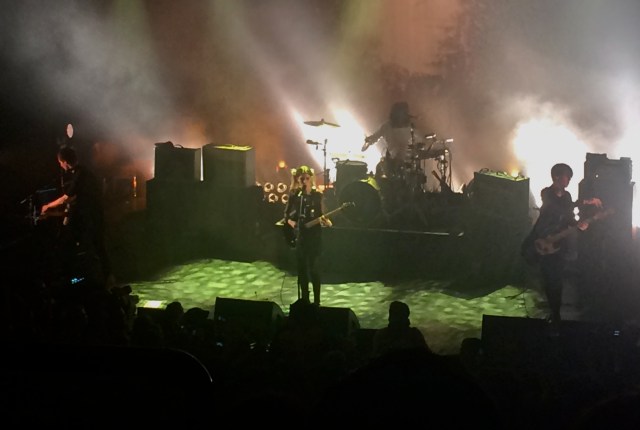
And then Wolf Alice. Jon and I and our kids saw them in the 6 Music tent at Latitude in 2015. They were excellent then and they were even better tonight. Another 8 months on the road, really honing their sound and performance. On top of that, I am now much more familiar with the music. Their debut album, “My Love is Cool”, just missed my top ten last year, though it was easily in Jon’s. But, you know, it would have to be in there now. You can hear the grunge influence, you can hear a bit of My Bloody Valentine; but you can also hear Blondie and even, I thought on Tuesday, when they played the brilliant “You’re a Germ”, Joan Jett. In other words they bring together the hard rocking with a pop sensibility. When the album first came out, I was mildly disappointed because it wasn’t noisier, but as I listened more, I realised how good the songs were, how well-constructed. Full of punching riffs, plenty of screaming, but engaging melodies too. And the latter is probably why their audience is actually quite young. I saw a review that described their music as bubblegrunge. Very clever, and I can see what it was getting at, but also condescending and probably sexist. Because it’s Ellie Rowsell screaming out the choruses, rather than some gruff bloke from Seattle, the implication of that review was that it was lightweight. To which I can only respond, bollocks!

All the favourite songs were there, as you would expect at this stage in their career. My own favourite three are “You’re a Germ”, “Your Love’s Whore” and “Fluffy” (ironic title, I’m sure). But the whole show was dynamic, in-yer-face and perfect for the youth at the front (and quite a way back) to do some serious moshing. Jon and I watched with affection and enjoyed our beers.

IMG_3613_2

A credit to John Victor of Genghar too. The lead guitarist in that band (my favourites of 2015) had stepped in to play bass in Wolf Alice because Theo Ellis had developed a rather nasty elbow infection – shared on Twitter in all its gruesomeness. You wouldn’t have known if you didn’t know the band line up. Seamless transition. Real talent. Gengahr must be big!

A great evening.

And on Thursday, it got even better…

For Chvrches, I was on the lone groove. Inexplicably, I cannot persuade any of my good friends that Chvrches are one of the best bands on the planet and Lauren Mayberry one of the finest singers. Never mind, I love them and am so looking forward to seeing them on the Obelisk stage (the main one) at Latitude on the Saturday this year, second to The National. They will be headliners soon.

Their show was labelled as one of the “Albert Sessions”. The artists haven’t yet headlined the Albert Hall, prices are kept reasonable, and the artists spend some time with students in workshops about their music. An excellent initiative all round, and you can read about it on the link below. There is also a nice selection of photos from the concert – way better than my iPhone efforts from a distance.

Link to Albert Hall review

Support came from Shura, who played a dreamy sort of electro-dance. I enjoyed it, although stuck behind her machines in what was then a half full Albert Hall, it was hard for her to make a huge impact. The songs were quite long too – mood pieces. I’ll certainly have a listen to her music online.

What I said about Wolf Alice honing their sound on the road applies doubly to Chvrches. Since “The Bones of What you Believe” came out in 2013, they have hardly ever stopped touring and doing the festival circuit. Especially in the USA. And it is paying dividends. Not only in increased popularity, but in their stagecraft. I remember when I saw them at Hammersmith Apollo in 2013 (there is a blog if you want to check it). They were great, but Lauren was fighting through a cold and she was still fairly immobile, clinging on to the leads of her microphone. That rather fragile image worked rather well in juxtaposition to the booming dance and electro beats. But now, all is different. Lauren is dancing, leaping around, standing on podiums, engaging with all the different parts of the audience. A very different performer. The music too, is even more pounding, the dance beats to the fore. The two boys get less attention than Lauren, unsurprisingly, but they are the music-meisters, and play a bit of guitar and bass now. And there have always been a couple of songs when they sing. This is a democratic band, which is still holding back from exploiting Lauren’s obvious beauty. Credit to them all, for that. It’s what tells you they are still, at heart, an indie band rather than a pure pop band. But they have the pop sensibility to make it big time if they want to.

So all the best songs from their two albums got an airing last night. With one exception: one of my two favourite Chvrches tunes, “Lies”, missed out – the other is “Tether”, which was a highlight. The songs from the most recent album, “Every Open Eye”, dominated, of course. But they work superbly live. Especially “Clearest Blue”, which ended the main set. Awesome!

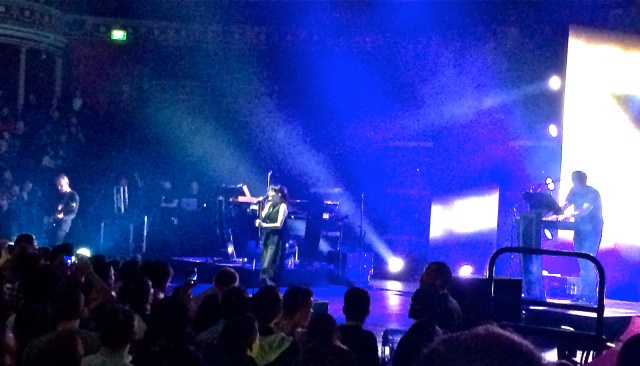
And what an encore. First the lovely “Afterglow” from the latest album. Lauren’s singing at its most beautifully tender. The Albert Hall bathed in blue light and so many people holding their phones with torches on, aloft. Used to be cigarette lighters – no more! An impressive sight, which this photos captures a bit.

IMG_3631_2

And, to end, what better than “The Mother We Share”? This will always be a Chvrches favourite, and it was total celebration. It was the first song at Hammersmith in 2013. It’s song which will always merit an important place in the set. I came out of the venue thinking, this is one of the best concerts I’ve ever been to. It was so enjoyable, uplifting. Even if my love for the Chvrches isn’t shared by my friends, I will be there whenever they play in London.

If you haven’t heard them, give Chvrches a listen – and Wolf Alice too – and check both out if they play near you. You won’t be disappointed.


Posted in Music - concerts, lists, reflections | Tagged , , , , , , , , | 11 Comments