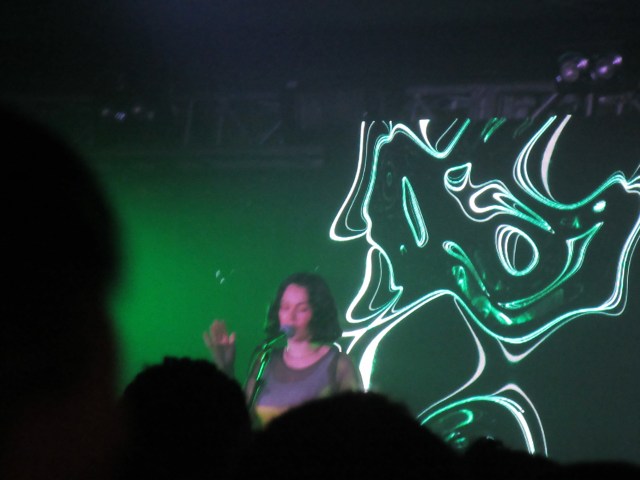
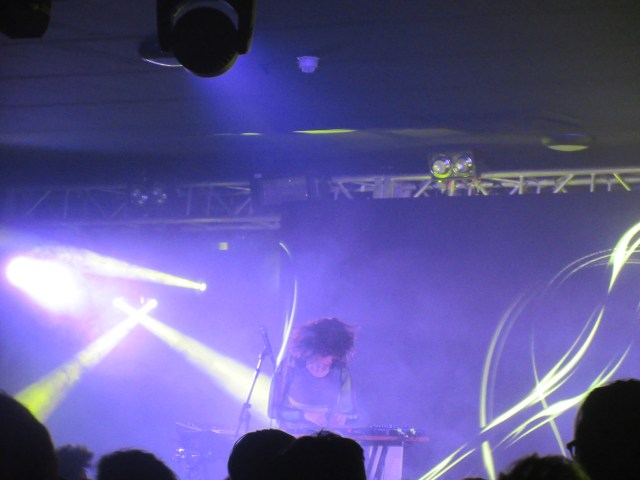
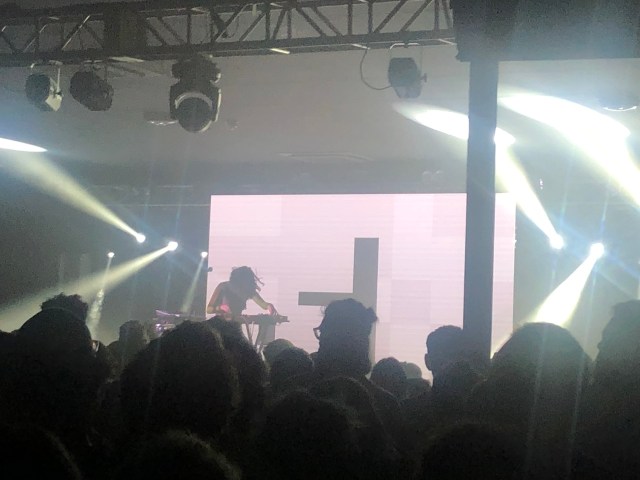
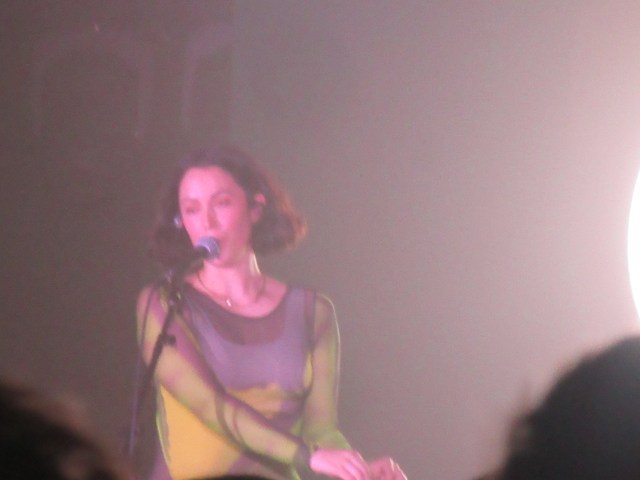
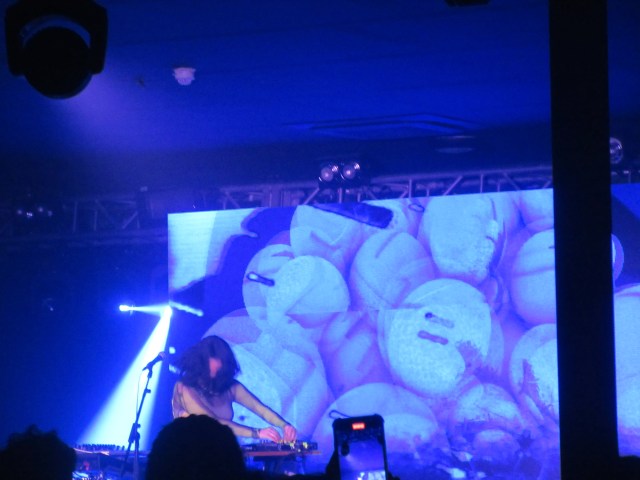
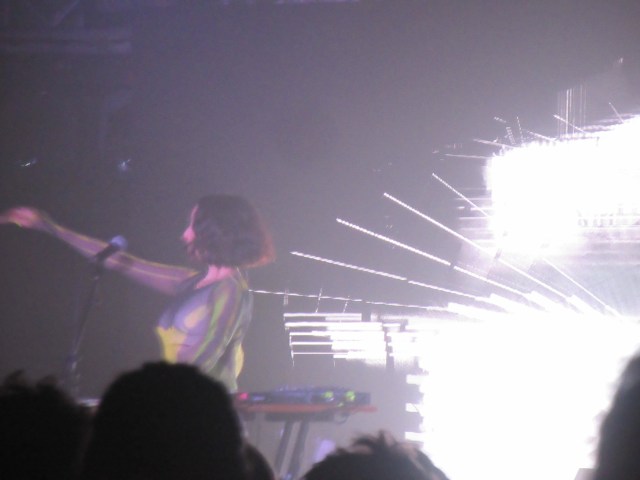
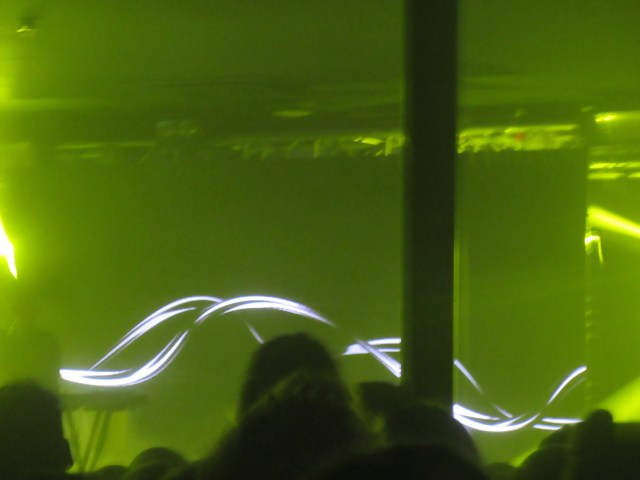
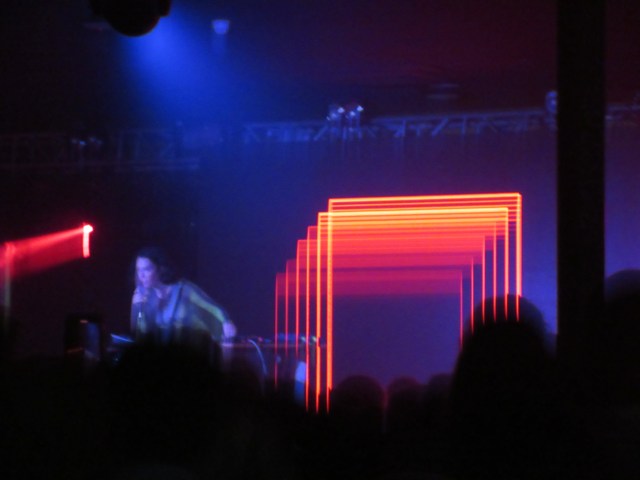
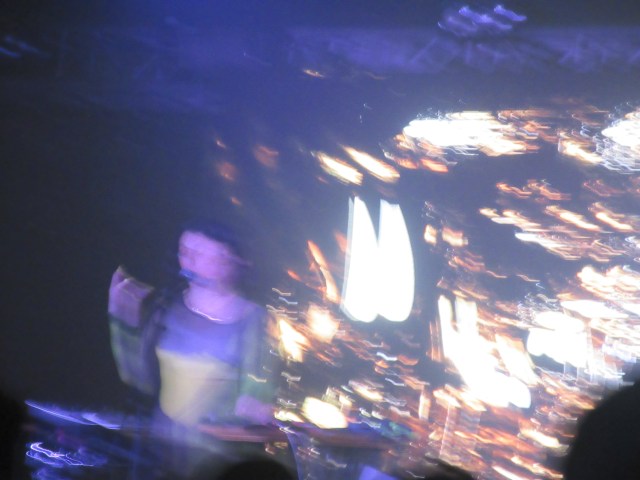
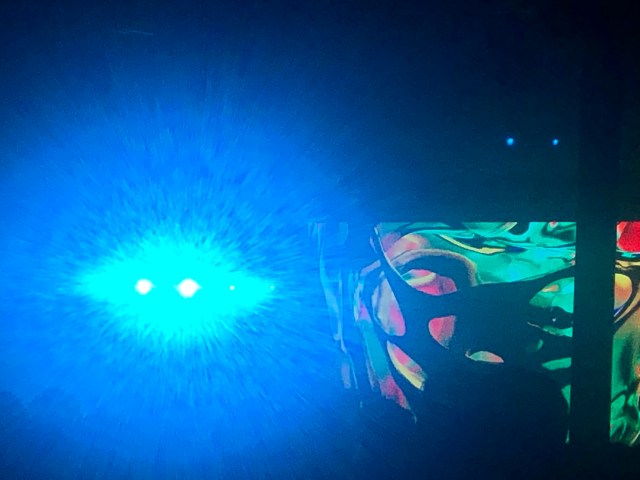
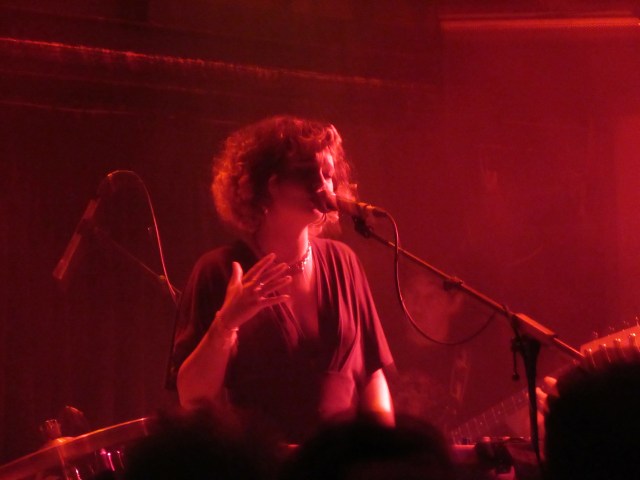
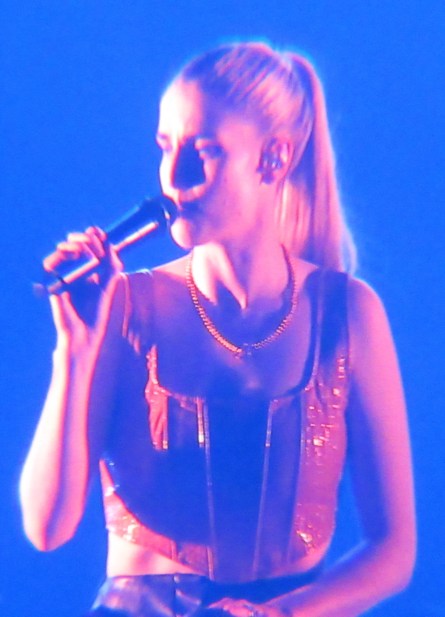
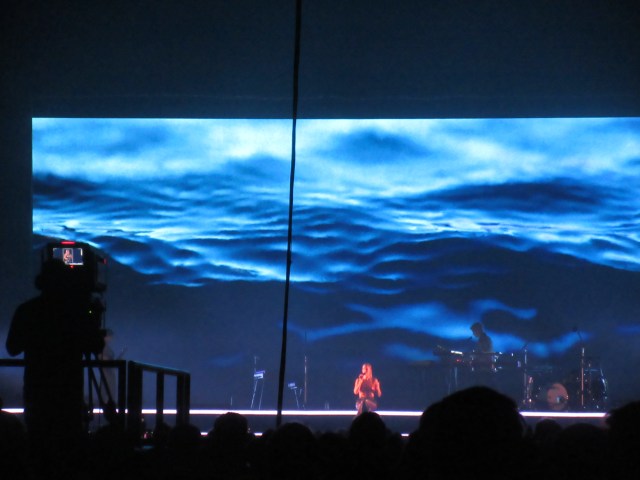
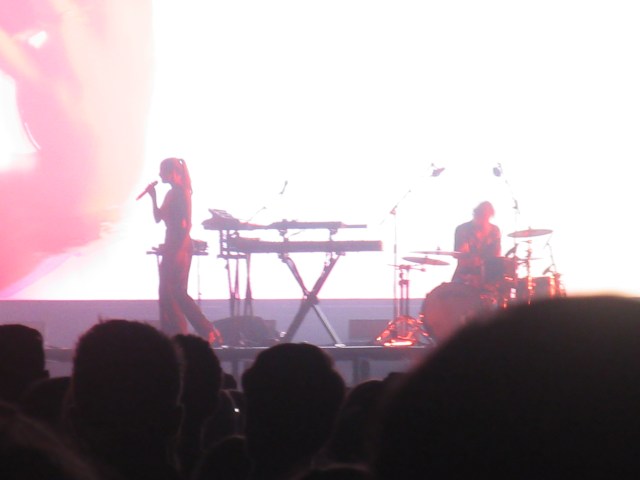
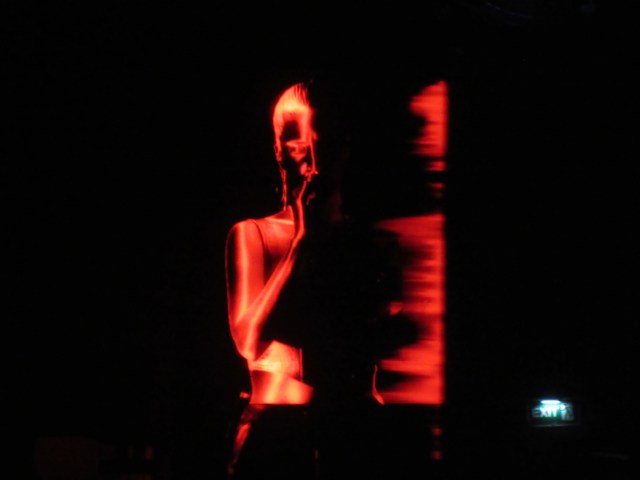
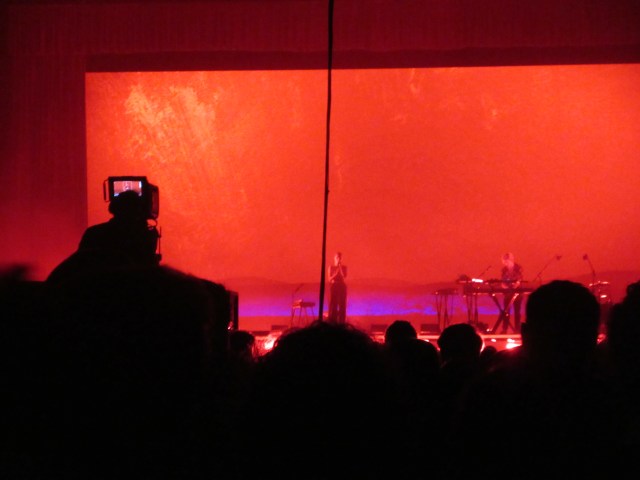
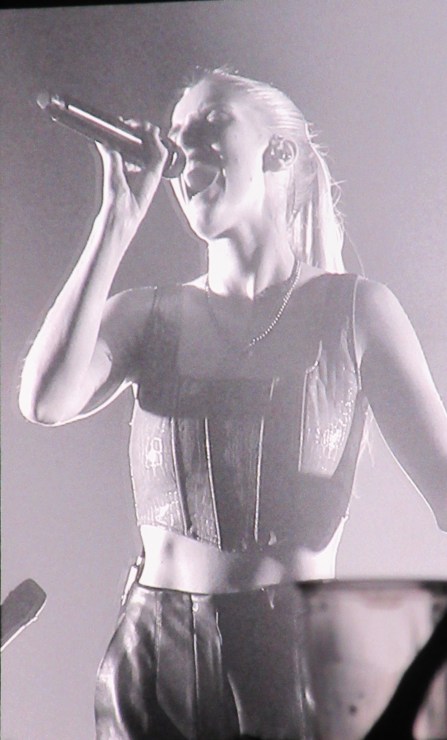
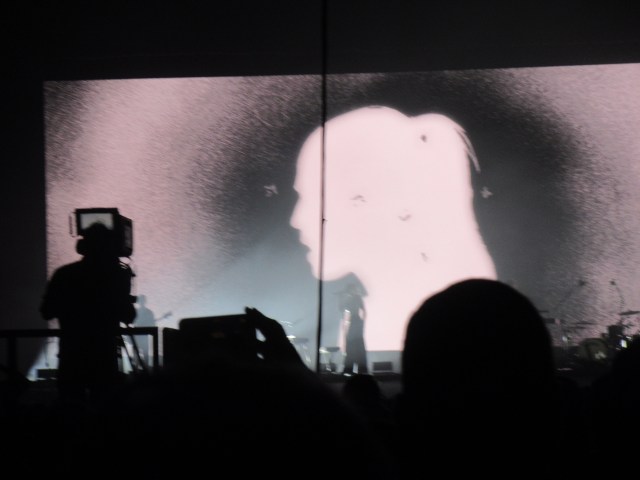
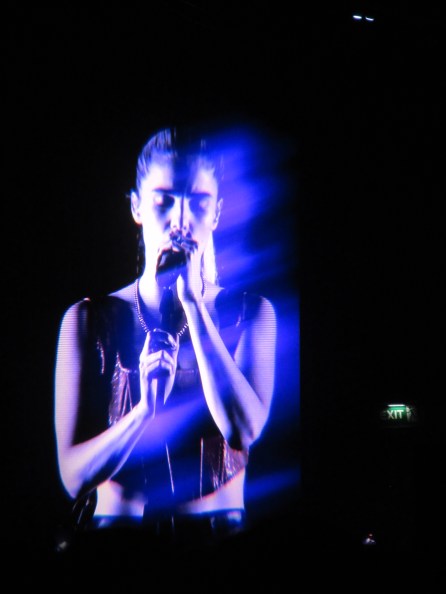
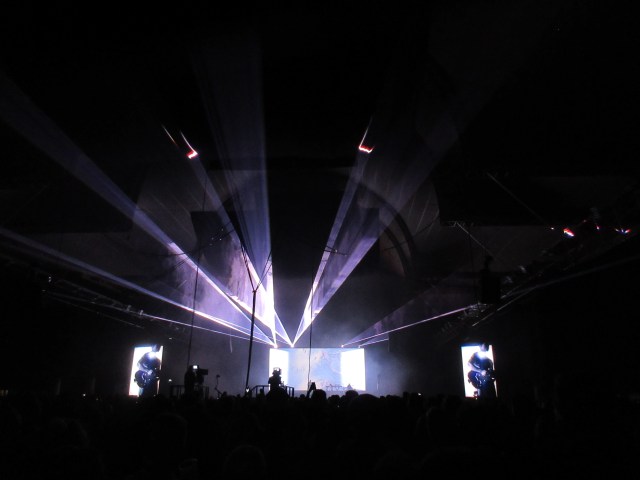
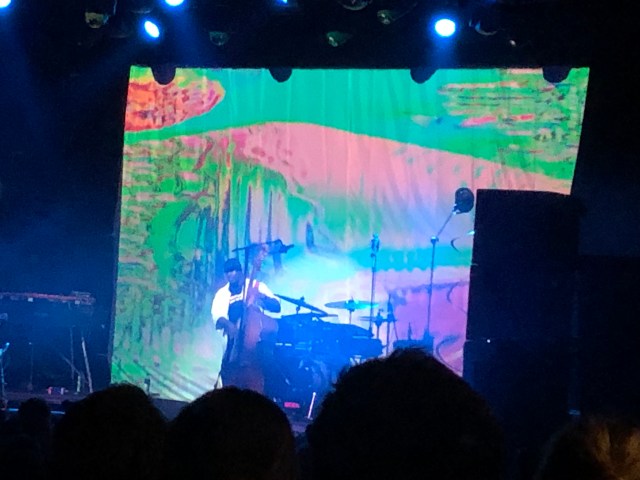
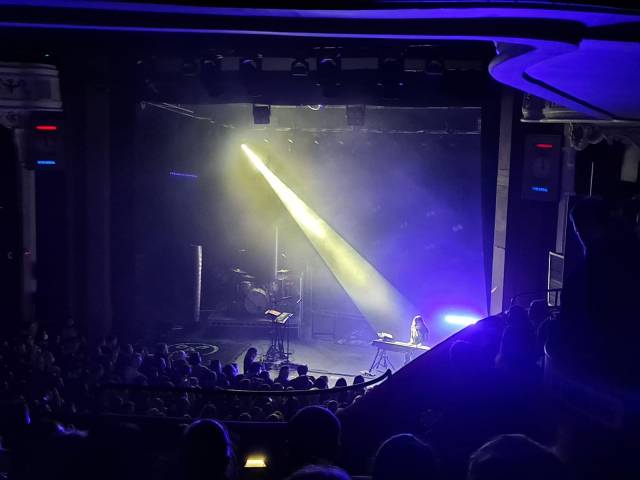
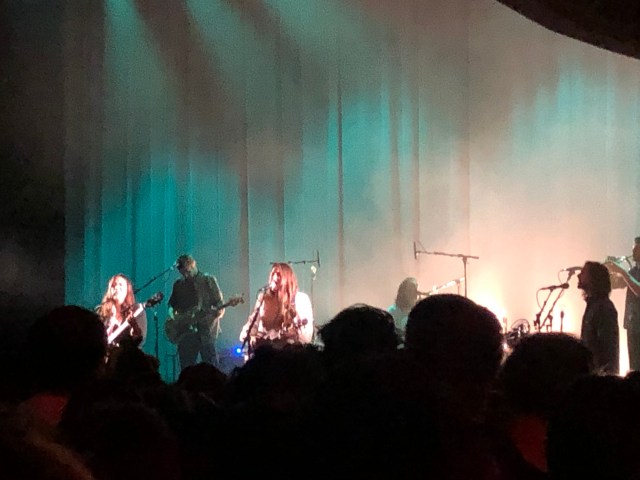
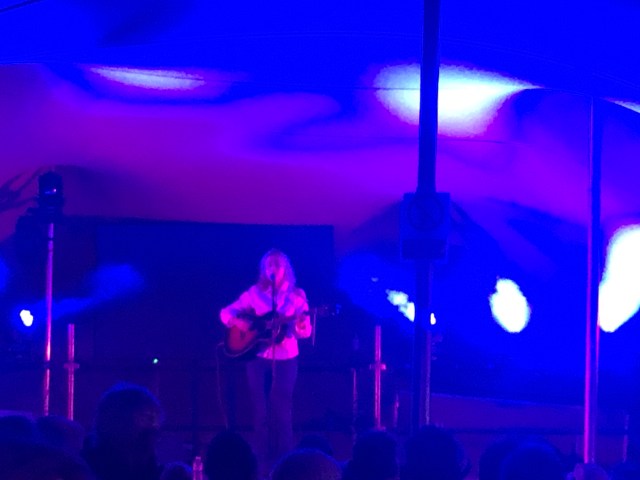
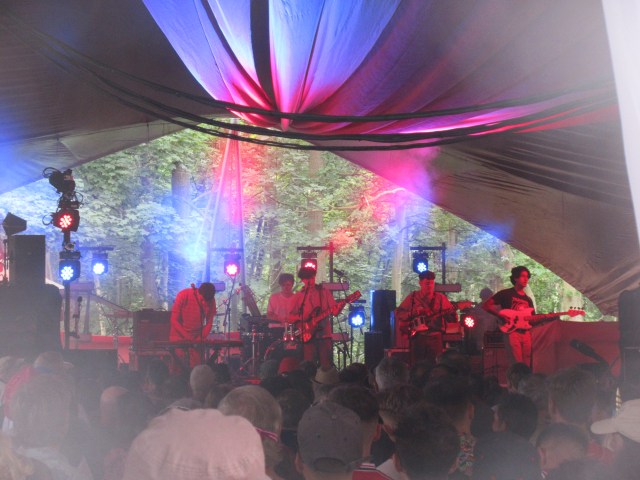
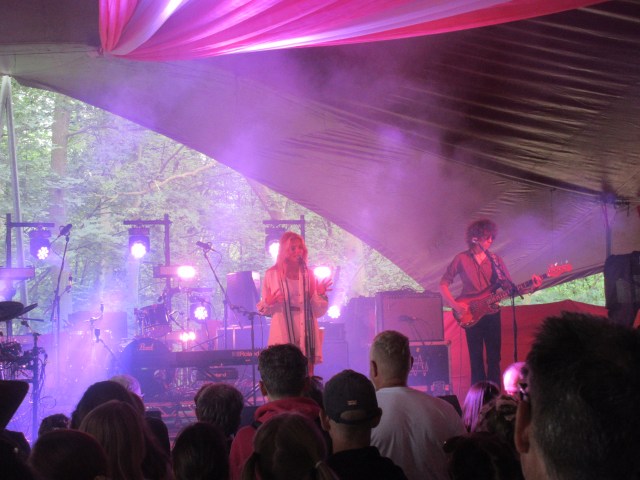
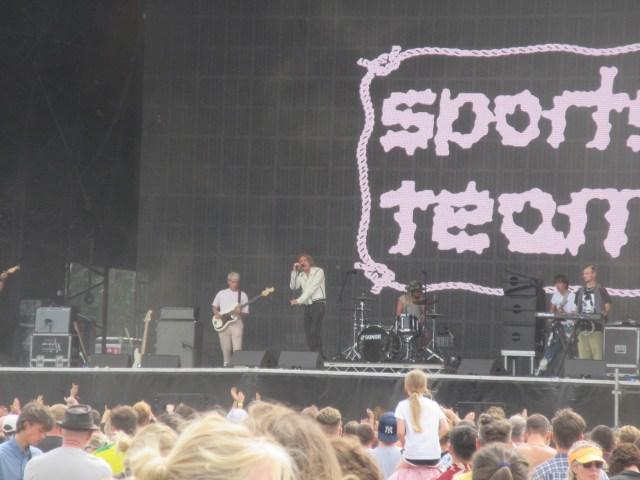
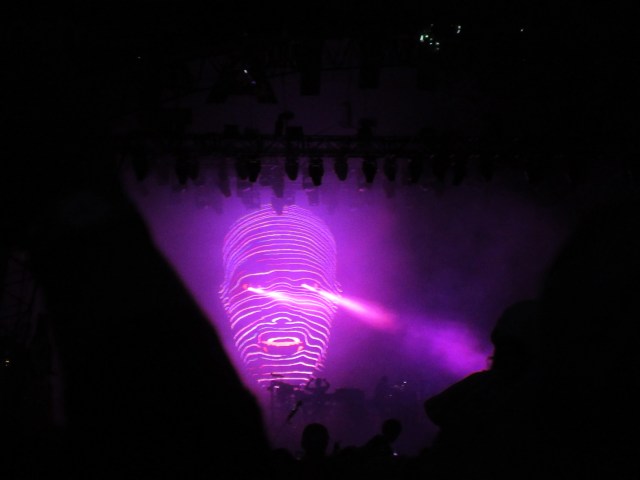
I first came across Kelly Lee Owens at End of the Road in 2019. A late night show in the Big Top, which I got to about half way through. All was darkness, except for the glow of the stage. A silhouetted figure danced by a couple of keyboards, with a swirl of images and light behind her. The beats boomed out of the speakers, deep bass lines challenging you not to move your feet. And a dreamy voice drifted across the sonic blast. Let it go…
Let it Go was Kelly Lee Owens’ latest single at the time, backed by another piece of infectious electro called Omen. I discovered that and her back catalogue when I got home after EOTR. The centrepiece was an album, Kelly Lee Owens, from 2017, which combined the dreamy soundscapes with all sorts of punchy bass-laden beats. I loved it, though I didn’t play it enough to get to know the names of the individual tunes. It was a journey in sound, like the landscape rushing by when you are on an inter-city train. You didn’t need names, you just took it all in.
I was looking forward to another album, but first, in December 2019, we had the treat of a collaboration with the brilliant Jon Hopkins called Luminous Spaces. An appropriate title, given the shared spaces they occupy on the musical spectrum. Then covid struck and we went into lockdown, but Kelly’s new album, Inner Song, emerged in August. And what a great album it was, from the moment that Arpeggi revealed itself to be a cover of Radiohead’s Weird Fishes/Arpeggi. Deconstructed, but still reverential. It was an album I listened to a lot – and still do. I made it No2 in my top twenty of 2020, pipped only by Taylor Swift’s Folklore. Both albums reflected the times: they were introspective, but uplifting with it. Very different sounds, but not so different origins. Kelly’s publicity suggested that the album was written at a time when she was recovering from a break-up; it was also deeply concerned with climate change. Not a mass of words decrying environmental catastrophe, but sounds that evoked her despair, and maybe her hope too. Abstract expressionism, you could say. Again those dreamy soundscapes mingled with bursts of heavy bass rhythms – the drop on the dancefloor. And there was interesting guest spot for fellow Welsh artist, John Cale – he of Velvet Underground fame amongst many other accomplishments. He sang, or more accurately intoned, to a piece called Corner of my Sky.
The rain, the rain, thank God, the rain…
Now all we needed was some live shows, to experience this amazing music in three dimensions, to feel those bass lines rumble against our ribcages! A tour was announced, around the same time as the album was released. I bought a couple of tickets for the show at EartH, in Hackney. Scheduled for April 2021.
You know what happened to that. At least the tour wasn’t abandoned, just postponed. The new EartH date was 2 December. A long way off and who knew what regime we’d be under by then.
Of course things here started to relax soon after April, and some of the summer festivals were able to go ahead. Kelly Lee Owens was on the bill for Green Man, in her home country, in August. Another late night show, in the Far Out tent. I was there, eagerly awaiting. It turned out to be even later than planned, as she hit a technical hitch after the first couple of numbers, which led to a half hour break. She resumed and gave us a spirited performance, with all the usual elements; but the edge had been taken off it – and the festival crowd does like a good natter during songs, especially after a few beers.
I was looking forward to the December show to provide the real thing. Slightly worried that it might be hit by another sudden lockdown, especially when the new variant emerged, but it went ahead. Back to EartH, with my friend Jon G again. I was hoping it would be in the upstairs hall, a spacious theatre space, with the wooden steps used as benches. I could see the sound and the lights working really well in there. The April show had been planned for there; but it was not to be – we were in the basement. Quite a big basement, a decent concert venue, though the ceilings are quite low, and it is all standing. The latter exposes you to two obsatcles to enjoying the show fully: the tall blokes standing in your sightline at the last minute and, of course, the chatting. Both were present for much of the evening…
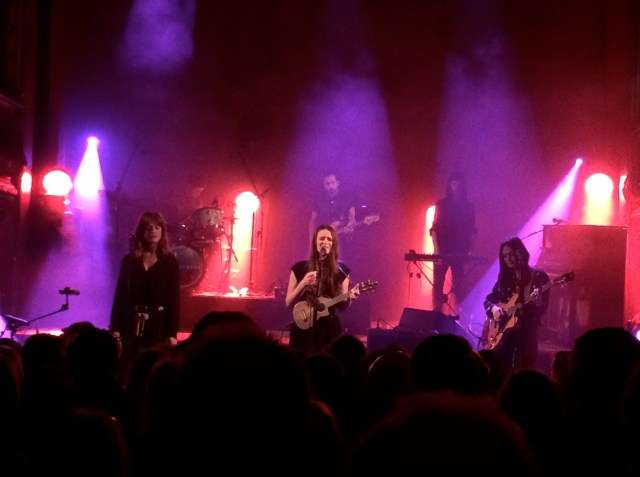
But despite those impediments, what a show it was. About an hour and ten minutes. Paced very nicely, opening with some of the slower pieces, and slowly building to an absolutely thumping climax over the last half hour or so. The show opened with Arpeggi – what else? – and flowed into the lovely Re-Wild, the most explicitly environmental piece on Inner Song. Through the show, we had a nice mix of the two albums, with occasional bursts of those techno beats to keep people on their toes before we went into full overdrive at the end. I guess On marked the point where the beats became relentless. That song is in two parts: a gently anthemic melody at first and then a lurch into jagged electro. The pulsating Night followed that and we were off. Through Jeanette – a tribute to her mother, and a crowd favourite – Evolution* from the first album and then the mighty Melt!, which shook the place to the core, while the flashing lights compounded the assault on our senses. Kelly rocked as she manipulated her keyboards, hair flying around her. The final tune was Kingsize*, which followed Melt! in bludgeoning us into submission – in a good way!
And you know, in that last half hour, people stopped talking to each other and actually watched the show – and danced. Kelly Lee Owens had taken back control!
The lights stayed dimmed and it felt like there was going to be an encore. Kelly came out again, to acknowledge the applause and express her gratitude. No music – she explained essentially that it was pre-programmed. But her emotions were real. Again and again she had to stop and wipe away the tears. It clearly meant a huge amount to her – a common theme in the shows I’ve seen in the last month or so. All that creativity, all that emotion suppressed as the world of the arts was shut down. And now back to life, sharing their creations – and their feelings. Catharsis.
Kelly Lee Owens’ music – and especially the live experience – does catharsis very well.
*As so often, I have to thank Setlist FM for allowing me to piece together the sequence of songs, especially those from the first album. The train was rolling…
A few more photos.
Both my little digital camera and iPhone were rather discombobulated by the lighting and ever-morphing images. Still, I did mention abstract expressionism earlier! And I didn’t even have a drink while I was there…
This year’s London Jazz Festival ran from 12 to 21 November. It took place in locations across London, ranging across the genres associated with jazz and in locations as large as the Royal Festival Hall and the Barbican, to pubs and clubs around the capital. I managed to see three concerts, which captured that variety. It should have been four, but unfortunately the pianist Brad Mehldau had to pull out a couple of days before his Barbican show on 21 November due to illness. We’re hoping that show will be rearranged for some time in 2022.
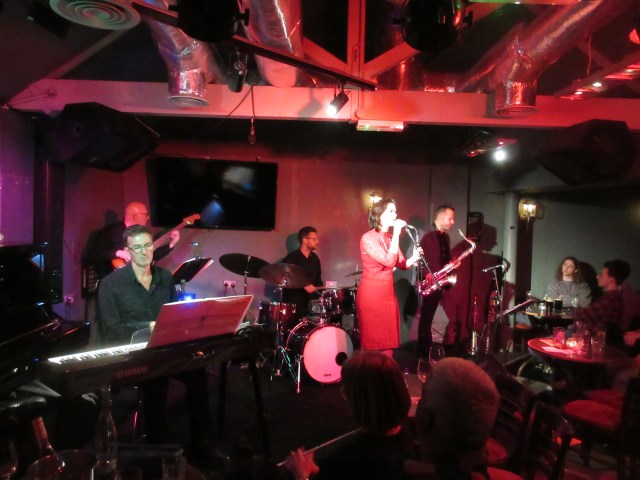
Katriona Taylor Quintet at the Bull’s Head, Barnes, 13 November
A few of us went down to the Bull’s Head, which looks onto the Thames just downriver from Barnes Bridge. It’s one of London’s stalwart jazz pubs, with bands playing most days. Of course, that all stopped during lockdown, but all is now in back in working order. There’s a dedicated music room out the back of the pub, which can take maybe a hundred people. I’ve been there a few times before. The pub itself is a nice place to stop for a pint if you are out walking, and the food is decent too – we ate there before the show tonight.
I’d not come across Katriona and her band before, but the prospect of hearing 60s and 70s pop and soul classics played in a jazzy style sounded like a nice thing to do on a Saturday night. And so it proved. The band were all accomplished players and Katriona herself interpreted the songs with imagination. If anything her voice is a little high and pure for this kind of music, but she carried it off with style. She has released an album this year called Blind Passion, which is a tribute to blind or partially sighted songwriters. Katriona is partially sighted herself. This meant we got three Stevie Wonder songs in the first set: Don’t You Worry ‘Bout a Thing, Master Blaster and My Cherie Amour, which was alright by me. Inevitably there were moments when I couldn’t help but be reminded of some of those international hotel bars I have sat in in years gone by, listening to mellow jazz standards being crooned in the background. I’ve always enjoyed that vibe, and of course it also reminds me of one of my favourite films, Lost in Translation!
The band circulated in the audience in the interval, which was a nice touch. We had an interesting chat with the keyboard player. Playing in the band is not the day job, but most of the band have been together for a long time and there was a clear affection for Katriona. The second set took a few more risks, notably a reconstructed version of the Bee Gees’ Night Fever which was barely recognisable. It was all good though, with some funky Latin touches at times.
So yes, a very agreeable evening, and as ever, we all agreed we should do this sort of thing more often. Time will tell!
Vijay Iyer Trio, Queen Elizabeth Hall, 14 November
Second concert of the weekend, and quite a contrast to the first, both in size of venue and musical pallet. The Queen Elizabeth Hall, part of the South Bank Centre, is a perfect venue to sit and soak in music of the highest quality. The seating is comfortable, the views excellent thanks to the relatively steep banking, and the acoustics superb. That was all just right for these three accomplished musicians: Vijay Iyer on piano, Linda Oh on double bass and Tyshawn Sorey on drums. I can’t say for sure what pieces they played, but my guess is that at least two of the five that spanned a good hour and a half were from the 2021 album, Uneasy, which was a collaboration between the three of them. I’ve been listening to it a lot since the concert and really like it – a cool and inventive set of jazz numbers, including a nearly ten minute version of the old standard Night and Day. Improvisation is the name of the game, and that was very much the case on the night. The first two numbers both lasted for around half an hour. That induced a variety of reactions: while you marvelled at the musicianship, and wondered where the tune would go next, it was also quite easy to drift off a bit and start thinking about what you needed to buy at the supermarket tomorrow. Having said that, time flew by, because the sheer quality of the playing was absorbing. I could happily have listened to more. And the first thing I did when I got home was put the new album on.
One slight criticism would be that the drums were a bit high in the mix. Tyshawn is an absolute master, and with a very spare kit, but the snare sound was overwhelming Vijay’s improvisation on the piano at times.
On a side note, this was the first band I’ve seen in recent times who have all been wearing masks. Some of Vijay’s comments suggested he was a bit fearful of catching something while he was in London. And the band have been whizzing around Europe by the sounds of things. Whether things are any better in America, I wouldn’t know, but I guess you feel more comfortable in familiar surroundings.
But to get back to the music, I would love to see Vijay Iyer play again someday, and I bet it would be very different to tonight.
Ishmael Ensemble, Jazz Café, Camden, 17 November
This one brings the music right up to the present, with a mix of jazz, soul, electronica and hip hop. The present, but also the 90s, another time when all these genres collided to produce an explosion of creativity. And one of the places that was central in the 90s, as it is now, is Bristol – from where Ishmael Ensemble hail. That Bristol sound, the sound of fusion, with Massive Attack, Portishead, Tricky amongst the principal players. And now Ishmael Ensemble are very much part of that tradition, while adding new dimensions, jazz dimensions.
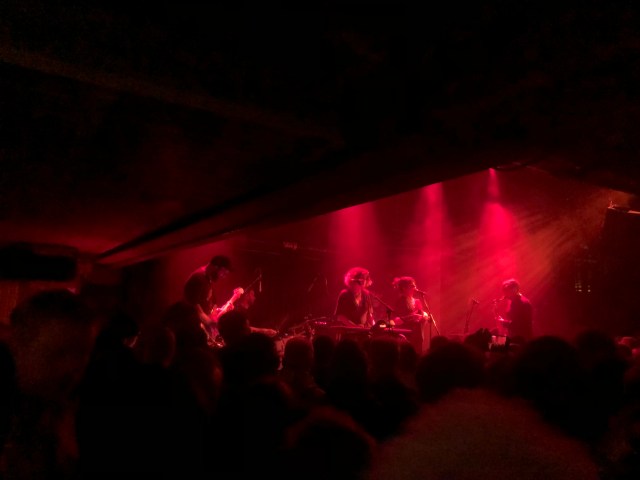
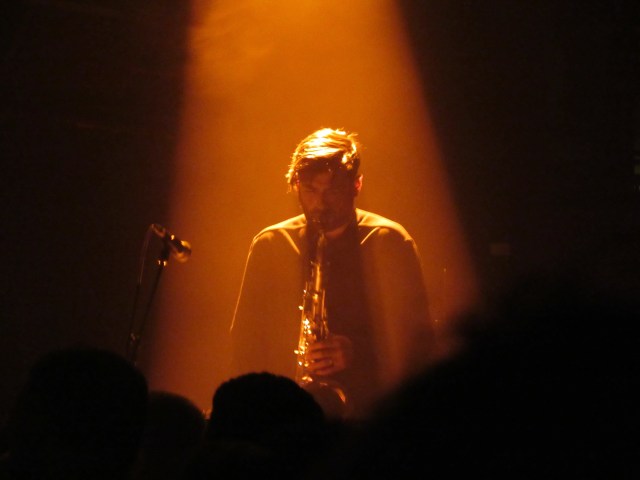
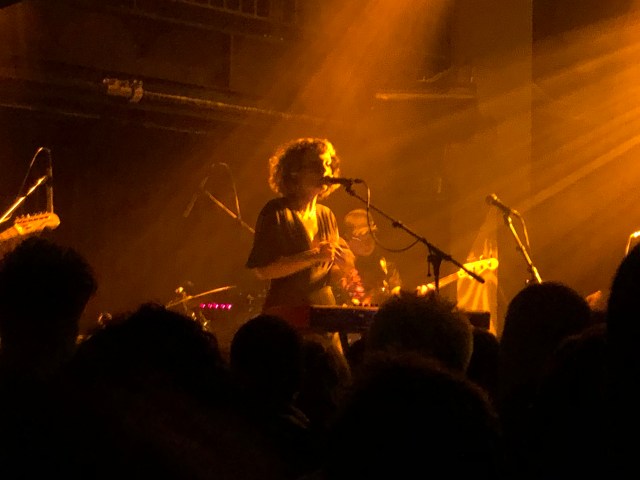
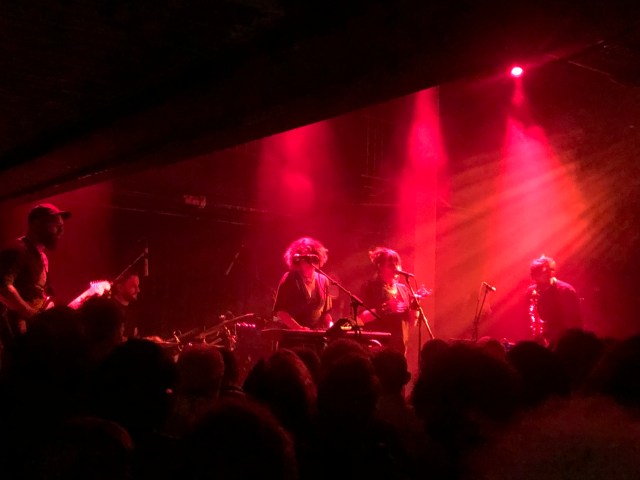
The band released an album called Visions of Light in August this year. It follows 2019’s State of Flow. Both are highly recommended. Tunes from Visions of Light formed the core of the set, which was a joy from start to finish. They were bathed in red or golden light much of the time, and their music was made to match: atmospheric, hard-edged, soulful, funky and wild. Not all at the same time! Unavoidably the sounds took me back to Massive Attack’s Mezzanine album, especially when the music built to a crescendo, with guitar and sax blazing. Likewise those soulful moments, adorned with the beautiful vocals of Holysseus Fly. Memories of Elizabeth Fraser singing Teardrop! Let’s not overstate the likenesses though – this was vibrant jazz music, with Pete Cunningham’s sax a constant source of wonder.
The band came back for a much welcomed encore and went back to their beginnings, with a piece called Song for Knotty, which was the title track of their first EP. A fitting finale to a performance which showcased the new, but celebrated their Bristol roots too.
I went to this gig with my friends Jon and Shane. We all came out of the Jazz Café knowing that we had seen a very special band. They must be nailed on to play some of the festivals next year – can’t wait to see them again!
London Grammar are a trio – singer and occasional guitarist Hannah Reid and multi-instrumentalists Dan Rothman and Dominic “Dot” Major. They’re Londoners, but formed at Nottingham University. Their debut album, If You Wait, was released in 2013. That was followed by Truth is a Beautiful Thing in 2017 and just this year, Californian Soil. A stately progress, which reflects the stately nature of their music, which, at least until the latest album, has been characterised by a beautiful, sparse melancholy that is at its most pronounced in Hannah’s singing. She is one of the best around in my view. In the slower songs, there’s a real sense of sadness, that duende that I’ve written about many times before. When they do stray into more up-tempo territory, there’s a strain in her voice, a venturing outside the comfort zone. The melancholy never quite goes away.
Californian Soil does take the band’s sound into more of a pop-dance zone than its predecessors. I guess that’s inevitable – there isn’t much in the pop world today that doesn’t have some kind of electronic dance beat attached to it. Got to move with the times. Further, that sound seems to reflect a change in attitude. In interviews accompanying the new album, Hannah said that she had assumed more of a leading role in the band and was asserting herself against the prejudice and misogyny in the music business, having been close to quitting in 2019. Well, I’m glad she stuck around, because Californian Soil is a fine album, which grows on you with each listen. And it was great to have them back on tour after all this time.
There were two shows at Ally Pally, on Friday and Saturday just gone. That means around 20,000 people made the trek to North London to see them. That’s not bad, and it meant a lot to them. Dan Rothman made the point during the show that he grew up ten minutes away from Ally Pally – this was a real homecoming. I went on the Friday, with friends Shane and Jon. We figured they’d be on stage around nine, so stopped for a couple of beers near Alexandra Park station. It’s another ten minutes’ walk up quite a steep hill after that, and we ended up getting the timing slightly wrong. Despite the fact that there were a lot of people still in the food hall when we got there, the band had started. I figured by checking previous set lists – thanks to Setlist FM as ever – that we had only missed Californian Soil and part of Missing, for which Hannah was wielding an electric guitar. It was reassuring to hear Hey Now after that – not only is it a wonderful song (from the first album) but, unless they varied the set each night, it was only the third of the set.
After that we had a succession of songs from the new album, culminating in the closest thing London Grammar have to a “banger”, Baby it’s You. The second half of the show stepped into more varied territory, starting with two favourites from Truth is a Beautiful Thing, Big Picture and Hell to the Liars, featuring one of Hannah’s most passionate vocals. Mind you, I was probably working from memory on the night – there was so much chatter going on all around that it was hard really to take in the more subtle elements of the show. I find it odd why people pay £35 to stand in a big hall and chat to their mates when they could do that down the pub for free, but that’s the way it is in these big shows. I was just about able to appreciate Wasting my Young Years, one of their signature tunes, which followed. A song I will always love, with the anguish of Hannah’s voice conquering the cavernous surroundings. The main set finished with America from the new album and another old favourite Metal and Dust, a suitably upbeat ending.
The encore was a triumph, with Bones of Ribbon followed by the London Grammar anthem, Strong, and finally Lose Your Head from Californian Soil. Strong is such a great song, as resonant now as when I first heard it back in 2013. I’d prefer it if Hannah sang the chorus rather than the crowd, but we were at a celebration of London Grammar, not a recital. Lose Your Head, rather appropriately, was also the moment when a fight kicked off just in front of us. Just some drunken lads, but this was a London Grammar concert. You don’t fight at a London Grammar concert!
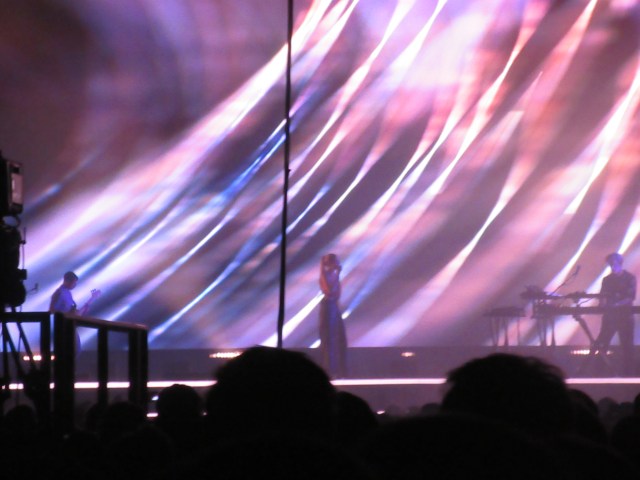
So, ultimately, I felt a little ambiguous about this one. I love the music and especially Hannah Reid’s singing. But neither of those could come fully to the fore given the remoteness of the stage – a choice we made by standing at the back – the chatter and the inevitable reliance on the dance beats to fill the arena and keep the crowd energised. The screens were good and the light show and backdrops were imaginative, which enhanced the experience. There was a nice mix of old and new in the set, and I’m really pleased to see the band doing so well. So I’m glad I went, and it’s got me fully appreciating Californian Soil. Could be in the year’s top ten.
With luck we might see them again at Latitude next year – I could see them headlining the Friday evening. The perfect fit, as the stars begin to light up the night sky, the laser show dazzles, and Hannah’s voice echoes through the balmy air…*
Some more photos, the close ups off the screen.
(* As long as the rain doesn’t pour down that is!)
November marks an upsurge of concert-going for me – a combination of rearranged gigs, new shows and the forthcoming London Jazz Festival. The month got off to a flying start with the three shows reviewed here. Three artists whose reputations have flourished over the past couple of years despite the constraints of lockdown. That’s been based on the strength of their recorded music. Now they have the chance to take it on tour. I’m talking about Arlo Parks, Nubya Garcia and Holly Humberstone this time around. All three in the space of five days. It’s like those proverbial London buses…
Arlo Parks at the O2 Shepherd’s Bush Empire, 4 November
Arlo Parks released her debut album Collapsed in Sunbeams in January this year. It won the Mercury Music prize in September. She’d been building a strong following through 2019 and into 2020 with a string of mellow, jazzy songs that spoke directly of the daily issues faced by her generation, which she called, in one of her early songs, the super sad generation. She played Latitude, on the Lake Stage, in 2019, but I didn’t know her music at that point and was at something else. Her music – mostly a mid-tempo groove which draws comparison with Sade if you are my age – and her reflective, sensitive lyrics were perfect for the lockdown mood. Black Dog, a beautiful song which is about a friend suffering from depression, but also about the friendship and care that helps them through, was perhaps the song that summed her up best. And while her music is predominantly in that jazzy soul/ singer-songwriter mode, her own musical tastes are eclectic. She presented a series of Artist in Residence programmes on BBC 6 Music where she got to choose the music she loves; all of them were great listening. One was devoted entirely to Radiohead, which was intriguing. And if you listen to a track like Eugene, one of her most popular songs, the bass lines sound like they might have been influenced by some of the tracks from In Rainbows.
I missed Arlo at the summer festivals this year. She was due to play Latitude, but had to pull out at short notice – covid-related I think. She did play End of the Road, but I missed that this year for similar reasons. So I wasn’t expecting to see her play this year; but a couple of weeks ago I was offered a spare ticket for one of the two the sold-out shows at Shepherd’s Bush Empire and thought, why not?
Two sold-out shows is pretty impressive for someone still very early in their career. It shows just how popular her music has become, especially in her own generation. It’s rare that I’ve been to a concert where almost everyone there seemed to be in the same age group – their twenties. I was a rare, greying exception, sat comfortably at the back of the level 2 seats! I got there at about 8.30, expecting to catch at best a couple of songs by the support act, Joesef. In fact, I think I saw most of his show – there had been another support, Lucy McWilliams beforehand. I enjoyed Joesef’s music – soulful with a good pop sensibility. It went down well with the crowd. He’s from Glasgow and already has a pretty strong following. One to watch.
Joesef
Arlo came on at 9.30 and played for an hour, including the encore. Felt a bit short to me, but one of my daughters back home begged to differ. That’s standard, she thought. I guess it depends how big your repertoire is. Arlo’s back catalogue is pretty extensive now, but she went through most of her most popular songs, both off the album and from previous singles, in that hour. She had a good, slick band – quite a few of them – and varied the pace of the songs nicely, so that Black Dog was slowed down a little, and became even more soulful as a result. Those Radiohead bass lines rang true, and the guitarist even got the chance to let rip towards the end of Sophie. The stage was embellished with plants and flowers – all part of that concern for well-being I guess. Hard to pick out highlights – there was just a mellow vibe all the way through, poised on the edge of dance music. Plenty to sway along to (if you were so inclined). And the crowd made an anthem of Super Sad Generation at the end of the main set. On the surface, an odd thing to celebrate. But then again, maybe an act of defiance, two fingers to the generations who have messed things up so royally.
We had had a poetry reading in the middle – the Collapsed in Sunbeams piece which introduces the album. And the encore featured Hope, which was a nice way to end: you’re not alone though you think you are. Evidence of the unabashed sincerity that permeated this show. Reciprocated by the audience. Something to make you feel optimistic about the future when it is in this generation’s hands.
This was a homecoming for Arlo – she is from West London. She made it clear how much the reception meant to her. Later on social media she wrote, this is dream fuel, this is full circle, this is being completely and absolutely alive. You can’t get much better than that.
Nubya Garcia at Electric Brixton, 7 November
If Arlo Park’s set was slightly on the short side, that wasn’t an issue for Nubya Garcia! She played for an hour and a half, and would have gone on a lot longer if she could have. She and her band were having a ball. And so were we. This was music, jazz music, of the highest quality. This was a vibe that you didn’t want to end.
Nubya’s debut album, Source, was released in August 2020, one of the many excellent recordings made by the new generation of jazz musicians over the past couple of years – another standout being Moses Boyd’s Dark Matter. Both albums featured in my top twenty albums of 2020. The music of Source lives up to its title, drawing on music from around the world, the sounds that have inspired Nubya’s own musical development. It’s an album that I liked from the first time I heard it, but it has also grown on me, as the layers, the sources revealed themselves with each listen. And live it provides so much scope for interpretation, reinvention, as great jazz music always does. That scope for reinterpretation is demonstrated by a new version of the album which contains a variety of remixes of the original tracks. It’s called Source # We Move. My friend Shane, who came to the concert with me, couldn’t resist buying the vinyl version from the merch table. A cool £25! When did the humble vinyl album become so expensive?
Nubya and her band had played in the BBC tent at Latitude this year, and were magisterial then. Tonight they were that, and more besides. Her band are all brilliant musicians in their own right: Joe Armon-Jones on keyboards, Daniel Casimiri on the double bass and Sam Jones on drums. You could focus on any one of them and marvel. They started with the track Source, with a wonderful reggae dub infusion underpinning the tune. Daniel’s bass lines reverberated through the hall, while Joe added the spacey echo from his synths. Meanwhile Nubya’s sax explored the possibilities of the melody. It was engrossing. It lasted longer than twenty minutes, but hardly seemed like it. It was much like that for all the songs. There were only five through the whole show, but within each one there were new stories, different directions. The Message Continues followed Source; it was equally magnificent, with Joe’s keys ranging far and wide, sometimes providing subtle backing, other times stepping out to lead the dance, over the solid foundation of the bass and drums, a joy in themselves. Daniel was given the opportunity to begin the third song, Pace, with an intricate few minutes of soloing on the double bass – completely captivating. Nubya gave the crowd the choice between two songs for the fourth: Inner Game and Before Us. The cheers for both were equally enthusiastic, so she plumped for the latter. Things finished with a new song – I didn’t catch the title, but it was another delight.
Daniel Casimiri runs that bass
The show ended at 10.45, close to closing time, but you could see she was itching for more. As with Arlo Parks, this was something of a homecoming, the chance to play her songs live in London again. She’s from north London and we were south, but that’s a minor detail! For so many artists, whose careers have been put on hold for 18 months, even if they have carried on recording music, there is a sense of catharsis as they return to the stage. All the frustration, all the love of what they do is palpable. Nubya’s performance tonight was an expression of love, no doubt about it. And the crowd loved her back. It was a privilege to be there.
Holly Humberstone at the O2 Shepherd’s Bush Empire, 8 November
Back to Shepherd’s Bush Empire on Monday for singer-songwriter Holly Humberstone. Jon and I saw her at Latitude, in the BBC tent again, and were impressed. She combined heartfelt ballads – some with just an electric guitar, others with piano – with songs that combined anguished melodies with dance beats that work for the modern age. All played (or pre-recorded) by her – it took a certain amount of dashing around the stage to keep things going. And she had a great voice – tender, plaintive but powerful enough to hold the melody on the more upbeat numbers. I’d say there was a bit of folk/country influence in what she was doing, but it has been adapted to reflect a modern pop sensibility. Not unlike Maisie Peters in that respect, but overall a bit darker in feel.
Holly is from Grantham, in the East Midlands. Not a town that stands out, even in the East Midlands, though it is notable for one of its previous inhabitants – Margaret Thatcher. I spent a bit of time there as a teenager, as I lived on an RAF station called Cottesmore, which is not too far away. We used to go shopping there. I remember nothing about it except that it had a decent record shop, where I bought records by the likes of Led Zeppelin and Robin Trower. We are talking pre-punk mid-70s here. Holly has an ambiguous relationship with the place – she escaped it, but like anyone, will still feel the tug of her roots. She spoke about that before the first of two songs in her encore. It was called London is Lonely. You’ve made it out of the small town to the big city. It’s exciting, but intimidating, and yes, sometimes lonely. It’s a feeling I experienced myself when I first came down to live and work in London in 1980.
Holly’s sound is pretty different to that of Arlo Parks, but they do have things in common, and not just their age – they are both 21. They both like Radiohead for a start – just as Arlo has covered Creep, Holly has tackled Fake Plastic Trees (which she played at Latitude, but not tonight). Above all, both are very honest about their feelings – their self-doubt and frailties. If anything, Holly was more candid than Arlo in her between-song patter. Almost excruciatingly so at times. And she seemed genuinely overwhelmed by the size of the crowd at the Empire – everyone there for her. She struggled at times to get beyond how amazing it was, and possibly the nerves were getting to her. But when she strummed the first chord on the guitar or played the first notes on the piano, it all came together. My impression from tonight was that she finds it easier to express herself in song than in speech – on stage at least. That’s not unusual – we all know that music can express feelings that words alone can’t always articulate.
Thanks to Jon for this one.
The set ranged through most her songs released so far, including one called Thursday which she said was her first. (It’s not on Spotify). I think she said it was about her relationship with her sister, who had been going through difficulties. Another example of that candour which she finds it easiest to express in song. I like the songs when she picks up the electric guitar – there’s a connection with Julia Jacklin there, whose music I love. But the big songs, the ones that helped to sell out the Empire, are the ones with an infectious beat as well as a strong melody. Notably Falling Asleep at the Wheel, The Walls are Way Too Thin, and the new single Scarlett. Those three came at the end, and left the crowd on a high, even if the lyrical content is rather downbeat. The super sad generation again, celebrating the fact. But the country music tradition too. Sad songs are often uplifting – for their beauty, or their rhythms. And Holly Humberstone’s songs succeed on both counts.
Another quite short concert – under the hour. But really enjoyable. Fascinating to see how Holly was dealing with her surge in popularity – not just here, but in the USA where she has just had a successful tour. I had the sense that she was finding it difficult to take it all in, and that’s hardly surprising, especially after the enforced inactivity of lockdown. She found her release in the music and gave it her all. And received an ecstatic audience reaction in return.
Holly with Jack Steadman of Bombay Bicycle Club. He came on for one song
Just as with Arlo Parks and Nubya Garcia, Holly Humberstone’s show was a celebration of being back to enjoying this thing called music, which means so much to us. They have all broken through in the most difficult of times. And now they have been able to show what they can really do when they get the chance to connect with their audiences. It has been a huge pleasure seeing and hearing them do that so successfully these last few days.
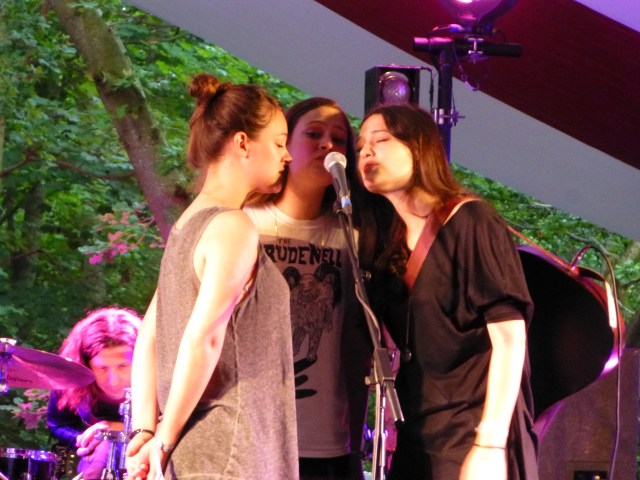
On Tuesday I went along to Shepherd’s Bush Empire with my friends Jon and Shane to see the Staves. It was my first non-festival concert since March 2020. And it was the Staves’ first tour promoting their new album Good Woman which came out in February this year, although they did do a very good livestream from the Lafayette, Kings Cross on the day of release.
It occurred to me as we watched the show, surrounded by mainly twenty and thirty- somethings, that I have been following the band for ten years now. I first came across them through a tweet by the veteran DJ and presenter “Whispering Bob” Harris, which linked to a video for one of the band’s early singles, Mexico. I liked it and checked out iTunes – remember that? – where I found a collection of beautiful, wistful folk-tinged songs, embellished by the loveliest harmonies you could hope to hear. Some of the lyrics were pretty dark, but it was music to soothe the soul. Their sound today is poppier, and rockier, with a discernable American influence, but their gift for melody, wrapped around with those amazing harmonies, remains.
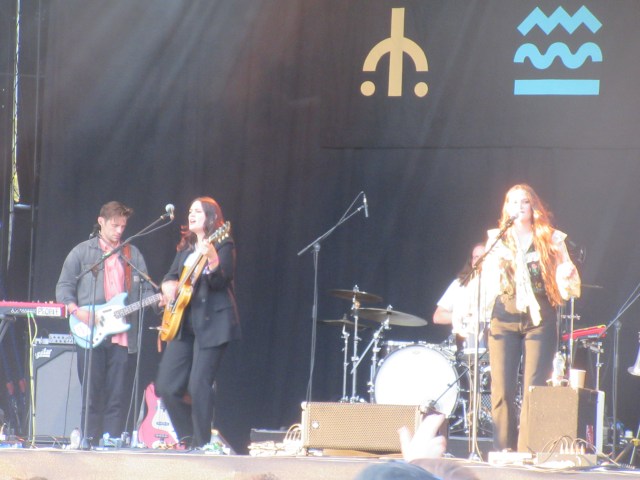
I saw the band play twice in 2012, first at the Tabernacle in Notting Hill, and then on the i-Arena stage at Latitude. That was my first Latitude, and the Staves were undoubtedly one of the highlights. I’ve seen them a few times over the years, with the show promoting their second album If I Was at Wilton’s Music Hall in east London in 2015 perhaps the best. After that I didn’t see them again until this year: first that livestream and then at Green Man festival in August. They were playing the main stage there in early evening. It was good, though the focus was, not surprisingly, on the more uptempo songs. And there were only two of the three sisters, Jessica and Camilla. Emily is taking some time out with her new baby. There was a full backing band too, a contrast with the early days when it was just the three of them and a drummer.
Latitude, July 2012
Wilton’s Music Hall, March 2015
Green Man, August 2021
Whether the line up was the same for the show on Tuesday I don’t know, though I imagine it was. But inside a hall, with the lights and more time, the Staves were able to explore the full range of their songs. And they did so superbly. I loved every minute of it. It was one of those shows that you don’t want to end. They played with dynamism and subtlety, with some lovely touches of cornet embellishing some of the slower pieces. The set naturally centred on the new album, which was played almost in its entirety. The show began with a selection of the more upbeat numbers, culminating in a past favourite, Black and White, from the second album. That was greeted like an old friend by the crowd. We then went into a lovely, reflective passage, with Jessica on keys for part of it. It included two of my favourite songs from the new album, Nothing’s Gonna Happen and Waiting on me to Change. But we also had three more from the soul-soothing past: Make it Holy, Winter Trees and that first song of theirs I ever heard, Mexico.
I could have gone home happy at this point, but the set built from now to a rousing Satisfied and finally, a great version of Damn it All, with Jessica really rocking out on the second half. They were obviously coming back for an encore, with the crowd loving it, and not having played their new anthem, Good Woman. So yes, they came back and played Good Woman and then finished with a joyous rendition of an older anthem, Teeth White. An uplifting end to a heart-warming concert.
Looking back at my previous reviews of Staves concerts between 2012 and 2015, I usually ended with a comment about how they were going places, had a great future ahead of them and so on. They weren’t the only ones, in fairness. But I’m glad to say, that for the Staves at least, I got it right!
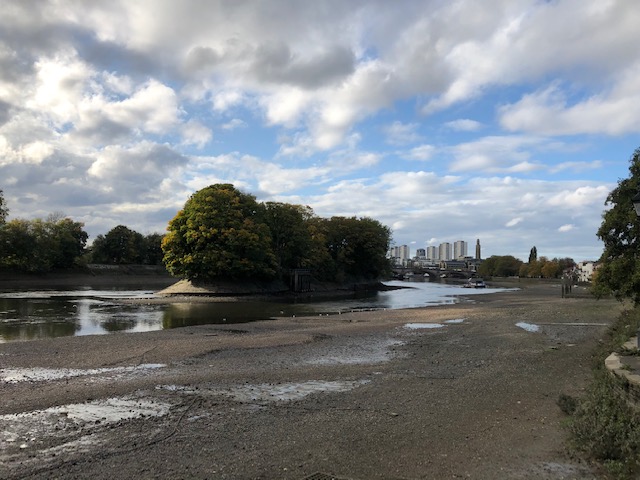
In the previous instalment of this journey – Hampton Court to Kew – I envisaged this piece covering Kew to Putney, a distance of around 6 miles on the river as it snakes through west London. The Thames Path in London guide gives the distance as 6 ¾ miles on the north side and 5 ½ miles on the south side. That’s quite a difference – caused by the bends in the river, and some of the diversions off river in Chiswick and Fulham. I’ve walked and cycled this stretch of the river more than any other, and Hammersmith has become something of a home from home for me. Consequently there are quite a few photos and reflections I’d like to share. Too many to take this journey all the way to Putney. So this one will end at Hammersmith Bridge and we’ll move onto Fulham and Putney next time.
This is Boat Race territory. The race, pre-covid, had run from Putney to Mortlake since 1845, apart from during the two world wars. It started in Henley in 1829 and from 1836 there were a few races between Westminster and Putney. Moving the race upstream was designed to take it away from the heavy river traffic further downstream. While the race ends at Mortlake, the crews actually disembark at a boathouse on the other side of the river, in Chiswick, just before Chiswick Bridge. I’ve only ever been down to the river to watch the race once. It’s a scrum, with a lot of drink being consumed. And you only see the boats for a few seconds. I prefer to watch it from the comfort of my sofa!
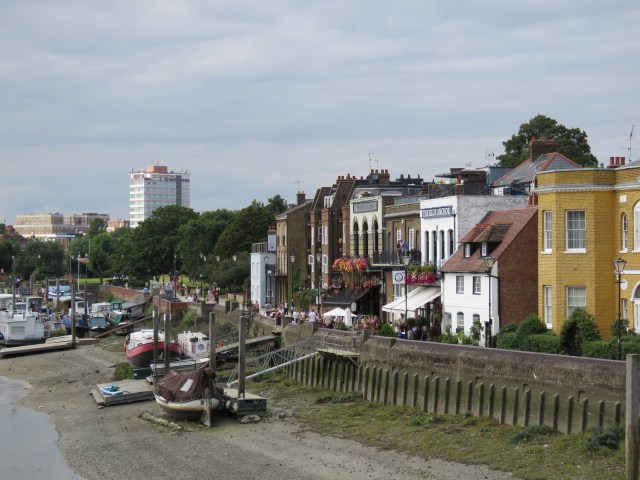
From Kew Bridge there is a towpath all the way down to Putney Bridge on the south “Surrey” side, taking in Kew, Mortlake and Barnes, as well as the renowned Wetland Centre nature reserve, a place I visited regularly when the children were young. On the north “Middlesex” side, there’s a lovely walk along Strand-on-the-Green, but then it’s a mixture of suburban streets, narrow countryish lanes and the odd bit of towpath until you get to Chiswick Mall, on the border of Hammersmith. From there the walk down to Hammersmith Bridge might just be my favourite in all of London…
But let’s start on Strand-on-the-Green. Strand means beach in German, and it’s reasonable to assume it meant something like shore by the 14th century, when it was known as Stronde. Later it became Strand Green and Strand under Green. No surprise, as Chiswick, of which it is part, was once known as the “great garden of London”. Today it is one of the more desirable parts of London to live in, with house prices to match. Peter Ackroyd speculates that Chiswick may mean cheese farm, in the same way as Keswick in Cumbria. He adds that it is: “Now best known for Chiswick roundabout.” Harsh. Chiswick House and its beautiful gardens perhaps, or even the shops, bars and cafés of Chiswick High Road. Having said that, circumnavigating Chiswick roundabout can be a traumatic experience!
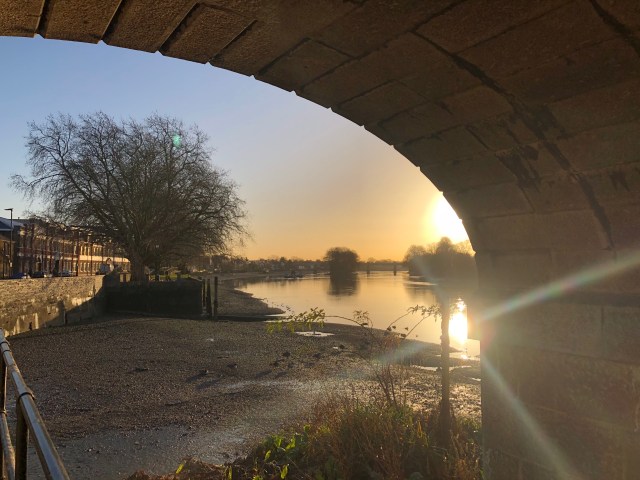
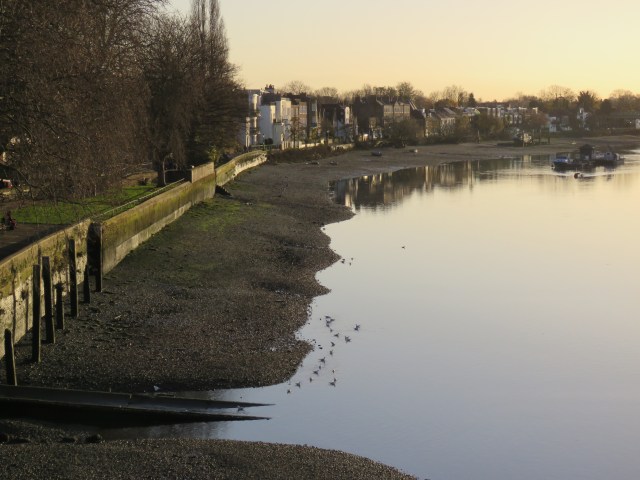
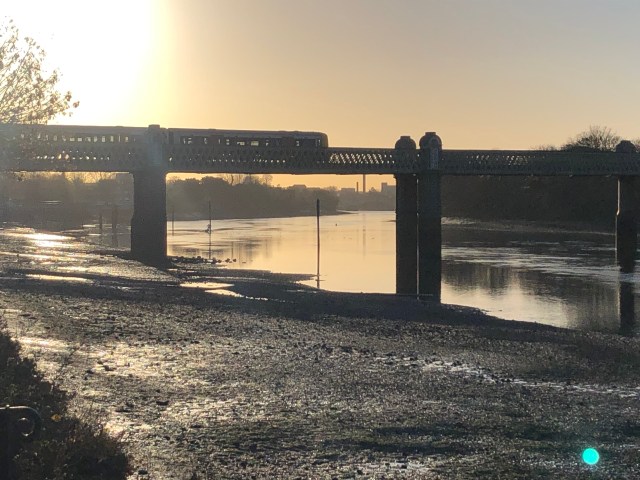
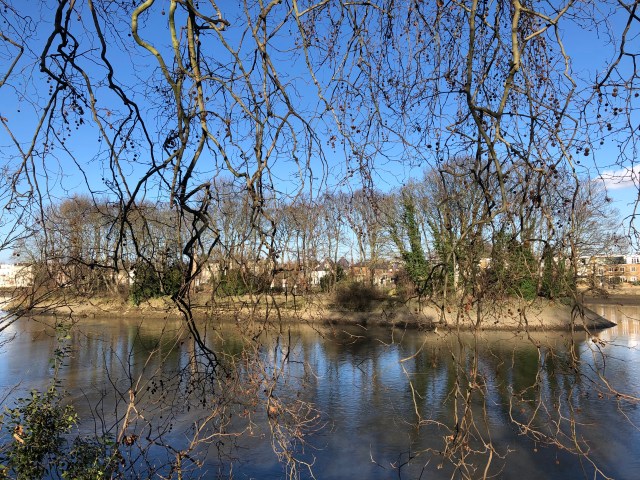
These first few shots were taken an hour or so after sunrise on a glorious day last December. Getting out and about by the river was one of the few remaining pleasures after we were plunged into the gloom of another lockdown.
The District Line passes over the railway bridge, heading down to Richmond
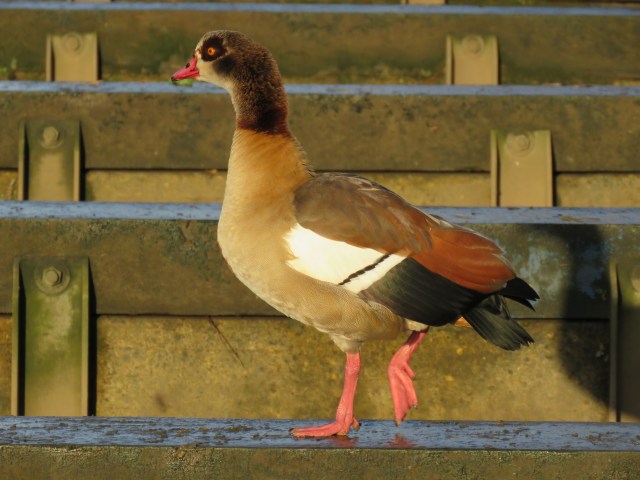
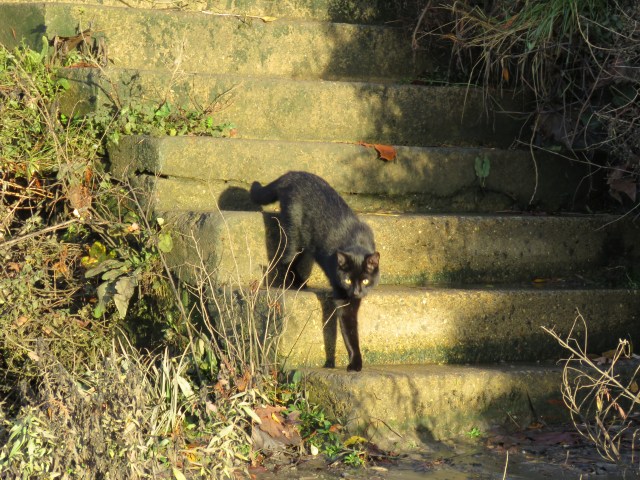
And here are a couple for the animal lovers.
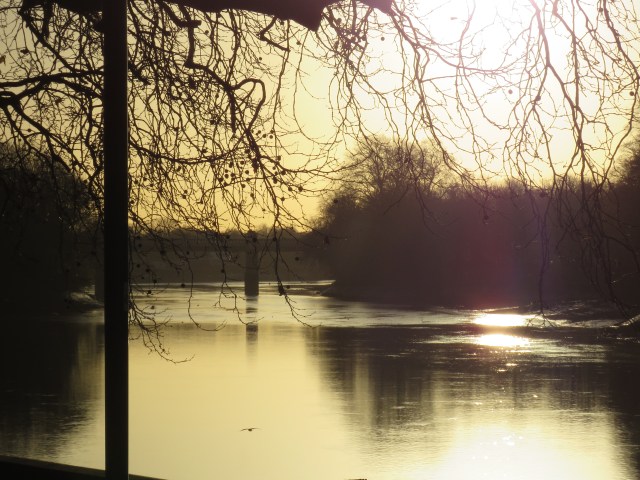
The next selection is from the other end of the day, in October 2020 and January 2021. The wooded island is known as Oliver’s Ait (or Eyot). Legend has it that Oliver Cromwell escaped from Royalist troops using a tunnel connecting the Bull’s Head pub to the island. The Bull’s Head is one of a number of venerable pubs backing onto the narrow paths of Strand-on-the-Green. Another is the City Barge, which dates back to 1484. Its name comes from its role as a location for winter moorings for the barges of the annual Lord Mayor’s Procession up the Thames. This event took place for 400 hundred years, the last one being in 1857. A more gruesome fact about Strand-on-the-Green is that in the 1920s, over a hundred skulls were discovered. There were similar finds in Kew and Hammersmith. The skulls dated to prehistoric times. Presumably the land around this part of the Thames was as sought after then as it is now.
Oliver’s Ait
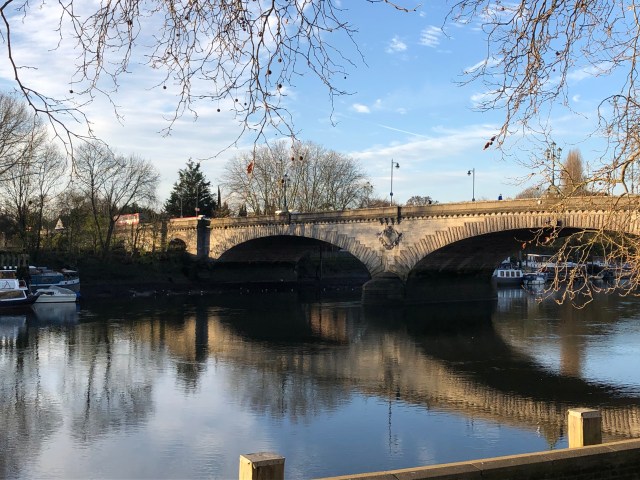
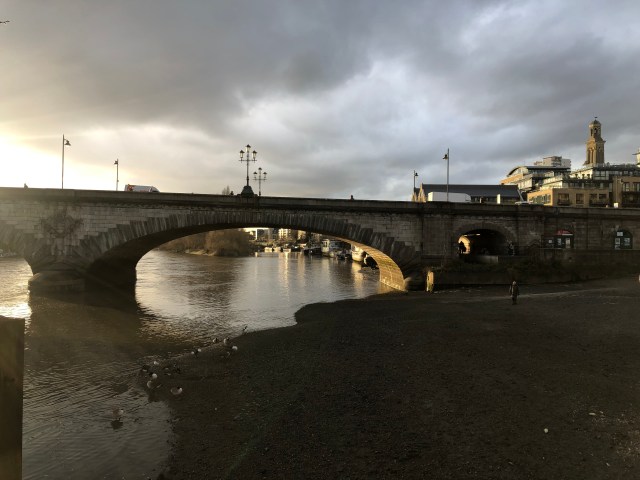
Kew Bridge was glowing in the sinking sun on this day.
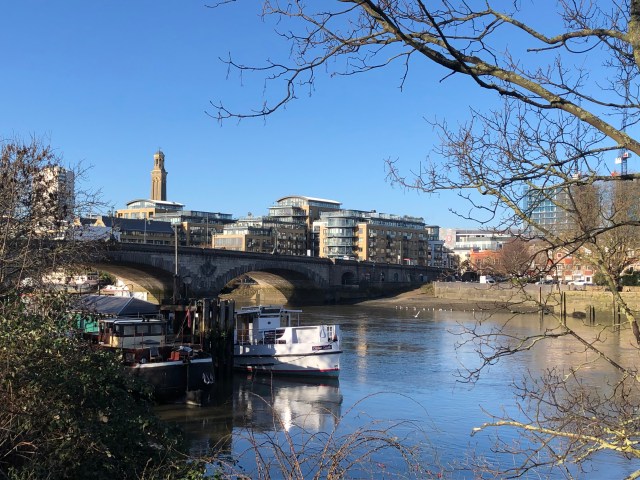
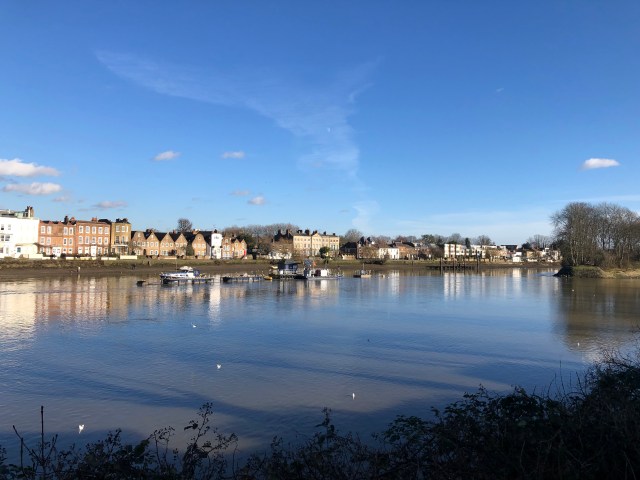
Jumping over to the other side of the river, we have a few photos taken in recent months as I walked along the towpath up to Chiswick Bridge. This is quite a tranquil stretch, though popular with walkers (and their dogs), joggers and cyclists, especially at weekends. It’s also prone to swarms of midges at times in the summer – when I used to cycle along here I’d be spitting them out as I rode along!
The heron was lurking by some boats just below Kew Bridge.
Strand-on-the-Green from the other side
Another take on Oliver’s Ait
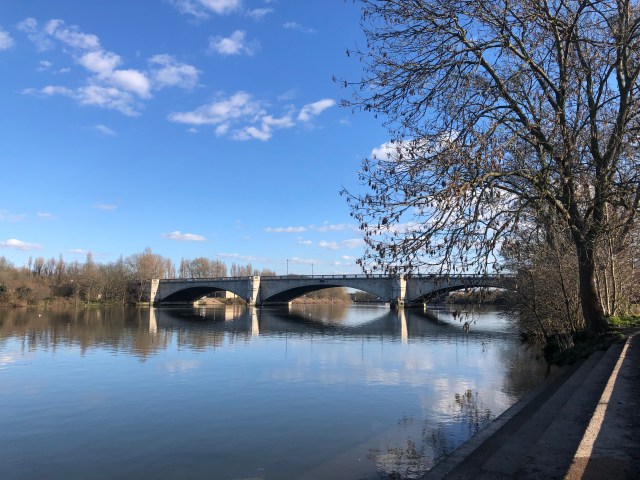
Chiswick Bridge from both sides.
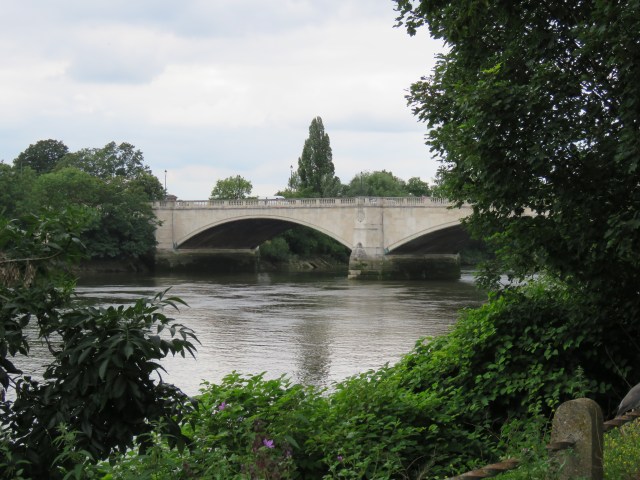
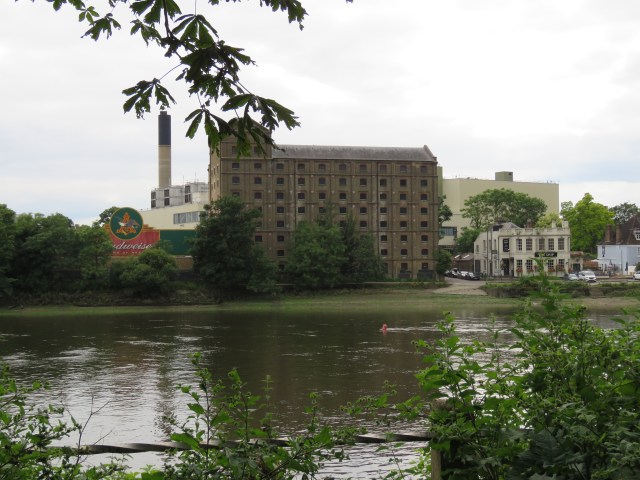
Chiswick Bridge is a relatively recent construction, having opened in 1933. It was built to help relieve traffic congestion in west London – an even more vital role at the moment, with Hammersmith Bridge still shut for major repairs – it reopened to pedestrians and cyclists, but not motor traffic, in on 17 July this year. Just beyond the bridge is Mortlake and the old brewery. Mortlake used to be famous for its weavers, many of whom were from Flanders. A number of tapestries produced between 1619 and 1703 are now displayed in Hampton Court Palace. It was also famous for its beer. The brewery was founded way back in 1487. It was acquired by James Watney and Co in 1889. At some point the brewery became known as the Stag Brewery, one of the Watney brands. Stag bitter was still being served in central London pubs when I first came to live here in 1980. Thankfully we have moved onto better things, though sadly the brewery is no more. Having survived a number of direct hits during the 1940 Blitz it met its fate when it was bought by Anheuser Busch in 1995. It switched to brewing Budweiser, which never really caught on in this country, despite a lot of advertising and sports sponsorship. It staggered on for another twenty years until AB sold the site to property developers. Plans for a mixed use development – residential, offices and a school – were refused planning permission by the Mayor of London in July, so we wait to see what happens next.
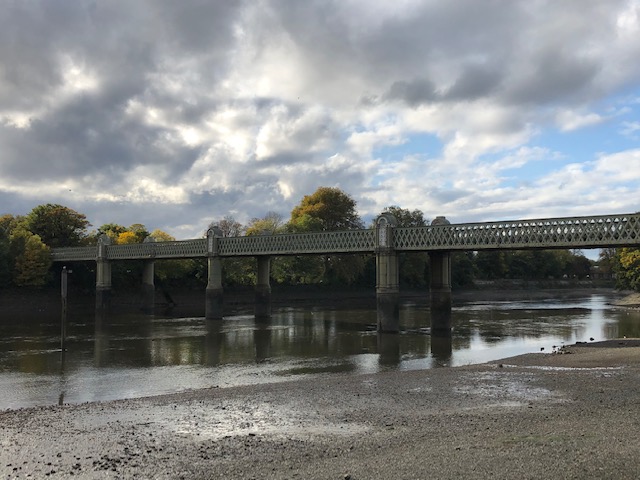
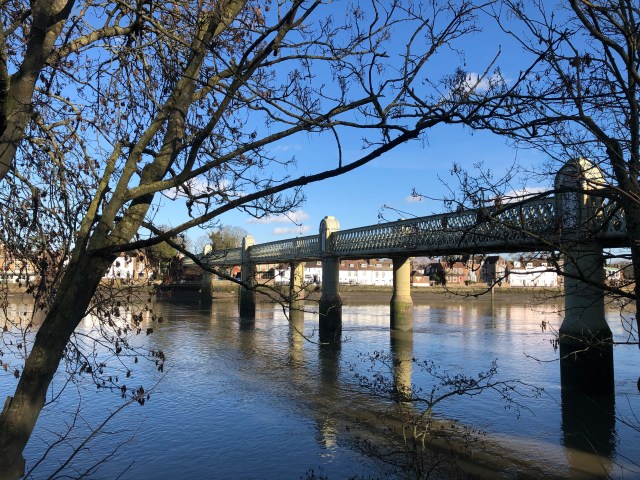
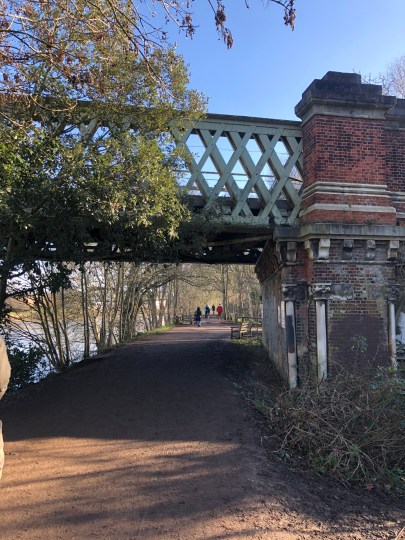
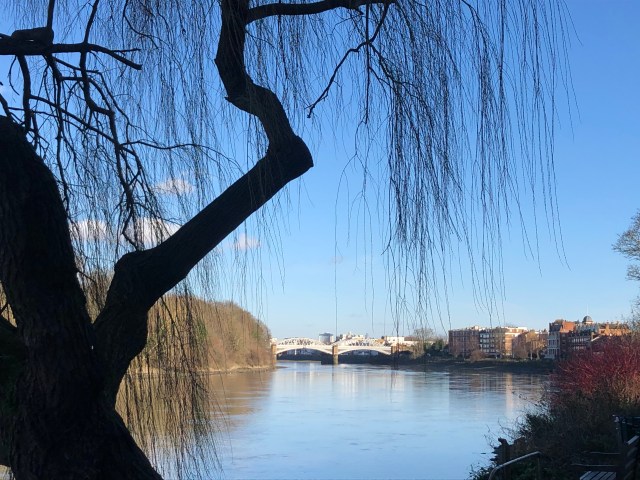
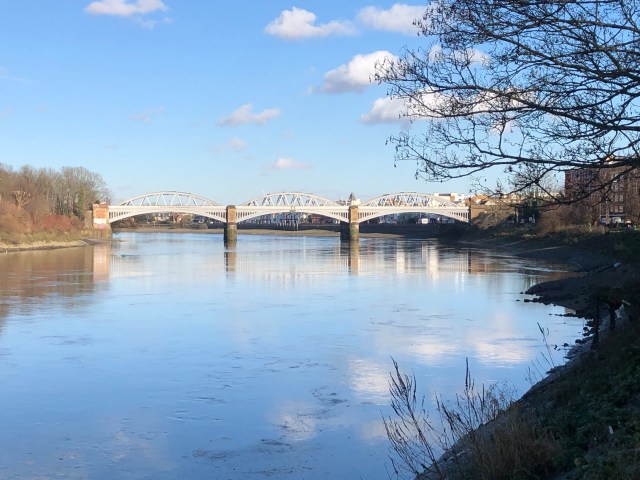
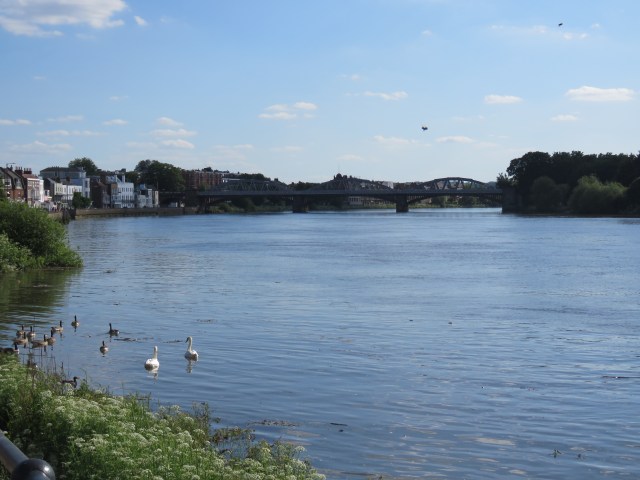
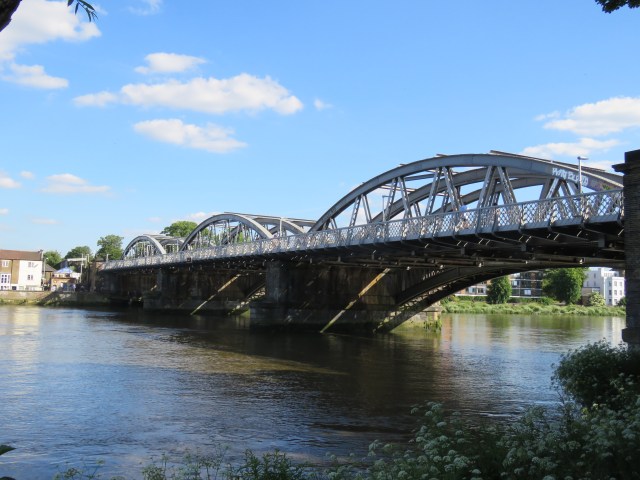
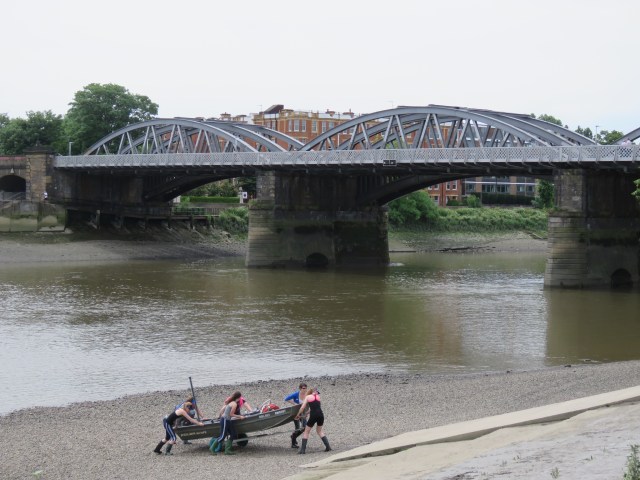
Staying on this side of the river, we soon approach Barnes Bridge, one of my favourite features on the Thames. It’s a railway bridge, which the train from Brentford into Vauxhall and Waterloo passes over. There’s a pedestrian crossing too. I always enjoy staring out at the vastness of the river and the sky as we cross – different every time, according to the weather and the hour. The bridge too takes on many different appearances – I’ve included a few favourite photos here, from over the years.
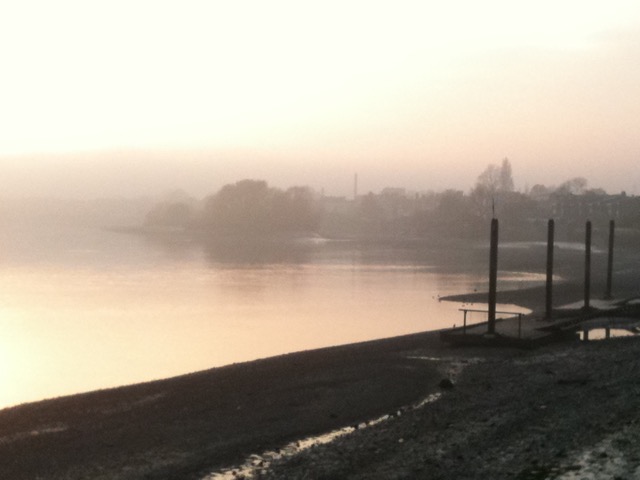
Starting with a misty scene from 2011.
The rest of the shots are from 2021, except the one with the rowers, which is May 2017.
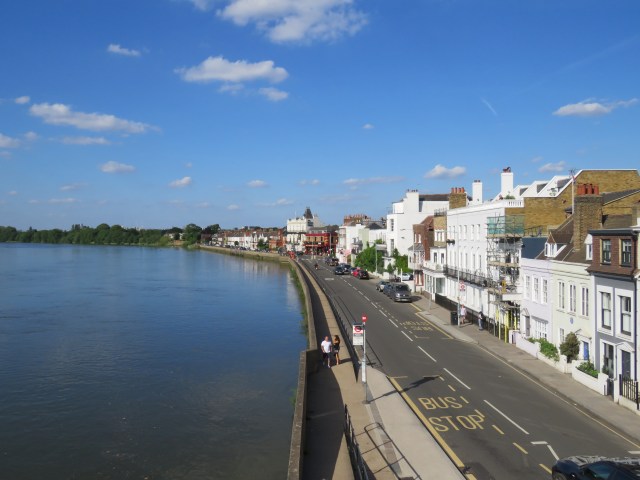
Barnes Bridge looks like a smaller version of Tyne Bridge in Newcastle and Sydney Harbour Bridge in Australia, but it predates both by some way. Barnes Bridge opened in 1849, Tyne Bridge in 1928 and Sydney in 1932. From the bridge a raised path takes you along the river and above Lonsdale Road, also known as The Terrace in this section. It’s an attractive scene, though the traffic can be heavy. The composer Gustav Holst – best known for The Planets – lived in one of the old Georgian houses at the far end of the street. He also taught music at St Paul’s Girls’ School in Hammersmith from 1905 until his death in 1934. There are some decent pubs here too, notably the Bull’s Head (another one) which is a centre of the jazz scene in London. The food is good and it’s a nice place to stop for refreshments if you are walking along the river.
Some views from the bridge.
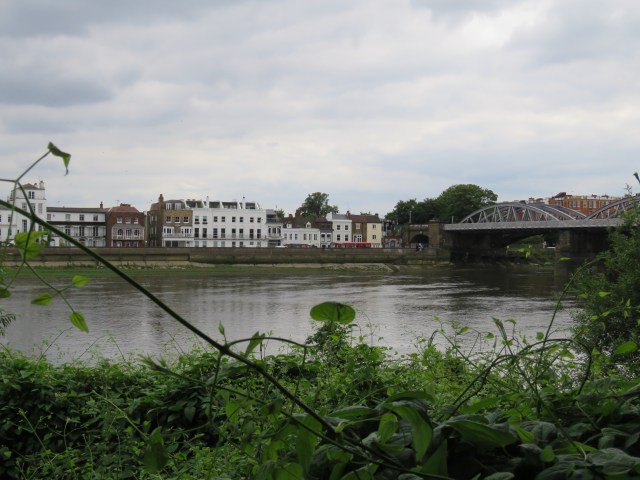
Just after the raised path ends the Thames path enters a tree-lined area which takes you all the way to Hammersmith Bridge. Clear views of the Hammersmith side are limited. I stopped cycling along this part of the path years ago, as it gets quite muddy, especially in winter. I prefer to bomb along Lonsdale Road – by my standards! – past St Paul’s Boys School with its vast playing fields, up to Castelnau, which heads up to the bridge. Except right now you can’t cross it in a car or a bus. A nightmare for local residents – the nearest road bridges are Chiswick and Putney. I remember my son playing rugby against a St Paul’s team in year 7. It was an utterly freezing February morning, in 2007. The icy winds whipped off the Thames. The boys who weren’t in the scrum were trembling in the cold. One boy had to come off because he was shaking so much. Good for the soul, no doubt.
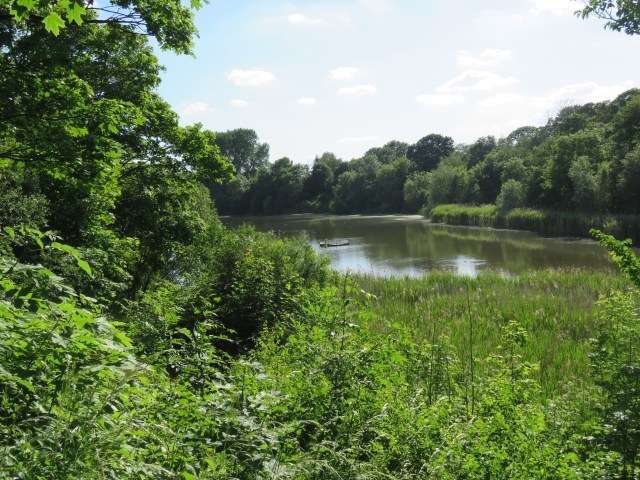
Despite my familiarity with this part of the river, it was only in December last year that I discovered the Leg O’Mutton. Tucked away between the river path and Lonsdale Road is what used to be a reservoir and is now a nature reserve, with leafy glades and marshes. There’s a lovely tranquility about it all. The lake is shaped like a leg of lamb, hence the name. The water used to serve local residents and business, but no longer. It has been reclaimed by nature. My friend Jon, a resident of Hammersmith, introduced this to me as we walked from Hammersmith to Putney, Barnes and back to Hammersmith – the Thames and its environs never cease to delight.
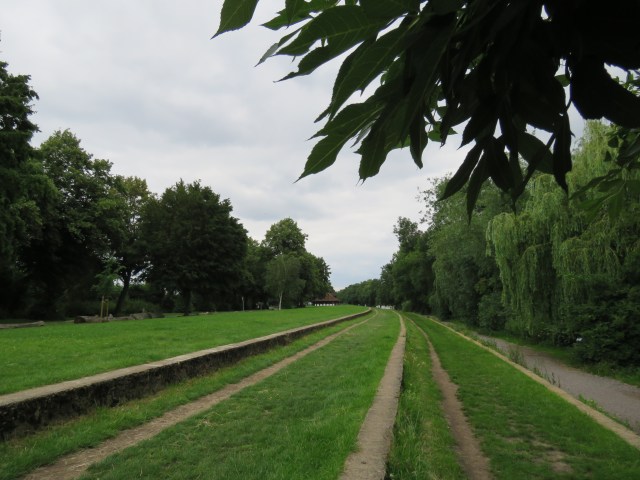
Going back to Barnes Bridge and crossing over, we come to Dukes Meadows. The meadows extend from Chiswick Bridge to the edge of a private estate that leads past Chiswick Pier towards Chiswick Mall. The meadows are mostly given over to various sporting activities – there’s a big leisure centre, a golf course, Chiswick rugby club, various other sports grounds and a couple of boathouses, one of which is sited next to the steps down from Barnes Bridge. The civil service has a sports ground in the area – I’ve played in a few 5-a-side tournaments down there in the past. After the boathouse there’s a promenade with good views of the Terrace on the other side of the river. There’s some parkland here, with a couple of bandstands. It’s a nice place to stop and have a sandwich and a cup of tea, sitting on the grassy steps that lead down to the riverside path. The area is very popular with picnickers in the summer. The aroma of barbecues wafts over the summer breeze. The park was opened by Prince Albert, Duke of York (and future King George VI) in 1926, after local residents twelve years earlier fought off plans for the Brentford Gas Company to build a gasworks there. An early example of middle class nimbyism?
The picnic area – sometimes
Looking over to Barnes
Approaching Chiswick pier
This brings us to Chiswick Mall: the beginning of a stretch of the river which might just be my favourite spot in London. I think of it as Hammersmith, although the first half of Chiswick Mall (looking downstream) is still in Chiswick, and hence the borough of Hounslow. Last year, when lockdown eased a little, but there were still strict social distancing rules in place, this made a difference as a cyclist. In Hammersmith and Fulham cycling along the river paths was banned, with stewards enforcing the rules. There was no such thing in Hounslow, or indeed the borough of Richmond on the Barnes side.
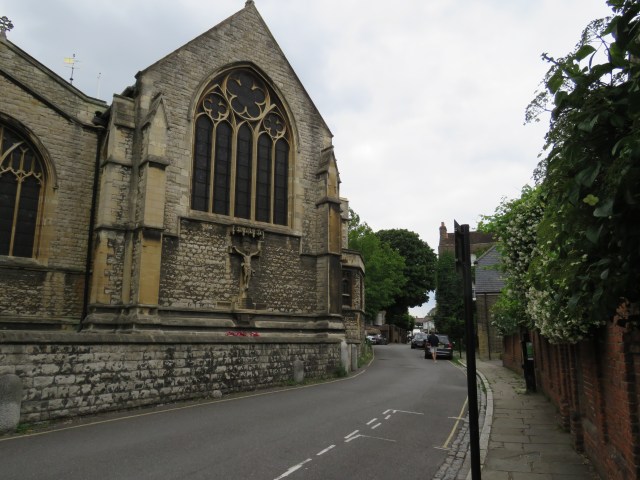
At the start of Chiswick Mall, heading downstream, you will find St Nicholas’ Church, Chiswick. The oldest part of Chiswick developed around the church in the late 12th century. The tower was built between 1416 and 35; the rest of today’s church dates from 1882-84 when it was rebuilt with money from the brewer Henry Smith, whose Fuller, Smith and Turner brewery was nearby. In the graveyard, amongst others, lie artist, cartoonist and satirist William Hogarth (1697-1764) and American artist James Whistler (1834-1903). Hogarth’s name is lent to another of Chiswick’s notorious roundabouts, which is located at the other end of Church Lane. From the tranquility of the church and the Thames to the snarling traffic of the A4 in a couple of minutes’ walk. Such is London.
St Nicholas’
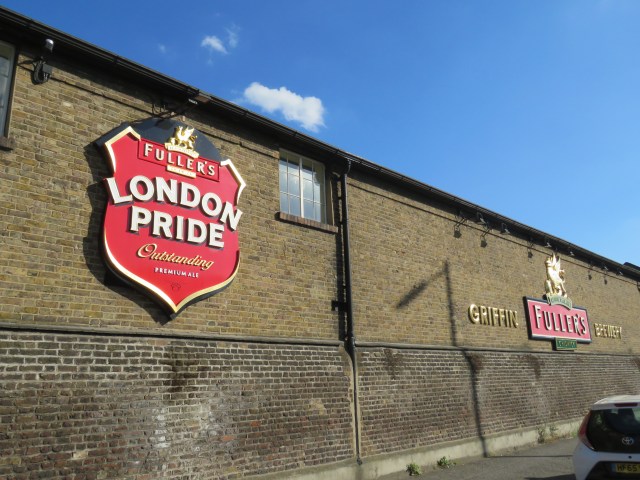
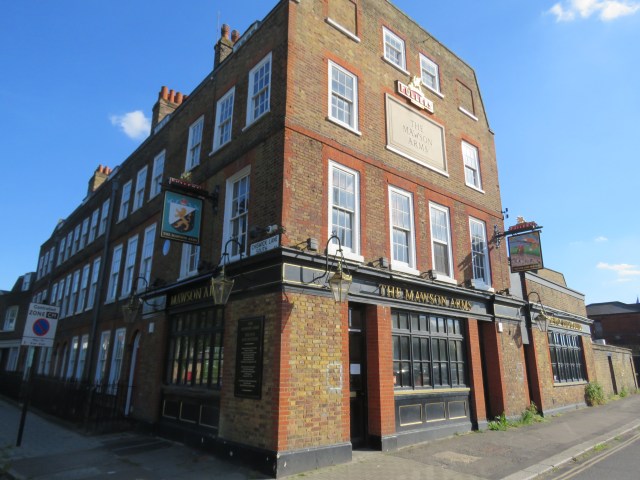
A short walk along Chiswick Mall then brings us to Fuller’s Griffin Brewery, home of one of the finest ales to be found anywhere, London Pride. Not to mention the powerful ESB and many others. The brewery was founded in 1845, though beer had been brewed on the site since the 17th century. Fuller’s had long been a public limited company and extended its operations across nearly 400 outlets, primarily in the south and west of England, but the family-run brewery anchored it – until, in 2019, it was sold to the Japanese giant Asahi, Fuller’s retaining the pubs and hotels. We have seen what happened to the Stag brewery – will a similar fate follow for the Griffin? Already the house pub, the Mawson Arms, has been closed for good, following its initial closure in the March 2020 lockdown. Only a few days before that I and a few friends were there, watching the Cheltenham races on Gold Cup day. There was a valedictory feel to the afternoon – we knew lockdown was on the horizon. But it was a pub we loved to visit each year for what we call our virtual Cheltenham after breakfast somewhere in the City. And it was a place I’d pop into for a quick pint during a walk along the river. It was popular with touring groups who’d been to look around the brewery, and was the local for the brewery workers themselves. Where do they go now? Its closure felt like a gratuitous act, sneaked through in lockdown, just another small example of unfeeling capitalism in action.
The Mawson Arms, much lamented
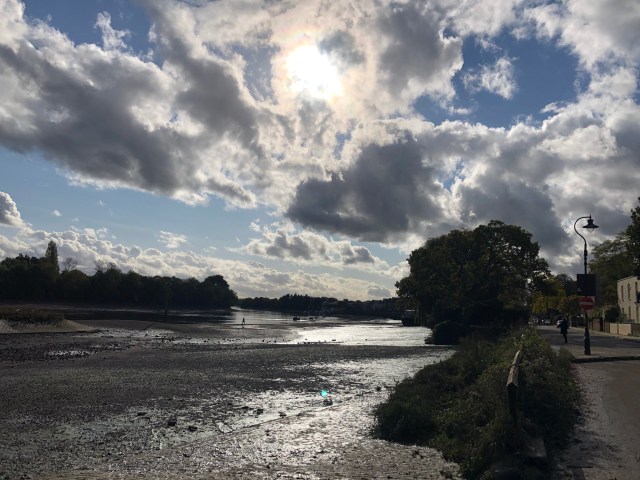
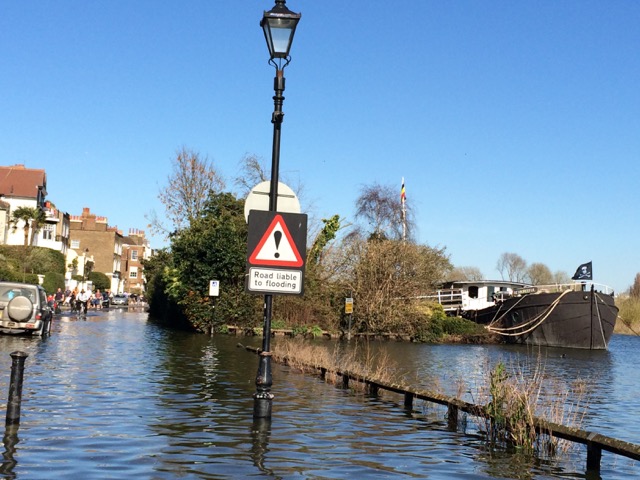
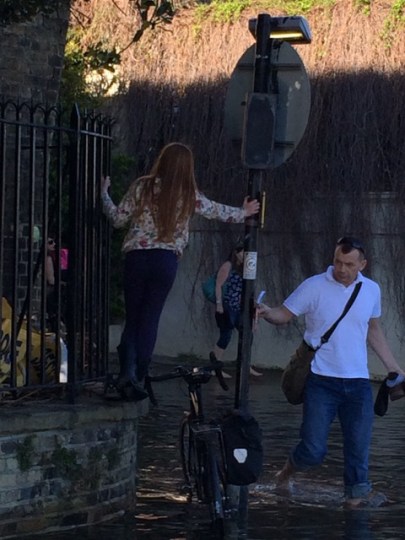
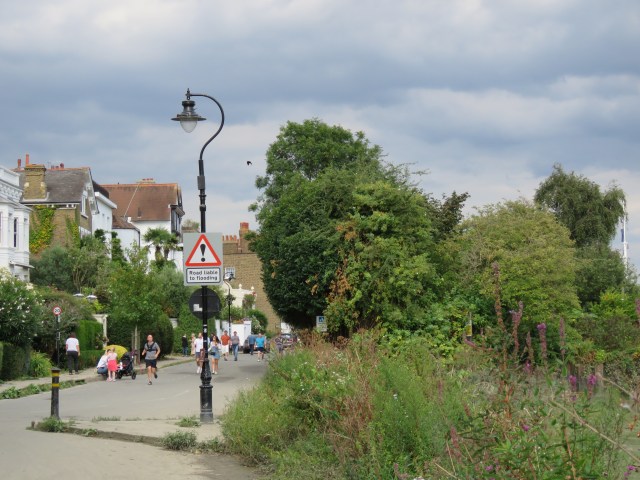
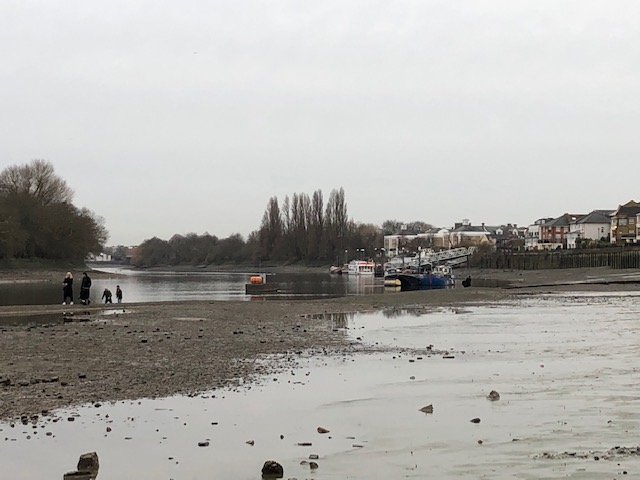
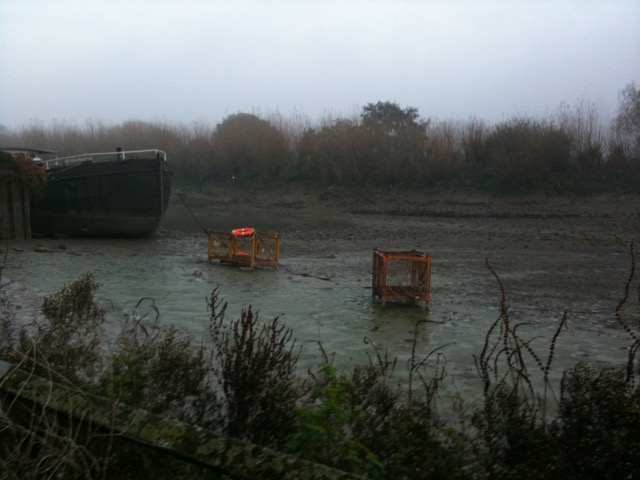
Chiswick Mall creates a permanent sense of wonder for me. Not just the huge, grandly designed houses with their richly planted riverside lawns on the other side of the road, but most of all the spectacular demonstration of the Thames’ tidal scale. The difference between high and low tides in the Hammersmith area is around 5 ½ metres, or 18 feet. The difference is even greater further downstream. It’s something that never ceases to amaze me, and Chiswick Mall demonstrates it very well. At low tide, the river is virtually dry all the way up to the eyot in mid-stream. At high tide, Chiswick Mall is flooded. The water can be deep enough to make cycling impossible. The photos below give you some indication of the contrast.
The two high tide photos are from March 2014. You can see more photos in lovelondonscenes 50.
May 2017 – same spot as above
The next two shots are from December 2018.
This misty scene is from November 2011.
Some of those riverside gardens.
These last three are from this month.
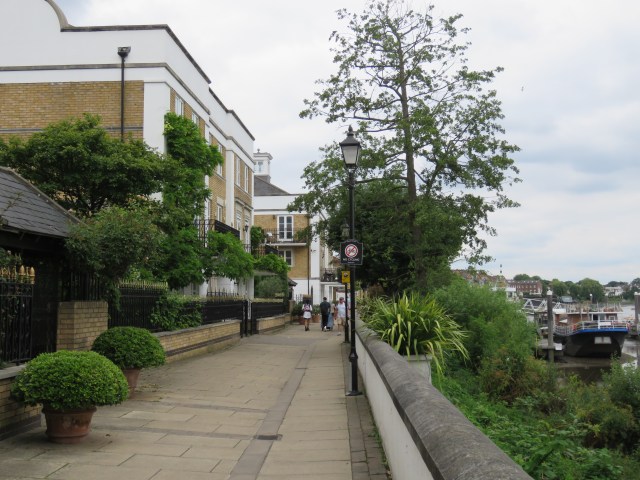
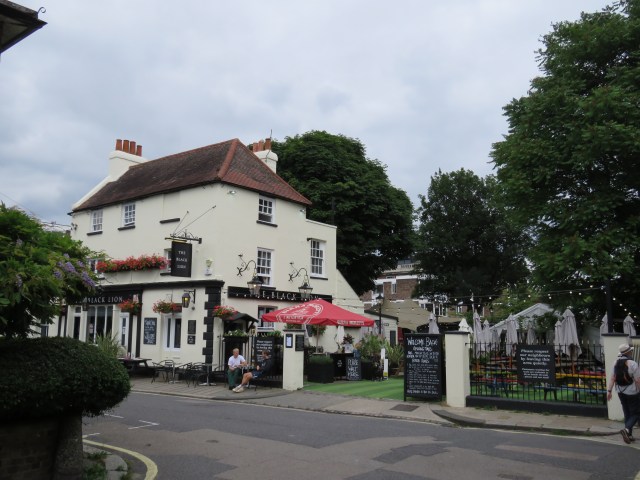
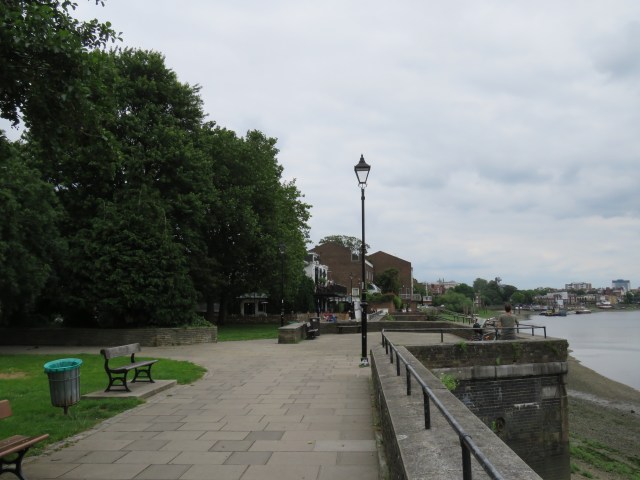
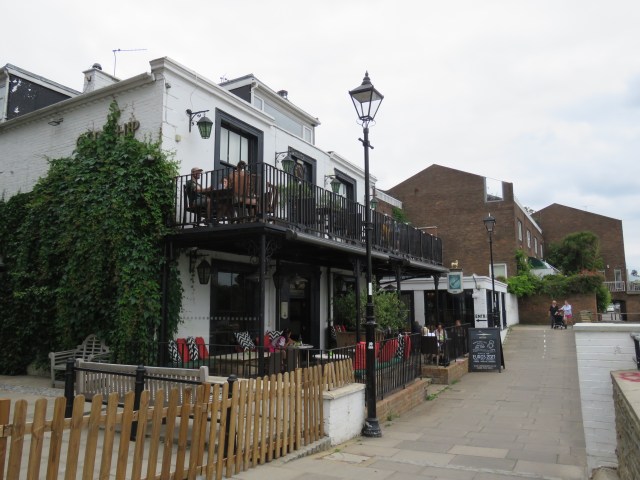
At this point the river is approaching the top of a bend: a north-east flow shifting to south-east. Along the rest of Chiswick Mall to the Black Lion pub, along the promenade past the Old Ship and then into Upper Mall, with another string of fine, if somewhat more understated houses than Chiswick Mall. No riverside lawns here, either – the street is protected from the river by a high wall. Upper Mall leads into a narrow alleyway which houses one of the best pubs around – The Dove. It’s small and has a rather cramped terrace looking onto the river, but is always worth a visit. Fullers beers, naturally. On the other side of the alley are Furnival Gardens and a promenade which takes you up to Hammersmith Bridge. Two more popular pubs, the Rutland Arms and the Blue Anchor, line the way.
The Black Lion
Approaching the Old Ship
The Old Ship
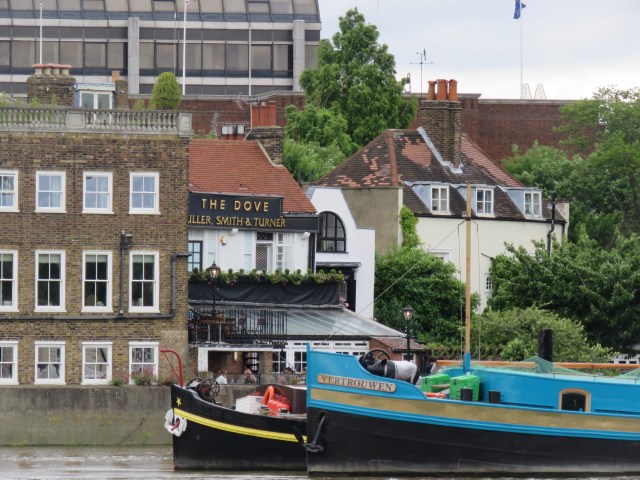
The Dove from the other side of the river, zoomed in.
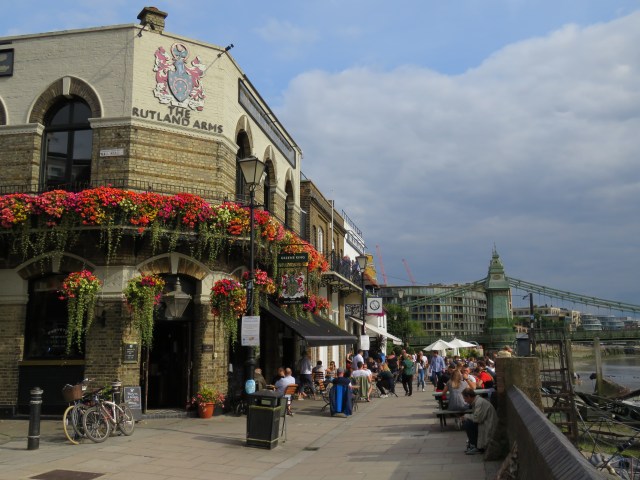
The Rutland Arms, with the Blue Anchor just beyond
View from Hammersmith Bridge
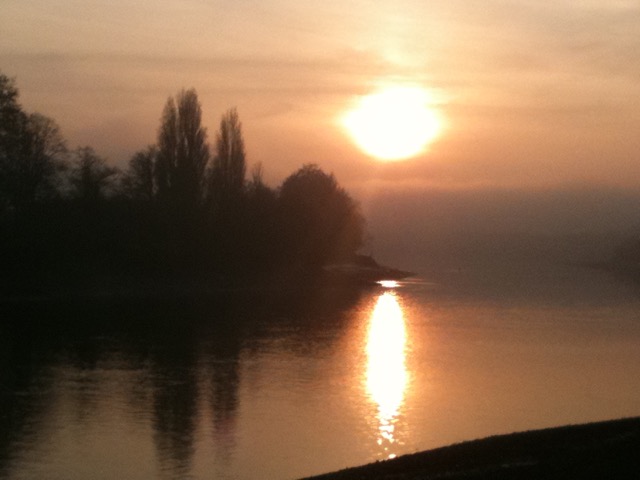
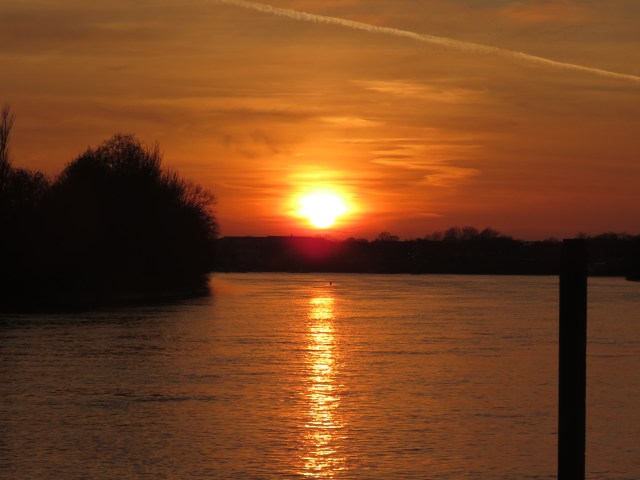
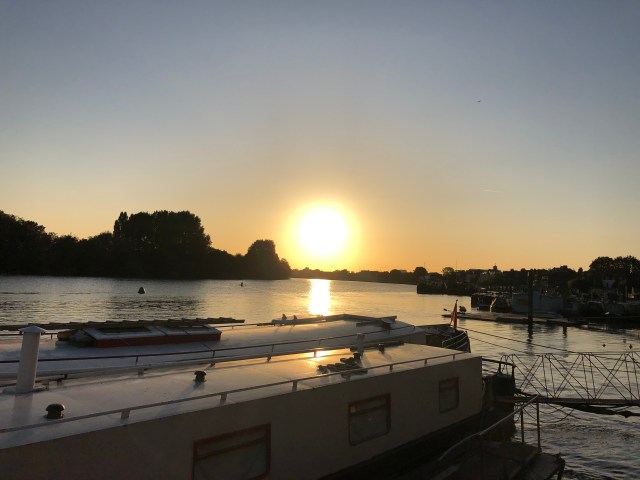
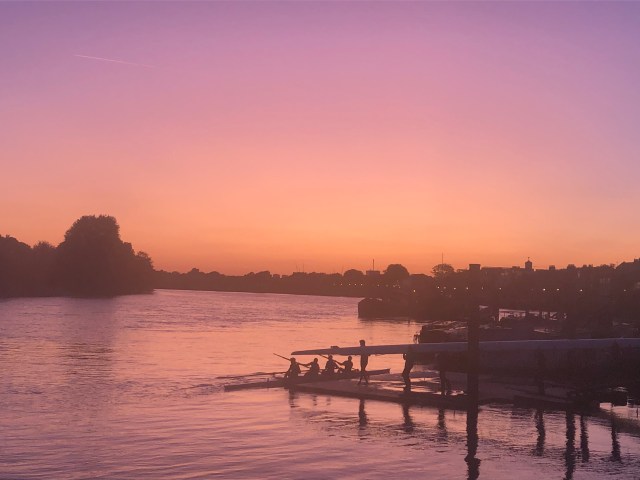
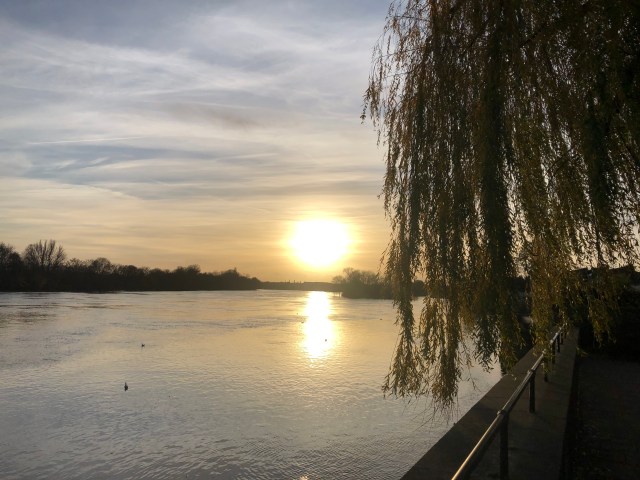
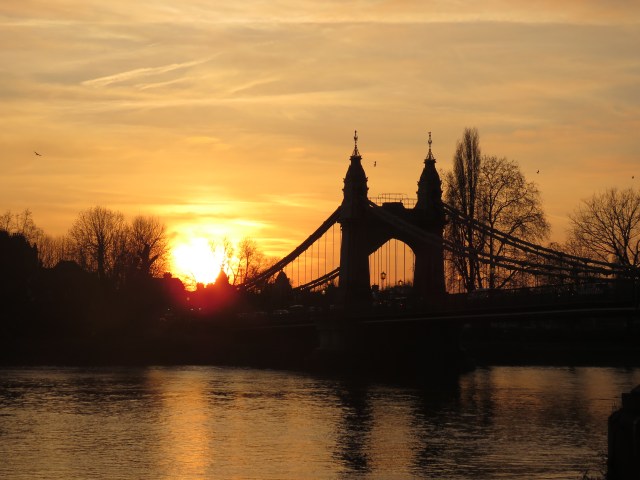
I love this stretch of the river, and not just because of the many hours I’ve spent in all of these pubs over the years. More than anything, it’s the views, especially as the sun goes down. The nature of the bend in the river is such that there are wonderful big skies to the west, and you can watch them turn yellow, pink, orange, purple, red, laced with the greys and blues of the clouds. The trees on the other side of the river and the boats on its surface are silhouetted against the glow. A good time to see all this is in the winter months, when the sun sets as early as 4 o’clock; but each season brings its own glorious perspective.
January 2016
Also Jan 2016. I think the boat might have been sinking!
The next two in the mist are from November 2011. Impressionism in nature.
Two from September 2019. I love the purple sky in the second. No enhancements – just the fact the photos were taken with an iPhone 8.
Onto December 2020.
Hammersmith is a place of many memories: of times spent with friends, of great restaurants and pubs, of walks and cycle rides, of music and drama (the Apollo, the Lyric, the Riverside, and, in the past, the Palais) and of learning (my daughters’ secondary school). It was natural that it should play a part in my novel, The Decision, and its successor, Hope Rising. They are part of a trilogy of futuristic political novels, though not quite as futuristic as I’d imagined at the time of writing, given our experiences in the last 18 months. In The Decision, the main character, the rebel leader Charlie, has to decide whether to go ahead with what is looking like a hopeless mission. He ponders the pros and cons while looking out over the river in – where else? – Hammersmith. In my imagination it was outside the Old Ship; the river here is a place for contemplation. The photo I used for the cover was taken slightly further downstream so I could get a closer view of the bridge.
Photo used for The Decision cover – in black and white
Charlie would have been standing with his beer around here
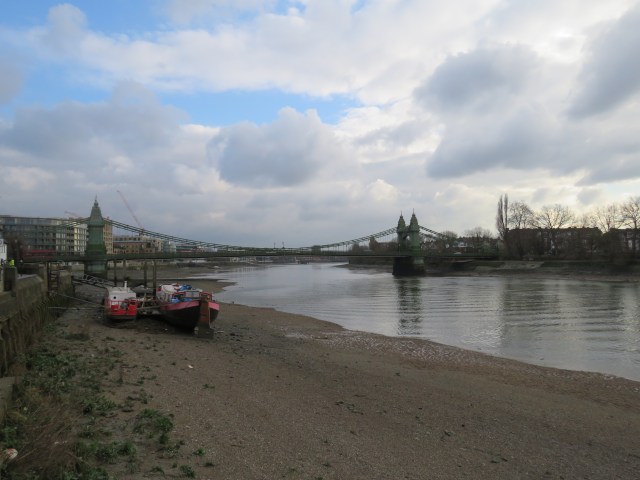
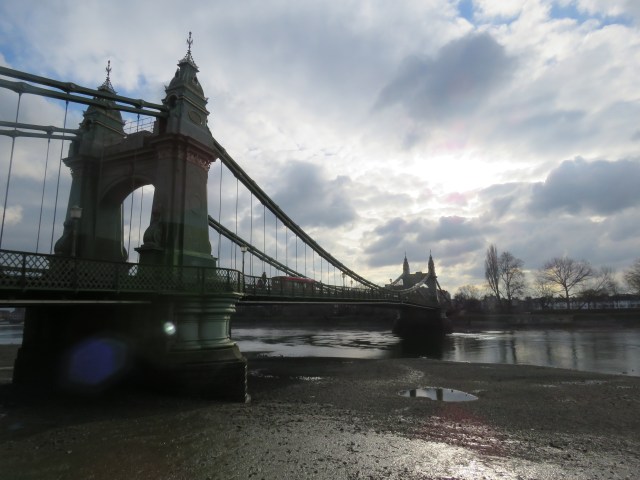
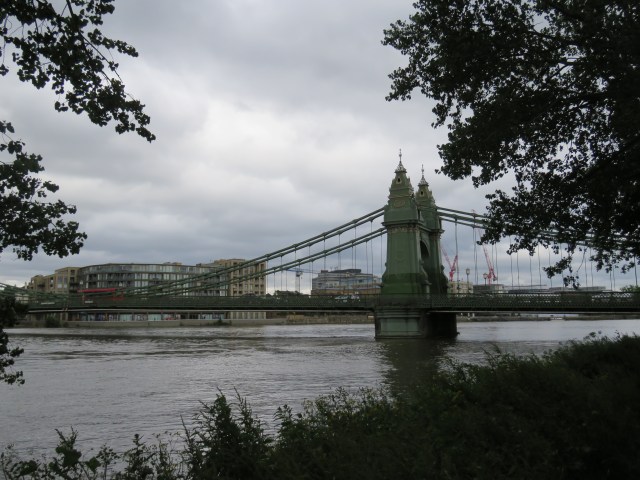
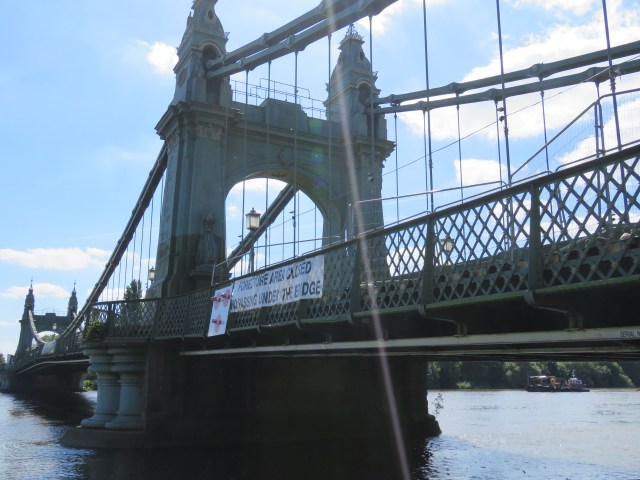
And so we come to the bridge itself. Battered and bruised; down but not out. It was the first suspension bridge to be constructed over the Thames. The first version was designed by William Tierney Clark, who was responsible also for the Thames crossing at Marlow and the great suspension bridge in Budapest, as I mentioned in part 5 of this journey. By the 1870s there were concerns about its ability to carry the increasing weight of traffic; and in 1882 it was damaged when a boat collided with it. A new bridge was constructed on the foundations of the first one – designed this time by the great civil engineer Joseph Bazalgette. It was opened by the Prince of Wales in June 1887. It has been the target of the IRA on three occasions: in 1939, 1996 and 2000. The only time the explosives detonated was in 2000; subsequently the bridge was closed for two years for repairs. It has been closed for repairs on other occasions over the years; but the recent problems seem to be more deep rooted. Cracks in the structure were identified in a major survey conducted in 2014 and the bridge was closed to traffic for a period. Further repairs were delayed by wrangling between the various bodies with an interest; but by 2019 the problems had become more serious, and the bridge was closed to motor traffic in April of that year. I can remember enjoying being able to cycle across the bridge undisturbed in the following period, but the closure to cars, buses and commercial traffic was a serious impediment to the daily lives of many people. Further structural damage was identified in 2020 after a heatwave, and the bridge was closed to all in August. The wrangling over the cost of repairs – between the local council, Transport for London and central government – continued; and it looked like closure could last for a long time. A ferry for pedestrians and cyclists was mooted; but then, seemingly out of the blue, it was announced that the bridge would re-open to pedestrians and cyclists in July 2021.
I went down to the bridge earlier this month simply to walk over it and back again. It was good to enjoy that simple pleasure which had been denied to us for many months. One of many things we took for granted until 2020, and now relish. But the pleasure – and the utility – is still only available to pedestrians and cyclists. The future for other traffic remains less certain: there have been various proposals, all with high costs attached, and no-one seems to have enough money. It seems to me that, given the importance of the bridge to the life of the capital city, central government should be stumping up the bulk of the money on an emergency basis; but of course that isn’t how it works. The latest progress, as far as I can tell, is in this update from Hammersmith and Fulham council. Obviously it is written from the council’s perspective, but it seems to have all the salient facts.
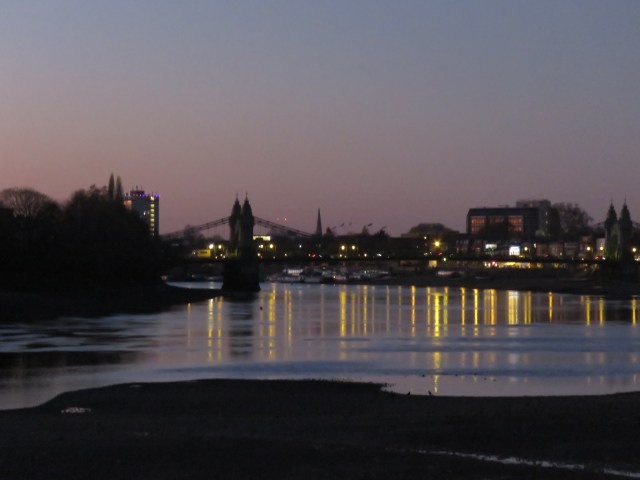
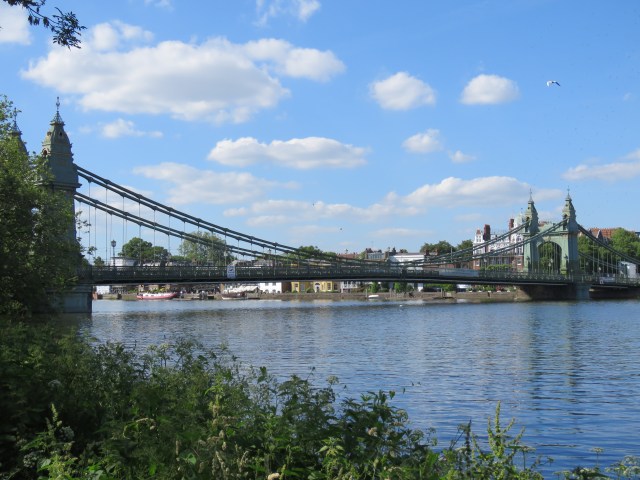
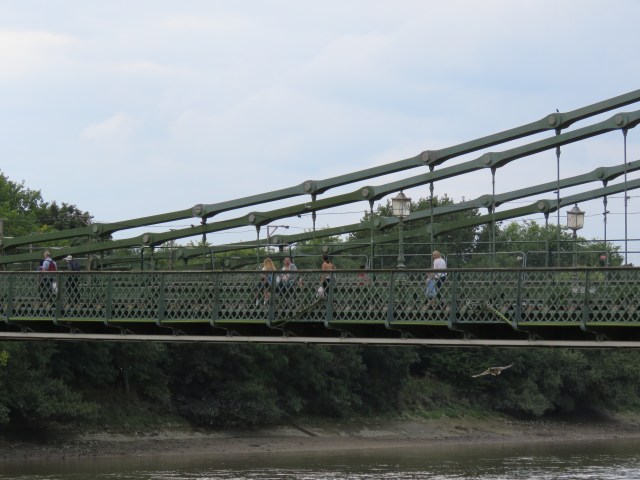
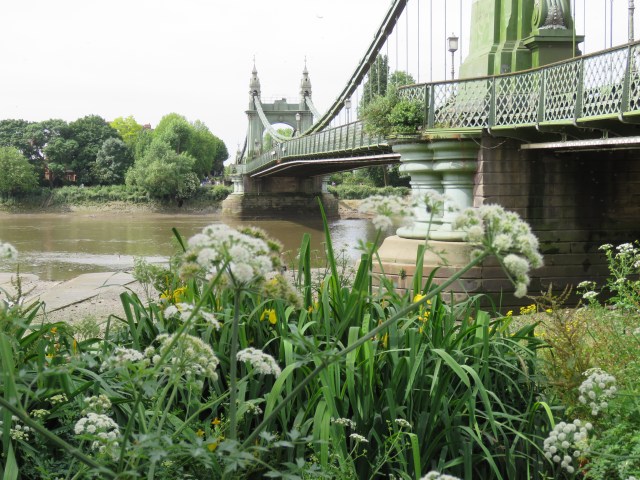
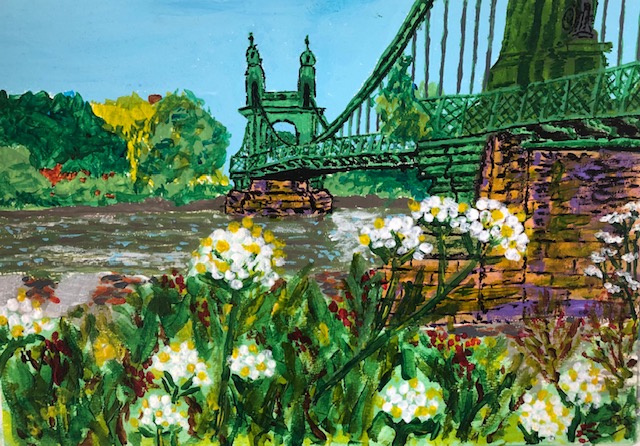
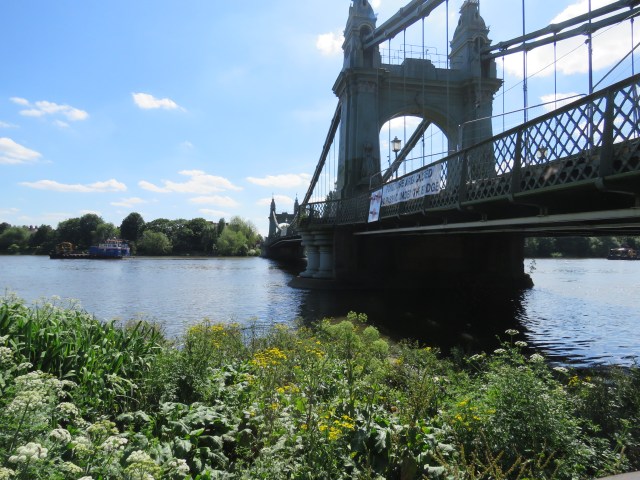
Let’s hope the bridge is restored to full functionality in the not-too-distant future. It is part of the lifeblood of west and south west London, as well as being a structure of great elegance and beauty as befits its Grade 2 listed status. It’s a gentle green in the daylight, it broods as the sun sets and the river sparkles below in the darkness. I hope the photos below capture some of that. I’ve included a painting of mine too – taking a luxuriant summer scene as my inspiration.
From The Decision photo shoot in February 2018
Feb 2018 again
June 2018, from the Barnes side
January 2019 – same as the orange sunsets earlier
November 2018
In June this year, the bridge was still closed.
Earlier this month – accessible again.
In July 2017 I took this photo, which became a painting. Took a few liberties with the colour, as you can see.
The scene revisited, June this year.
So that’s it for this instalment. Hope you’ve enjoyed the journey. Next time we will head to Putney Bridge and beyond – to the edge of central London at Vauxhall Bridge.
Looking downstream from Hammersmith Bridge, September 2021
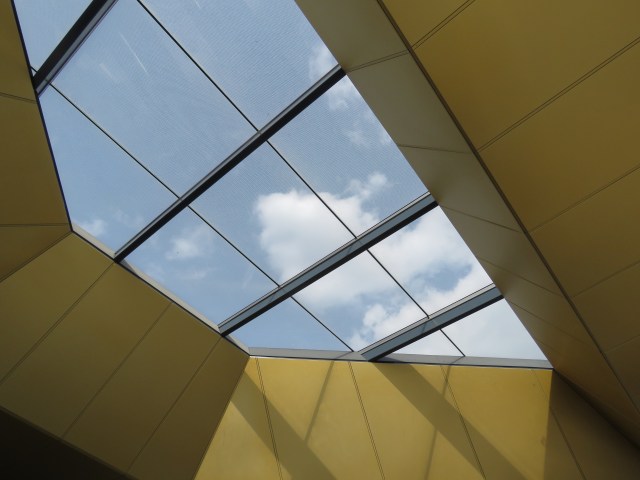
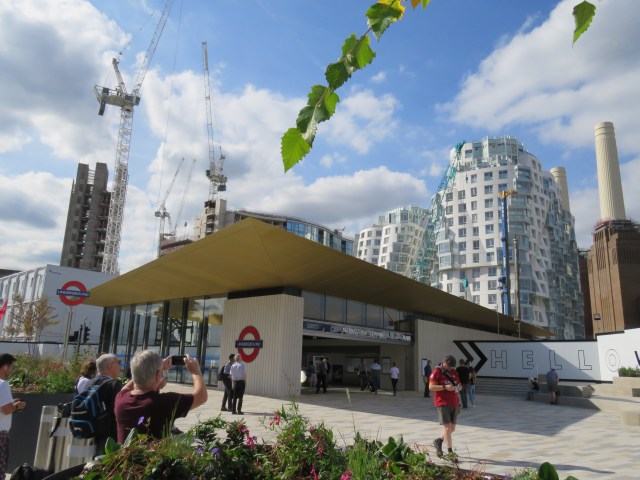
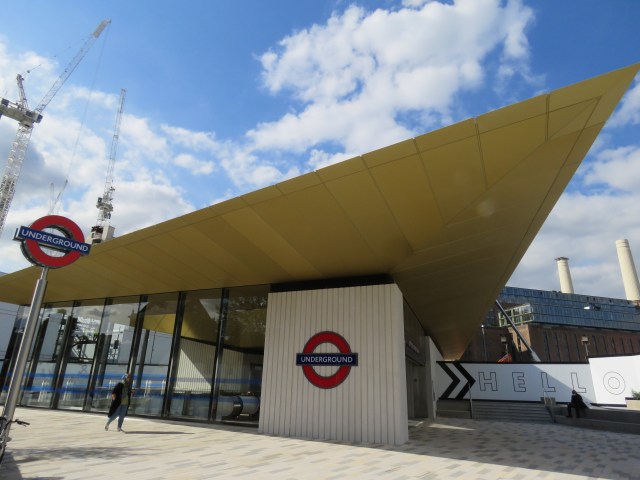
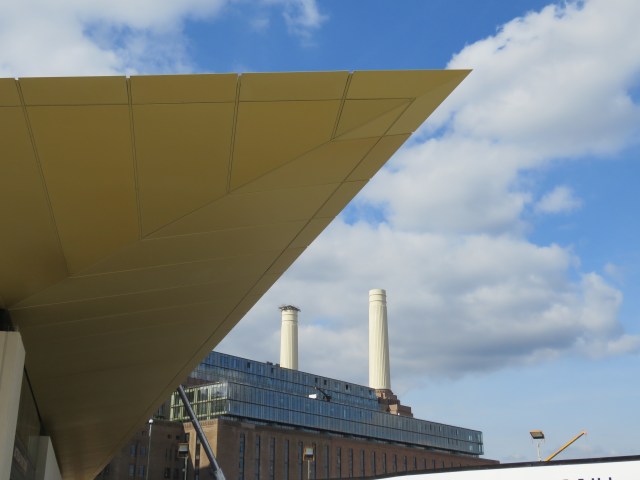
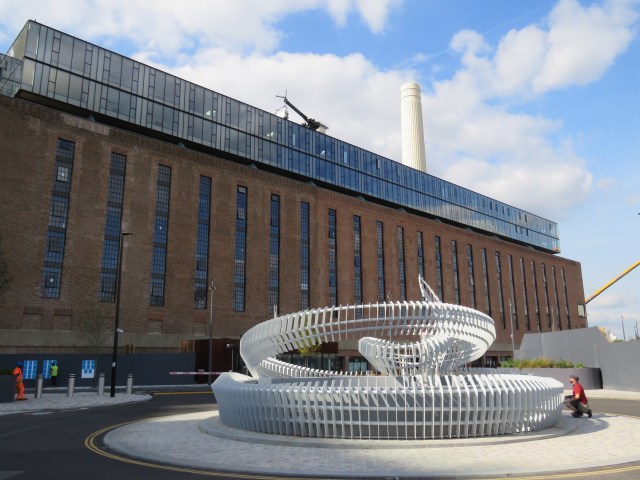
On Monday 20 September an extension to the London Underground Northern Line opened. A short one, south of the river, travelling south-west from Kennington to a spot not too far from Battersea Power Station. With the one intermediate station, Nine Elms. This is an area in which a lot of development has been taking place over the last few years, primarily the construction of luxury tower blocks, many of whose flats are probably lying empty much of the time. They are investment opportunities, a safe haven for foreign capital, as much as somewhere to live. No surprise then, that in 2012, Boris Johnson, then London Mayor, described the Vauxhall Nine Elms Battersea opportunity area as “the greatest transformational story in the world’s greatest city.” Donald Trump didn’t agree. In 2018, he described the location of the new American Embassy as “lousy”, “horrible” and “off location”. Ok, so it’s not exactly Grosvenor Square, but it’ll have a great view of the river, there’s a big Waitrose nearby – and now there’s a tube line!
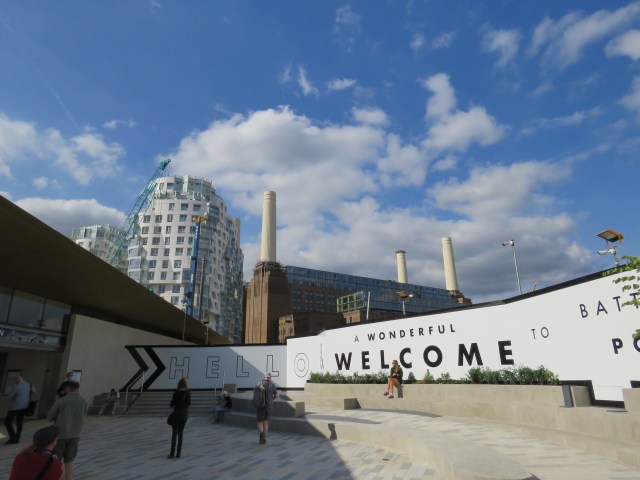
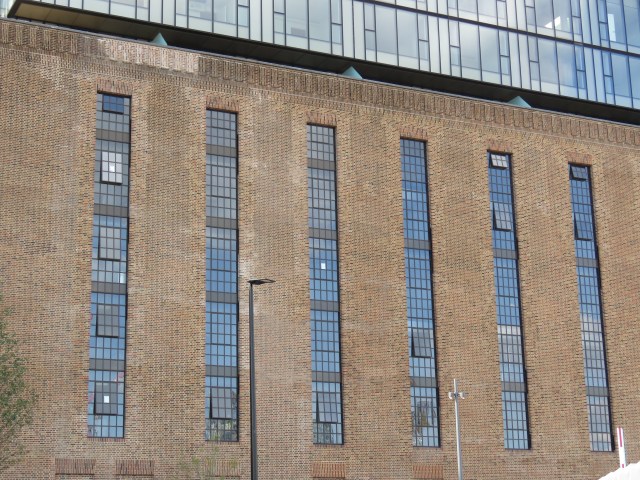
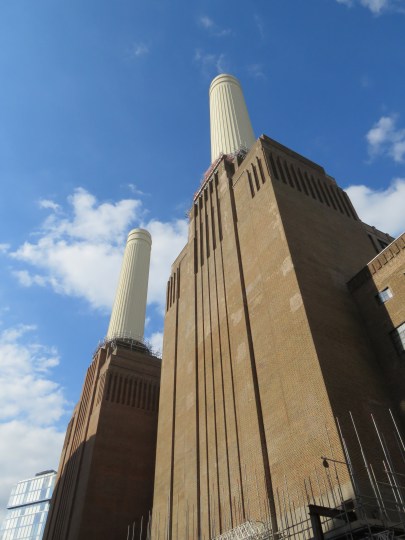
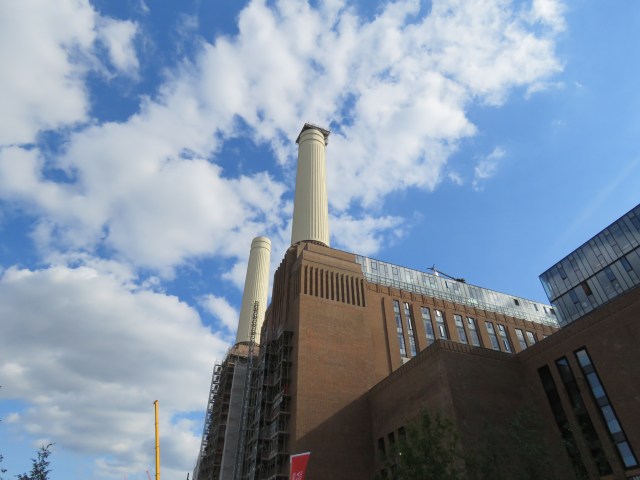
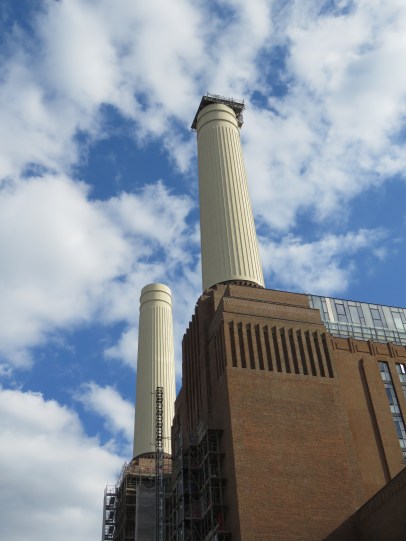
More established residents of the area include New Covent Garden, the fruit and vegetable wholesale market, and, of course, Battersea Dog’s Home. But the main feature, around which an ecosystem of shops, restaurants and bars is slowly developing, is Battersea Power Station. The power station is one of London’s iconic buildings. Music lovers will remember it featuring on the album cover of Pink Floyd’s “Animals”, along with the floating pig. It wasn’t a functioning power station for all that long. Construction began in the 1930s and was interrupted by the second world war. It was completed in 1955, but was decommissioned in two phases, in 1975 and 1983, by which time it was a Grade II listed building. Over the years there were endless plans for alternative uses – including at one point becoming the footballing home of Chelsea FC – but none came to fruition and it remained empty until it was acquired by a Malaysian consortium in 2012. Since then, the structure of the building, which was in poor condition, has been restored and it is being redeveloped internally to house – guess what? – flats, offices and shops. Apple has plans to move in. The nearby waterfront and railway arches have already been revitalised. I can recommend Battersea Brewery under the arches, which serves excellent craft beers and unfiltered lager. We don’t have a pathway all along the river to Vauxhall Bridge yet, but hopefully that will come when the development is completed, which is due in 2022.
The tube extension is a key part of the redevelopment of the area. It’s the first extension of the tube since the Jubilee Line in 1999. We will have the delayed Crossrail 1 – the Elizabeth Line – soon. Next year? That will be our version of the Parisian RER, running west to east. A second line, north to south, has been shelved for the time being, for post-covid financial reasons – and, I’m sure, the Tories’ intention to starve London of future infrastructure funding as part of its “levelling up” programme. We still await signs of the positive elements of that programme – it’s mostly bluster at the moment.
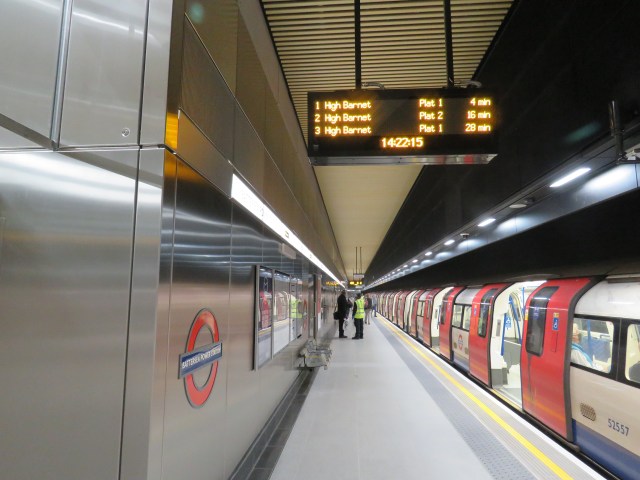
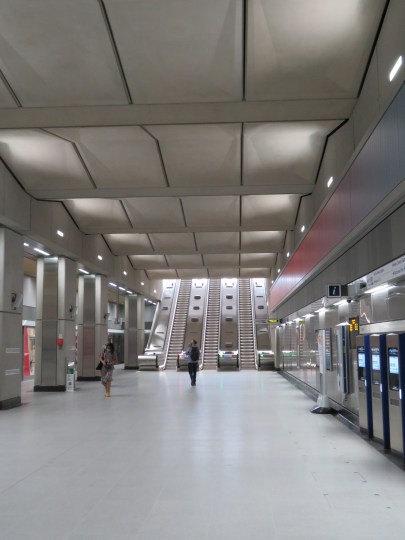
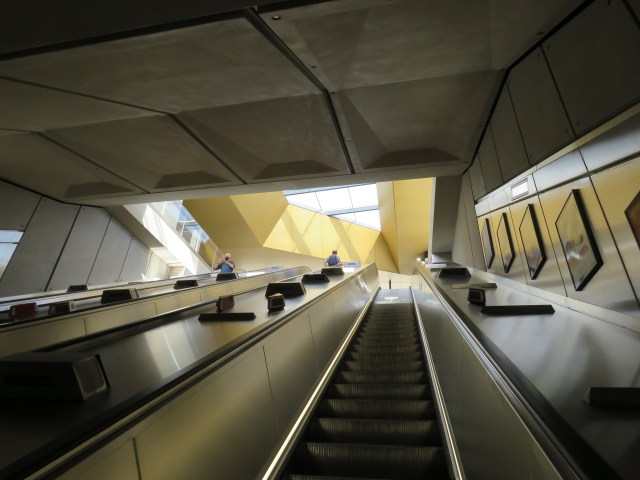
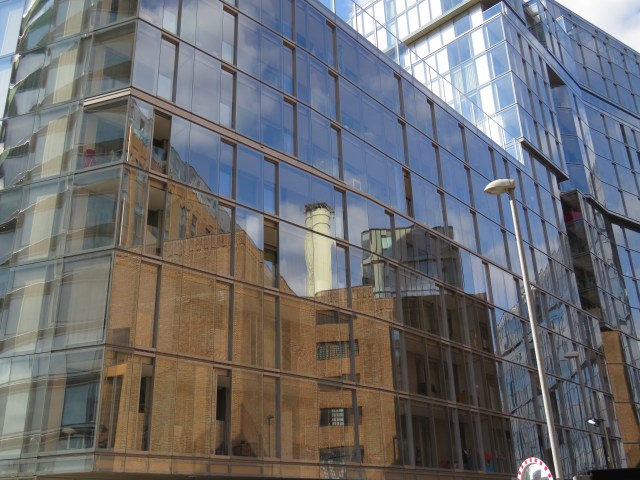
But hey, we’ve got the Northern Line extension, and Battersea Power Station is nearly ready! Here are some photos from Tuesday. As you can see in one of them, I wasn’t the only one snapping away. As you can also see, the photographers were mostly men of a certain age… old geezers with time on their hands.
The internal architecture is very much in the style of the Jubilee Line extension. I like it.
External views.
Last, a few shots from the walk down to the waterfront, which takes about 10 minutes.
So, less than a week since the Olympics finished, and only 33 days since the European Championship final, the Premier League is back! And it starts tonight with a fixture that has me torn. My second team, Arsenal, away to my local club, Brentford. The mighty Bees, back in the top division of English football for the first time in 75 years. And with a shiny new ground, sandwiched between Kew Bridge and Gunnersbury Park, with a lovely view of the M4 flyover. It’s a nice ground, actually – I went there the other day with my friend Tony, to watch the Bees take on West Ham in a pre-season friendly. The Irons cruised to a 1-0 victory, which made me feel quite optimistic about the new season; but read on…
Let’s look back briefly at my 2020-21 predictions. I got the top two right; Man City and Man Utd. Not a lot of people did, as they were so fixated on Liverpool. I had them fifth, thinking they might be found out and would focus on the Champions League. As it happens, I was almost right – they just snuck back into the top four in the last week of the season. They did well to do that after a horrendous run of home defeats in the first months of 2021. Injuries wiped out their central defence, and with that their wide and pressing games went out of kilter. They showed tenacity in getting back to some kind of form late on. I had Chelsea third; they came fourth, and were lucky that Leicester imploded in the last two games. Still, they did win the Champions League! That was City’s to win, but Pep fell prey to overthinking again and put out a team with no defensive midfielders. Chelsea took advantage then shut up shop. Quite a turnaround after sacking Frank Lampard in January, when the club were ninth in the league.
I got plenty wrong of course. Spurs did not make the top four under Mourinho – in fact he got the chop in April, days before Spurs played City in the League Cup final. They flashed brightly in the autumn, topping the league in December. They came down with the Christmas decorations. Arsenal were even worse than I expected, and ended up eighth. I had Sheff Utd at tenth, after their excellent first season back in the Premier League. They couldn’t score goals and finished bottom. Conversely, I didn’t fancy Aston Villa to avoid the drop after surviving by the skin of their teeth in the preceding season – they finished a creditable 11th. But maybe the biggest surprise was the excellent season enjoyed by my team, West Ham. I had them twelfth – they finished sixth, only two points behind Chelsea in fourth. If only Declan Rice and Antonio hadn’t been injured in the run-in… Credit to David Moyes and his coaching team for instilling a resilience and discipline in the team which we’ve not seen since…when? 1986? (The year we came third – our best ever season). There was attacking brilliance too, especially after Jesse Lingard arrived in the transfer window. And the reward? Thursday evenings in the Europa League!
Anyway, enough of last season, how about the new one? Can we look beyond Man City, especially if they add Harry Kane to their squad, as well as Jack Grealish? It’s not fair! I think Grealish is a great footballer – I wish Gareth Southgate had used him more in the Euros, especially the final. But will he make that much difference to City? It just gives them yet another attacking midfield option to go with De Bruyne, Foden, Sterling, Mahrez and Silva. Like I said, it’s not fair! Kane, on the other hand would give them a nailed-on goalscorer, someone who can be relied on to be at the end of all those brilliant crosses and cutbacks. He could be the final piece in the Champions League jigsaw – except that PSG now have a forward line of Mbappe, Neymar and Messi! Like I said…
It will also be intriguing to see whether City adapt their game to revolve around Kane, or whether Kane has to become just another of those fluid attacking midfielders. The former, surely. He has also been quite injury-prone in recent years, as has De Bruyne. Could that hold City back? And will other teams figure out how to put their defence under more pressure? Chelsea showed how in the Champions League final. I’m going to take a punt on that happening, with City’s focus even more on the holy grail of the Champions League. And I am going to say Chelsea for the title. Tuchel has already transformed the team; he now has the goals of Lukaku at his disposal. 115m euros is a lot of money for a player you had on your books as a youngster, but if he helps win the league it will be deemed worth the investment. I heard an interesting discussion on the BBC Football Daily questioning whether Lukaku has the pressing game which Tuchel will want; and there is the memory of his sluggish performances for Man Utd before he went to Inter. But I suspect he will deliver for Chelsea and provide the focal point that they sometimes lacked last season. Their main weakness may still be the centre of defence: while Thiago brought much needed calm and experience last season, he is getting on. But I’m banking on their midfield and attacking riches restoring the title to Stamford Bridge.
Liverpool haven’t invested all that much yet, but they will have Van Dijk as well as Gomez back in defence soon, if not right at the beginning of the season. And they have spent £36m on French centre back Ibrahima Konate. This should be the trigger for the other parts of the team to get back to their best. Salah and Mane have both had proper pre-seasons, though will they both be off to the African Nations cup early in 2022? I think third – but with less angst this time – is where they’ll end. As for Man United, they have bought Varane to improve the defence, and Sancho to provide yet more speed in attack. But can you win the league with a central midfield of McTominay and Fred? Fourth, I say.
Right now it feels like the gap between those four is getting bigger, though Leicester have been top four for much of the past two seasons, before falling away at the end. Questions for them include whether Vardy is still a goal-scoring machine (though Iheanacho really came on last season) and how they will cope with the loss of Fofana, who has broken his leg. I think there is a case for Arsenal clawing their way back into the top six, with the youthful talent at their disposal. And Ben White will shore up the defence. It could all still fall apart though. Jury’s out on Spurs, with the future of Kane unclear, and some doubts about Nuno as a manager. I’m assuming they will slip further, to make room for Villa, who have spent well again – losing Grealish was a major blow, but they have brought in Buendia from Norwich – and Leeds, who looked better and better as the season went on last time. They have crazy levels of pressing compared with all other teams, but are fit enough to keep it going.
Down the bottom, I can’t see Watford surviving and there have to be doubts about Norwich and Brentford. I’m assuming Norwich, who won the Championship by a mile, have strengthened their defence since the last venture into the Premier League. Selling Buendia wasn’t great for them, but they seem to have good attacking options. I think they may have learned lessons from last time and will survive. As for the Bees, much will depend on Toney’s goals. I just don’t know whether they have the quality to last 38 games against the teams they will face in the Premier League. They have good spirit and pass the ball well these days. Their fans will love just being in the elite. Could they surprise everyone? I’m going to give them my sentimental vote and predict 17th. But I’m not all that convinced. If Norwich and Brentford stay up, that means two of the more seasoned Premier League teams will face the drop. I’m going for Burnley and Wolves. I just sense that time is running out for Burnley, while Wolves slipped quite badly last season and have lost their manager. Is the Portuguese experiment unravelling? They will have striker Jimenez back – they really missed his goals last season. But can he be the same player after that terrible head injury? I wish him luck. Crystal Palace are a team I often tip for relegation. They could be anything under Patrick Vieira. I have them staying up, which could be the kiss of death.
That leaves us with West Ham. A magnificent sixth last season. No Lingard now – at least not yet – but Benrahma has been in scintillating form in pre-season. I have three concerns at the moment. First, will Declan Rice move before the window closes? Chelsea or Man United would be likely destinations, though I think he could do a great job for Liverpool too. It will be a major loss for us if he goes. Second, can Antonio stay fit? We really need some reinforcements up front. Maybe the Czech connection will bring Schick – who starred at the Euros – to East London. Third, do we have the squad depth to cope with the Europa League fixtures? For these reasons, I have my doubts about whether another sixth place, or better, is realistic. So I’ve gone for a respectable if slightly disappointing tenth. We need some serious investment in new players, or some really good youngsters coming through. I’m not sure if either is forthcoming.
So, in summary, these are my predictions. Feel free to disagree. I know some who will!
Champions: Chelsea. 2. Man City. 3. Liverpool. 4 Man Utd. 5. Arsenal. 6. Aston Villa. 7. Leeds. 8. Leicester. 9. Tottenham. 10. West Ham. 11. Everton. 12. Newcastle. 13. Brighton. 14. Southampton. 15. Norwich. 16. Crystal Palace. 17. Brentford. 18. Burnley. 19. Wolves. 20. Watford.
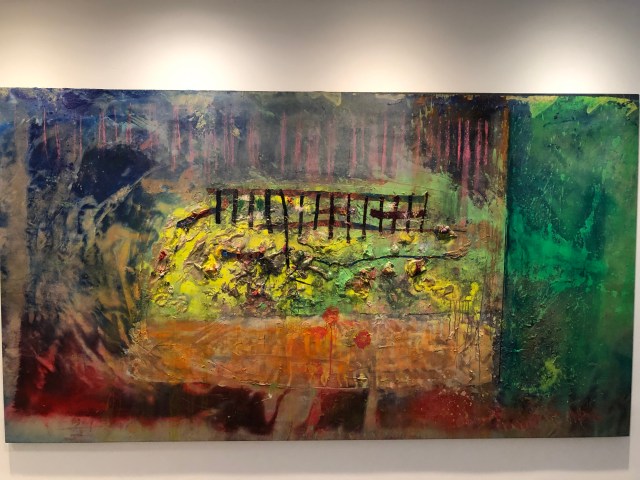
I was in Bristol for a few days last week with my wife Kath. Exploring and enjoying that great city. On Friday morning we spent a bit of time in the Arnolfini art gallery down by the waterfront in the centre of Bristol. The quay where the statue of Edward Colston met its watery end last year. We were at the Arnolfini to see the Frank Bowling exhibition, Land of Many Waters. Frank Bowling is an abstract painter who was born in 1934 in what was then British Guiana and is now Guyana. He moved to London in 1953 and for many years moved between studios in New York and London. Now 87, he is still painting in his South London studio, and this exhibition is a collection of paintings from the last decade. He had a major retrospective at Tate Britain in 2019, which I had the pleasure of seeing a couple of times.
Bowling’s work is vivid, engaging and yes, very abstract. The titles, which are often related to family and memory, get you thinking; but mostly it is down to your imagination. You make what you will of the array of colour, of shapes which emerge and then disappear in the whirl of images that jump from the paintings. There is a variety of paints, materials and found objects splashed across the canvasses. Slashed or sprayed or even poured – the techniques are as various as the materials. Bowling himself has said that his abstract works are more imagination than memory: the idea of a view rather than the view itself*. The use of colour is central in his work. Again, to quote him: colour affects the eye and heart, physically and metaphorically, more directly than any other single element in painting.
Now, a sceptic might say to all of this, obviously colour is important. It’s a painting. And what’s all this stuff about the idea of a view? A view is a view. Well yeah, like Brexit is Brexit. Remember that one? Let’s just say there are many interpretations – of Brexit and even more so, abstract art. In fact there are as many interpretations as people – indeed more, as we might see something differently every time we look at it. It’s called perception.
So, quite a lot of this was going through my head – not the Brexit bit, I just came up with that – when I overheard a couple of people, students perhaps, discussing Bowling’s work and art in general. One of them said something which really struck me at that moment. She said,
The thing about this art is, how do you know when you are finished with it?
Yes, I thought. That works on so many levels. When are you sure what something means to you. Are you ever sure? Is there anything actually to be sure about? And what about the artist? How did Frank Bowling know when a painting was finished? If a painting is an idea of a view, rather than the view itself, then when is the idea finalised? Can it be? Is the room for just one more bottle top somewhere? Could you do with just a little more green in that patch of red? What are you trying to say, and will it be different tomorrow?
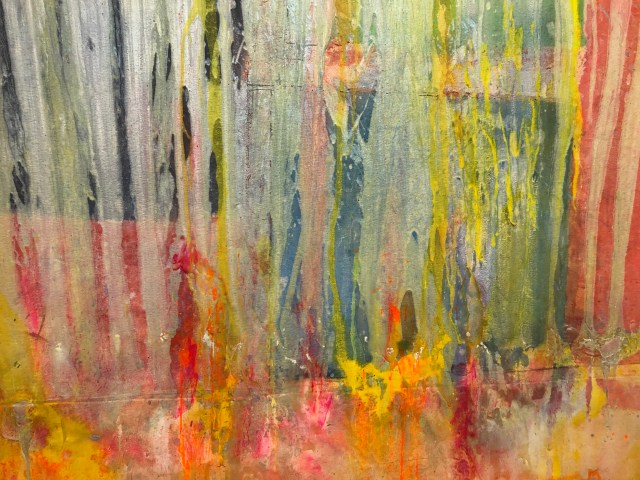
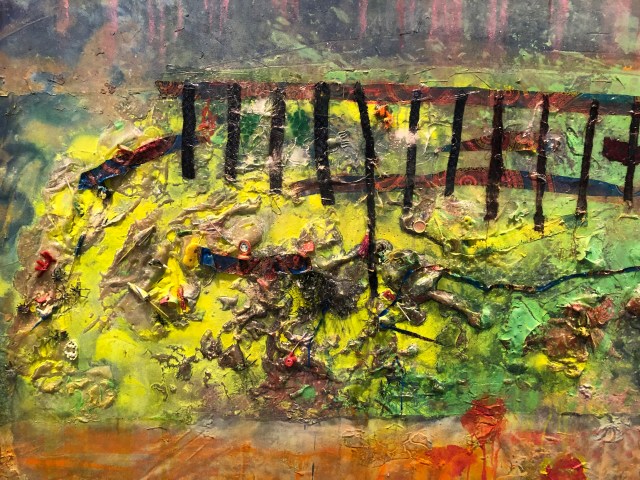
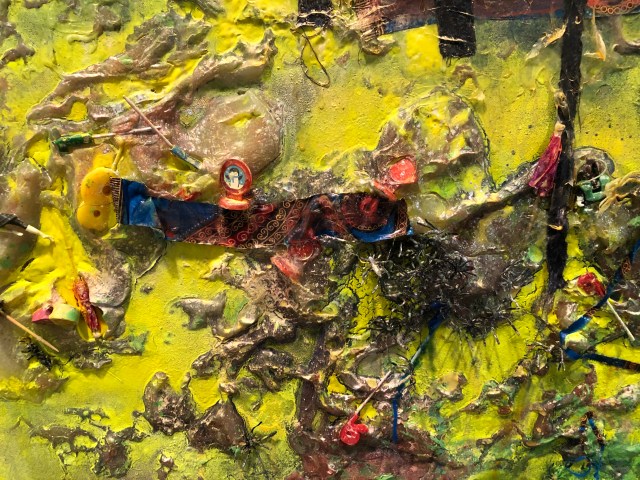
For the next few minutes in the gallery I went round taking photos of some of the paintings – the whole and then details. At each level you can concoct a different story. I’ll take just one example, a painting called Witness, from 2018. It’s more figurative than many of the works, as there’s something in it that could be taken to be a fence. Maybe those are tree trunks in the background – it is set in or inspired by Guyana. The middle detail has a suggestion of bodies just in front of the maybe fence. Or is that just me trying to see something concrete in an abstract flow? Was the witness a witness to a massacre? I’ve no idea. I doubt it. But the word witness, and perhaps my awareness of colonial history, especially while in Bristol, brought that briefly to mind.
And there are all sorts of objects embedded in this painting. A close look suggests lollipops. Why? And how did he know when to stop adding lollipops? Why not just one more? Maybe he ran out, maybe he got bored. Maybe he thought, I have said enough in this painting.
This question of when to stop changing or refining something isn’t confined to abstract art. It’s in all art. JMW Turner was known for constantly fiddling with his paintings: in the film Mr.Turner (2014) he is depicted at one point altering a painting when it was already on display at the Royal Academy. He was embroiled in competition with Constable at the time. You read about a lot of musical artists who just can’t stop adding sounds and re-recording as they make an album – it can add years to the creative process. Others like to bash them out in one or two takes – Nick Lowe was known for that as a producer on Stiff Records in the 70s. I’m quite sympathetic to the idea that you probably have your best ideas on the first or second go. It’s an approach I’ve adopted in my own novel writing. I hear about people who regard the first draft of a book as little more than a skeleton, something to be rewritten endlessly. Maybe I’m just being lazy, but I’ve found that most of my first draft is better than anything I come up with later. Obviously I correct grammatical infelicities, and occasionally realise that there’s something that couldn’t have happened because of something else I wrote earlier. And maybe second time around I think of the adjective I just couldn’t conjure up first time. But generally I’m with Nick Lowe – don’t waste too much time on very marginal gains. We are not talking international cycling here.
I suspect that, for most if not all artists, there is never a moment when you think, I have achieved exactly what I set out to do. And when you have been working on something for so long, it will have become familiar to you. You can become bored with it. It is time to hand it over to the viewer, the listener, the reader, who will encounter it for the first time and, if you are lucky, experience some of the excitement and wonder that you may have had when you covered the last corner of the canvas, or recorded the last song, or typed that last full stop – before you went back over all of it again.
I was listening to a podcast while out on a walk yesterday. It’s called Locklisted and is an offshoot of the excellent Backlisted podcast, in which books from the past are discussed in depth by the two regulars, Andy Miller and John Mitchinson, along with a couple of guests. In Locklisted, they and producer Nicky Birch get together to discuss their recent reading, music, films, all sorts of things. They were talking at one point about the joy in sometimes not really knowing what a book is about, what Andy called the zone of uncertainty (I’ve been in that zone recently, reading Ali Smith’s seasonal quartet). John built on that point by relating it back to the artists. He quoted the writer and film-maker Jonathan Meades: if a painter knows what he is going to paint, he’s an illustrator.
That’s brilliant, I thought. And it took me back to the Arnolfini: if he doesn’t know what he is going to paint – not precisely, anyway – then how does he know when he is finished with it?
The never ending circle.
* The two quotes from Frank Bowling are taken from the Arnolfini’s guide to the exhibition – which helped me navigate my zone of uncertainty! The four photos are from paintings in the exhibition – the first I don’t know the title of, but conveys that sense of water and flow and colour, I think. The other three are aspects of the painting Witness, as described in the piece above.
Yes, it actually happened. Latitude 2021. It seemed unreal as we drove up to Suffolk on Wednesday afternoon. Latitude was happening. After 16 months without live music, save for the online variety – and credit to all those musicians who put on some brilliant shows from their homes and studios and empty concert venues – we were heading for four days of music, music and more music, made by people, real people, standing a few metres away from us. From famine to feast. And yes, there have been many more important things to worry about over those last 16 months as covid and the necessary restrictions blighted all our lives; but music, like all the arts, is so important to how we live our lives beyond the basic, how we express ourselves as human beings. Latitude signalled a return, not only to music, dance, comedy, art, poetry, literature, debate, theatre and all the other pleasures on offer, but to being fully ourselves.
Jon and I went up on Wednesday and stayed overnight in a village called Campsea Ashe, which is near Wickham Market – in fact Wickham Market railway station is located there. We had a couple of beers and some very good food in a pub called The Duck – worth a visit if you are ever in the area. Up early on Thursday, for a half hour drive to Henham Park, the location of Latitude. The car park was open from 8am they said. We got there at 8.15; and hearts briefly sank as we saw the length of the queue already outside the entrance to the campsite. Those vaccine and lateral flow test checks were clearly holding things up badly. Then relief, as we realised the gates hadn’t opened yet! And it all worked very smoothly; we were soon heading for a prime spot by a big tree and marking out a space that hopefully we could hold on to for our group – friends and family – who numbered thirteen in all. We pitched various tents – or, I should say, Jon did – and put up bunting in a German towels-on-the-beach style. It just about worked; and by mid-afternoon everyone was present and correct and enjoying the sunshine.
So, on to the music that I enjoyed this year. As ever there were clashes, which meant I had to miss out on bands like the Staves, Goat Girl and Sons of Kemet. But I hope to see all of them either at Green Man or End of the Road later in the summer. A number of artists also had to pull out at short notice because of covid – they included Fontaines DC, Arlo Parks and one of my recent favourites, Billie Marten. But that still left a rich variety of talents, drawn almost entirely from the UK and Ireland this year because of travel restrictions and other factors.
There was no Lake Stage this year – the organisers haven’t really explained why. A real shame, as it was a great venue for new bands and one you’d often pass by, leading to some of your most spontaneous discoveries. Celeste was one such example in 2019. But there was no shortage of discoveries as you’ll see…
Thursday 22 July
There was more entertainment than usual for Thursday evening this year. Jon and I headed over to the main site at 6 o’clock. There was already a buzz about the place as we neared the Writers’ Bridge – crossing that bridge every year is the moment that you feel you have returned. And that feeling was more special than ever this year.
Our first show – my first since Moses Boyd at the Electric Brixton on 12 March 2020 – was William the Conqueror at the Trailer Park stage, which had replaced Solas. You could describe the band’s sound loosely as Americana with a leftfield twist. They are a trio fronted by Scotsman Ruarri Joseph. I didn’t know a lot about them, though I liked a track called Quiet Life off 2020 album Maverick Thinker, which got a bit of airplay on BBC 6 Music. Needless to say they didn’t play that one! But I liked the JJ Cale-influenced sound, and the punchy bass lines from Naomi Holmes. And a couple of songs in, it hit me, as Ruarri went into a guitar solo. I was in a crowd listening to live music again! I felt a tingle down the spine and a tear in the eye. William the Conqueror will stay in the memory, not so much because of their music, but because they were the first.
We went on later to another new venue, located in the Faraway Forest, a part of the site to which we rarely venture. The home of cabaret and hippies and Zen… and small dance sites belting out the techno, rather incongruously. It was called The Outpost rather appropriately, and was a low rise tent, with room for a couple of hundred people. We were there to see Lizzie Reid, a singer-songwriter from Glasgow. I’d heard a few of her songs on 6 Music and checked out her recent EP Cubicle. They are delicate, somewhat downbeat songs and Lizzie struggled to project them on the night. She wasn’t helped by the booming techno beats in the background. I’d happily see her again though, in a more propitious setting.
Afterwards, I went on my own to the Listening Post – the renamed (again) spoken word tent. It turned out to be my only visit, such was the music on offer. It was to see my favourite contemporary poet Luke Wright, a Latitude regular. I’d been extolling his virtues as a trenchant observer of modern life to my companions, but was quite relieved I’d failed to persuade any of them, as Luke was performing a collection of new poems based on Victorian characters, in the ballad form of the time. Very clever and densely textured. Still engaging, but perhaps only for those who knew him from his previous work.
A couple of beers followed with a few of the gang in the new bar, the Tap Room, located on the site of the Lake Stage, and what was to become the meeting point for the rest of the festival, with the demise of the Danish bar, which had been great over the last few years. Still a choice of Carlsberg Pils or Carlsberg Export though. How does the advert go? Probably the only beer in the world…
Friday 23 July
The “general campers” have been pushed even further away from the amenities and the main site this year, to make even more room for the posh tents, camper vans and families. You can see the demographic that Latitude is trying to attract, but fortunately this entirely commercial approach isn’t yet reflected in the curation of the music, which still ranges far and wide. The result of our location meant that it was a one mile walk to the showers – much better this year – and the Co-op, which became even more vital for breakfast material this year, as many of the old favourite stalls near the camping areas seemed to have fallen by the wayside (quite possibly because of the Co-op, though just as likely, the pandemic). So that was a two mile walk around 9.30 each morning – come to Latitude and get fit! Over the four days, the health app that comes with the iPhone tells me I walked 36 miles. Helped offset the diet of Carlsberg I guess.
After breakfast, with Rick, one of our regulars, supplying the cups of tea to go with the Co-op egg and bacon sandwich (not bad) and assorted fruit (excellent), Jon and I set off to see the Goa Express at the Sunrise Arena, in its usual place In The Woods. (The band write their name in upper case.) I had them down as Britpop revivalists, but there was a bit more to them than that. They had a really fresh, jangly sound, very much the sort you associate with Liverpool through the ages, starting with you know who… A good reference point would be The La’s, that band who have influenced so many, even though they only made one, rather under-produced album themselves. Who doesn’t love the song There She Goes? The band are from Hebden Bridge, West Yorkshire, which is a bit of a creative hotspot at the moment. Check out their recent single Second Time. It’s a lovely melodic thing that raises the spirits. Indie guitar music is not dead!
I checked out Lucia and the Best Boys on the BBC Sounds stage (which I shall call the BBC tent) next. We’d seen them, just as Lucia, in 2018 in the Alcove. I rather liked them then; this time the songs felt a bit overblown. I stayed for most of the show, before meeting Jon for a beer and then heading back to the Sunrise for Lucy Blue. She’s an up-and-coming Irish singer from Dublin. I liked her songs, which reminded me a little of Maisie Peters (see later), with a bit more electric guitar. One to watch. Next was the tail end of Wille J Healey’s show in the BBC tent. He makes an enjoyably retro rock sound that appeals to generations old and new. But this was just an interlude before we made our first visit to the main stage, the Obelisk, to see Maisie…
Lucy Blue
It’s hard to believe Maisie Peters was playing the Obelisk, and in mid-afternoon. She has a strong following and has been getting plenty of airplay on Radio One for recent songs like John Hughes Movie and Psycho. But she was playing Solas in 2019 (although she was already capable of selling out Shepherd’s Bush Empire that year too). I first came across her early in 2019, after reading a very complimentary article on the Line of Best Fit website, which asserted that she was making the best “observational pop” of 2019. I checked out her back catalogue on Spotify and was quickly taken with the songs. Singer-songwriter pop, written from the perspective of a young woman – boys are unreliable at best – with lovely melodies and sharp lyrics. Those observations that Line of Best Fit mentioned. All sung beautifully. A timeless sound. She was prolific during lockdown, releasing a string of excellent, confessional singles that reflected, but also rose, above the times. There are more collaborations now and you can tell that leading producers are involved, with some of those ubiquitous dance-pop sounds becoming more prominent. A debut album is imminent.
I was at the Shepherd’s Bush concert with a friend, who didn’t know Maisie’s music beforehand. She loved it. The show was a triumph and demonstrated that while the songs might be created in the bedroom, they were made to entertain. And the performance at the Obelisk confirmed that. It was Maisie’s first live show for two years, but she was straight out of the blocks with a set that brimmed with confidence. She mixed “old” favourites with the recent singles and a couple of songs from the forthcoming album that hadn’t been performed before. For me, highlights included the relentlessly upbeat Adore You, the samba-lite groove of Sad Girl Summer and a rendition of the ballad Feels Like This which tugged at the heartstrings. That was the first Maisie Peters song I ever heard. The two latest singles went down a storm with the crowd, John Hughes Movie closing the set. Psycho was apparently written with Ed Sheeran, though it also owes a debt to Carly Rae Jepson’s Call Me Maybe. Maisie is clearly going places.
After Maisie, most of the group went off to see The Snuts at the Sunrise, but I stayed at the Obelisk to see Beabadoobee. Real name Beatrice Laus. She played Green Man in 2019 and was on the Sunrise at Latitude, but I’d never got around to seeing her, despite some positive reviews. Her music is on the slacker/grunge part of the musical spectrum, though when I listened to it on Spotify I found it a bit lightweight in comparison with the 90s version. But I liked the recent single Cologne and she’s a fellow west Londoner, so I was curious to see how she would fare on the Obelisk stage. The answer was very well! The music packed a real punch, with some good grungy sounds. More Smashing Pumpkins than Nirvana, but definitely in the spirit of that era. There was a bit of singalong pop with her early single Coffee, which was very popular with the crowd. Glad I stayed, though I’m told the Snuts were pretty good too.
Strategy came into play at this point. Jon and I were both keen to see Wet Leg and Chubby and the Gang in the Alcove, but we’d encountered big queues earlier for a singer called Gabby Rivers. (We gave up on that one.) The Alcove isn’t that big anyway, and I think there were some restrictions on numbers for safety reasons this year. So we decided to go the concert before that – Sinead O’Brien. No problems getting in for that, but it was difficult listening. She talks/sings to a fairly repetitive beat and guitar scrawl. Let’s just say, it wasn’t my thing, or Jon’s. But it meant we were in place for Wet Leg, described recently on 6 Music as the Isle of Wight’s best kept secret! They have only released one song, the incredibly catchy Chaise Longue. But there is a buzz about them in the music industry and they have signed to Domino records, label of the Arctic Monkeys, amongst others. The Alcove was full when they began, with a lot of people left outside. Wet Leg are two women, Rhian Teasdale and Hester Chambers, backed by three hirsute blokes, who laid down a tight, infectious beat throughout. Rhian Teasdale sings and couldn’t stop smiling, in contrast to her droll vocals. The songs were fast and danceable, with lots of Strokes-like guitar. And of course they left Chaise Longue until the end. What a reaction! Pure bouncing joy and everyone singing along to the refrain, revelling in the daftness of it all.
Most of the Wet Leg crowd left at that point, and a rather gnarlier group assembled for the next band, Chubby and the Gang. I was really looking forward to this one. I’ve heard a bit of them on 6 Music, courtesy of Steve Lamacq, ever the upholder of indie and punk. They bring to mind the Clash colliding with Dr Feelgood and speeded up. Signature tune All Along the Uxbridge Road, a shouty tribute to the road that cuts through outer west London, from Uxbridge, via Southall, Ealing and Acton to Shepherd’s Bush. As an Ealing resident I have to love this. Live though, it wasn’t so much punk and pub rock as Motorhead played at double the speed. It was brutal! Chubby – aka Charles Manning-Walker (suspiciously posh) – posed at the front, one foot on a monitor, bottle of what looked like Jack Daniels in the other, bawling out the lyrics indecipherably. The guitars thrashed, the bass and drums drove the music on at supersonic pace. Chubby, when not singing, looked on with a menacing pride at the crazy moshing taking place in front of him. Like all the bands on the Alcove this year they played a straight half hour, even though they were the headliners. And to be honest, much as I loved this, it was enough. It was exhausting just to watch! Jon and I reeled out at the end, exhilarated, but heads spinning. Buzzing from the combination of Chubby and his gang and the brilliant Wet Leg. Strategic mission accomplished. We could now enjoy headliners Wolf Alice on the Obelisk…
Wolf Alice have been one of my favourite bands of the last few years. I’ve seen them five times, twice previously at Latitude as well as at the O2 Kentish Town, Alexandra Palace and the Roundhouse. Their first album My Love is Cool was a brilliant collection of catchy grunge-pop. Album two, Visions of a Life, was an epic revisiting of 70s rock, with some modern pop hooks. And number three, Blue Weekend, continues the journey into a grandiose pop with the occasional rock fling. They performed a great short set at the Stone Circle at the Glastonbury 2021 live stream, buffeted by the wind. And now, they were headlining Latitude. The trajectory is ever-upward. And yet… still coming down from Chubby and the Gang, both Jon and I found the set, which did cover all three albums quite well, just a little bit…tame. Very slick, superbly presented, a band at their peak. But I got slightly bored at times in the middle of the set. We were a bit of a way back, so that the screens were the best way of watching, but I think the element of detachment was the Chubby effect. At the end I thought, I need to process this one later. And yes, it was really good, one of the highlights of Latitude. Towards the end, I loved the rocking revival of early single Moaning Lisa Smile; and the rendition of Last Man on Earth at the end was beautiful and epic, a crowd-pleaser for years to come. In the future I’ll forget that Chubby and the Gang blew them out of the water at the time. And I can’t wait to see them again at Hammersmith Apollo in January 2022…
Ellie sings The Last Man on Earth
Saturday 24 July
We’d been lucky with the weather so far – a mixture of sunny and cloudy, but no rain. We were expecting a wet weekend, but the forecast for today had changed, and if there was to be rain it would come late on. Sunday looked nasty though…
We sauntered up to the Obelisk to catch a bit of Supergrass. The place was packed, the busiest I’d seen so far. A lot of people buy day tickets for Saturday, and I think most of them set up camp in the Obelisk arena and stay there most of the day. Supergrass were perfect for the occasion and duly churned out their 90s hits, culminating in “Pumping on Your Stereo” and the evergreen “Alright”. An upbeat start to the day. They were followed by Sports Team, late replacements for Alfie Templeman. Very late replacements: they’d been playing Margate the night before and got a call at one in the morning to ask if they could do a set at Latitude at 2 o’clock that afternoon! And here they were, putting in a very lively shift, singer Alex Rice bouncing all over the stage. Sports Team divide opinion a bit, mainly because they went to Cambridge University and Alex is quick to voice his opinions on all sorts of topics. They were also nominated for the Mercury music prize for their debut album Deep Down Happy, which accentuated the sense of privilege. Their jerky indie is a poppier version of Squid and can be a bit annoying if you listen to more than a couple of songs. But credit to them, I thought they put on an energetic and entertaining show today.
After Sports Team, there was no-one we had in mind to see, so when in doubt, see what’s on at the Sunrise. It rarely lets you down. Next up was an Irish singer, Orla Gartland. The blurb in the programme referred to her “existential pop”. Wikipedia said she’d made her name singing cover versions on YouTube. It seemed worth a go. And by the time she started the place was heaving. She was given a rapturous reception by the mainly youthful audience, most of whom seemed to know all the words to her songs. The Sunrise comes up with surprises like this from time to time, and it’s a reminder that there’s a world of music out there that you just know nothing about. Her songs were pretty standard rock/pop with occasional slashes of angry guitar amid the Taylor Swift-style choruses. (Example: I did it to myself.) But the atmosphere was great and we stayed for the whole show. That meant we missed most of Lava la Rue in the BBC tent. She is part of a west London music collective playing that melange of R&B, hip hop, dance and jazz which is pretty popular right now. Takes me back to the 90s – the Rebirth of Cool and acid jazz vibe – and I love it still. Will have to try to catch her somewhere else.
Orla Gartland
We stayed in the BBC tent for the next artist, Holly Humberstone. Another up-and-coming singer songwriter; but on this evidence she really stands out. She began with her electric guitar, reminding me a little of Julia Jacklin, but worked through a range of instruments during the show. Some of her songs were straight ballads, but most had some kind of dance beat, as befits the modern era. She engaged really well with the crowd, prefacing each song with a story of how it came about. And then there was the voice – beautifully expressive. I wasn’t familiar with her songs beforehand, but a couple that stood out were Falling Asleep at the Wheel, and one I later identified as The Walls are Too Thin. A fine performance, which made Holly Humberstone my number one discovery of Latitude 2021.
Back to the Sunrise next, for a couple of shows. First up were Sorry. I really liked their recent single Cigarette Packet, which was a punchy bit of electronic indie. But that didn’t seem to come through this evening. The music didn’t seem to take hold and my attention wavered. You couldn’t say the same about the next act, Working Men’s Club, fronted by the precocious Sydney Minsky-Sargeant. The band hail from Todmordon in West Yorkshire – the same area as Goa Express and another great recent band, the Orielles. Must be something in the West Yorkshire water! There’s a bedrock of New Order in the band’s sound, but more punch and a lot more guitar. There’s an element of the Fall too, especially in Sydney’s vocals. They played the Lake Stage in broad daylight in 2019. They were good then; they are outstanding now, with a superb 2020 debut album, eponymously titled, to work from. Tracks like “John Cooper Clarke”, “Valleys” and the lacerating “Teeth” come across brilliantly, with their hammering beats and swathes of synth, peppered with bursts of searing guitar. Sydney prowls while guitarist/synth player Mairead O’Connor sits or stands eerily still, with a stony face. The perfect foil. Lights glare in the dusk, giving the Sunrise a claustrophobic feel. Working Men’s Club have a real presence. One of the best new bands, and one of the very best performances of this year’s Latitude.
After the exhilaration of Working Men’s Club, we were in the perfect mood for the Chemical Brothers. The Obelisk crowd buzzed in the darkness as 9.30 approached. Would they start with…? They had to. They did!
Hey boy, hey girl…
The frames of slimmed down Michelin Men, glowing red, danced and somersaulted across the screens. Lasers shot out of eyes. The visual assault on the senses was as powerful as the relentless beats that had a lot of the crowd dancing (I tapped my toes with a bit more vigour than usual, but Jon and his son Louis were giving it some!). It rained a little during the show, but no-one seemed to notice. Apparently there was even some lightning, but it couldn’t compete with the Chemicals’ light show. I didn’t recognise many of the pieces, but old favourites like Galvanize were snuck in here and there, and the whole thing ended with a pounding Block Rocking Beats. That pretty much sums up the show – the block truly rocked. In 2019 we had the awesome spectacle of Underworld to finish our Saturday’s entertainment. Chemical Brothers came to Latitude in 2021 and carried the baton with aplomb. Who will be next?
Sunday 25 July
I woke up at around seven expecting to hear the rain hammering against the tent. There was nothing but a light breeze. I checked the BBC forecast – there rain was pushed back to the evening and the percentage chance was quite low. Maybe we were going to get away with it. And we did. A beautiful, warm, sunny day for the most part. We got lucky.
And ten of us were raring to go for the first show of the day on the Obelisk at the unusually early time of 11.30: none other than Bill Bailey! What a great way to start the last day. Bill only has to walk on stage and pull one of his bewildered faces and I start to crack up. I think most of the adults in the crowd felt the same way. I was hoping for plenty of music amid the jokes, and he didn’t disappoint. Highlights included the intro to Stairway to Heaven played on a collection of tinkling bells and a walk around an imaginary house growling his location, while accompanied by some of his trademark death metal riffs! (Ok, you had to be there…) It was quite a short set – only about 40 minutes – and it flew by. But I’m sure it put everyone in a good mood for the rest of the day.
After Bill, I got myself a beer and settled on the grass to watch Self Esteem, the musical project of Rebecca Lucy Taylor. She was standing in for Billie Marten, sadly missed in my case. Thankfully there’s another chance to see Billie in the festival season, at Green Man. She’s doing a show in London in September too. I don’t know the music of Self Esteem that well, but I have picked up on its confessional nature, exemplified by recent single, I Do This All the Time, which got a lot of airplay on 6 Music. The show was quite dancey too, with Rebecca and accompanying troop dressed in black as they executed their moves. I think I could hear the odd Madonna beat in there. It seemed a bit lively for the lunchtime sunshine, but credit to her, she came in at late notice and put on a greatshow. I need to explore her music properly.
After that I wandered over to the Sunrise for Irish band Just Mustard. They’ve been around on the fringes for a couple of years now, but this was the first time I’d seen them live. I was really impressed. I suppose you could categorise their sound as modern shoegaze. There is a wall of distorted guitar over which Katie Balls’ vocals waft gracefully. The Cocteau Twins came to mind, but to sum them up I’d say it’s the Cranberries meets My Bloody Valentine. And that is all good! This show really woke me up – I loved those howling guitars and the sweet relief of Katie’s voice. Definitely a band to get to know better.
I met up with Jon at the Tap Room after that and we decided to go over to the Obelisk for James Vincent McMorrow and enjoy the sunshine for a bit. I must admit I was thinking of another three worded singer, Benjamin Francis Leftwich, who we’ve enjoyed at Latitude before. Never mind, JVM was a perfect accompaniment to an hour’s basking in the sun, with his lightly soulful songs, mostly sung in a falsetto. I’m not familiar with his music, but plenty of the crowd were. I liked his version of Steve Winwood’s Higher Love. And he finished with an excellent bluesy number. I liked his summery shirt too!
A pleasant interlude, but it was time to shake off the summer torpor. We had planned to stay on for the Kaiser Chiefs, but it was a 45 minute wait, by which time we would probably have zoned out altogether. Also, the Kaisers would eat into Nubya Garcia’s set, and she was essential viewing. So we decided to forgo the delights of I Predict a Riot and Ruby and take a punt on Liz Lawrence at the Alcove. It was a good call. She has a lively indie-pop style which makes you want to move your feet. The Alcove wasn’t full, but the crowd was incredibly enthusiastic – she has a loyal following. It was an upbeat half an hour which primed us for this year’s final straight, starting with Nubya Garcia at the BBC tent. Nubya is an amazing saxophonist and a central figure in London’s new jazz scene. She had a successful lockdown, releasing her debut album Source, which is an essential listen, exploring not only jazz, but her musical roots – the influence of reggae and African sounds is very evident. The show was an absolute dream, taking you to a higher place. Her sax-playing is exquisite and she had a superb band backing her, including Joe Armon-Jones on keyboards. Joe had headlined in his own right at the Alcove on Saturday. This was a pure indulgence of a show, a real joy.
We stayed in the BBC tent for the next band – something of a contrast! Those rowdy south Londoners, Shame. They put on a brilliant live show as ever, really engaging the crowd. It was a shame – no pun intended – that they clashed with Bombay Bicycle on the Obelisk for the first half hour, as the tent was only half full until reinforcements arrived after BBB finished. Not that it made a jot of difference to Shame’s performance, which was as full-on as ever. Singer Charlie Steen didn’t take long to pull off his shirt and launch himself into the crowd. And it was great to hear One Rizla near the end – that one has a real tune! I loved it – though possibly not as much as Jon, who disappeared to the front when Louis, Gab and Mark arrived from BBB. Steady on, old chap, don’t want to do yourself an injury!
A change of vibe for the last show: one I’d been looking forward to all weekend. Enough to miss the excellent Sons of Kemet. I’m talking about the strangely wonderful Greentea Peng. I love her music: the ever present influence of reggae and dub, the smoky, jazzy vibe, the distinctive woozy vocals. And the bass lines, oh my god, the bass lines! They snake around the melodies, ready to pounce. The recently released debut album Man Made is a summer delight – so relaxed on one level, biting on another. You get echoes of Grace Jones, Erykah Badu and even Sade, but Greentea Peng is a real one-off. The Sunrise was the fullest I’d seen it all weekend; a young but not teenage crowd, a lot of women. Shoreditch transported to a Suffolk wood! It was cooooool. And then there was me and Jon! Well, we do our best to keep up…
And what a performance it was – all those vibes I mentioned above and more. And sung with a smile by Aria Wells – for Greentea Peng is she. That was something I’d wondered about – would she affect that same aloofness as Grace Jones? She looks like she could. But not a bit of it. She was a down-to-earth London girl, just celebrating being let out to perform her songs again. Echoing the Beastie Boys, her song Jimtastic Blues combines a pulsating bass line with a familiar refrain: you’ve got to fight for your right to party. The young crowd sang that one back to her with gusto – you could feel the relief all around. The band were immaculate, perfectly delivering the required vibe. There was dub everywhere, including a few minutes of an instrumental when the echoes truly reverberated from the speakers. The bassist was so good, letting the music flow, deploying his double bass on quite a few of the tracks. The word that always springs to mind with this music is languid. Nothing is forced; everything grooves, Aria herself included, as she paces right to left, left to right. The set ended with two of her best known songs, Hu Man and then that perfect summer song Mr.Sun (miss da sun). That one ran on for a while, as the band improvised and even let the guitar rip for a spell. It was all glorious. Maybe the best show of the weekend – it certainly felt like it at the time.
We met up with Louis, Gab and Mark afterwards for a couple of drinks. They’d been to Sons of Kemet and loved it. Nubya Garcia had joined the band on stage. Nubya and the incredible Shabaka Hutchings on the same stage – awesome! We looked back on the weekend – so many high points. But most of all we all felt so lucky, so privileged to be at Latitude after everything that has happened over the past 16 months. Maybe it will only be a brief respite, maybe it will signal that much hoped-for return to normality, or what now passes for it. Who knows? But at least we will have Latitude 2021 to savour. Never to be forgotten. When music once again came to the rescue, and we became ourselves again…
A Postscript
On Monday evening, back home, Jon texted me and Louis to ask what was the one song that summed up our Latitudes. He chose Wide Open by the Chemical Brothers. Louis went for G.S.K by Squid, though he was sorely tempted by The Last Man on Earth by Wolf Alice. I could have gone for that last Greentea Peng song, Miss Da Sun; but it had to be the song that jumped out immediately I thought about it. Of course it was Chaise Longue by Wet Leg. A moment of pure, unabashed fun in the Alcove.
Is your muffin buttered? Would you like us to assign someone to butter your muffin? Excuse me.